

Dog geofencing works well for most owners, especially on medium-to-large properties with a clear view of the sky, but it’s not a universal fix. The core tradeoff is simple: you get a wire-free boundary you can reshape in minutes instead of a buried line you dig once, in exchange for accuracy that depends on satellite signal and terrain. For owners who want that flexibility, HAVEN Freedom is built for exactly this job, with optional live tracking layered on top of a fence that runs without a subscription.
TL;DR:
- GPS accuracy issues are most prominent in wooded areas, near buildings, or on hilly terrain, which can cause false alerts or unpredictable boundary behavior.
- Collars with multi-constellation GNSS and dual-band antennas significantly improve reliability by reducing satellite signal bounce and drift.
- For properties smaller than half an acre or with many hazards close to boundaries, physical barriers or hybrid solutions may outperform pure GPS fences.
- Core containment functions on HAVEN Freedom operate without a subscription, while optional features like live tracking require a recurring fee.
- Proper training and a methodical setup, including a gradual boundary introduction and buffer zones, are crucial for effective and humane dog containment.
Table of Contents
- How Does Dog Geofencing Actually Work?
- How Accurate Is a GPS Dog Fence, Really?
- How Do You Set Up and Train a GPS Dog Fence?
- Geofencing vs. Physical Fences: Which Wins?
- What Does a GPS Dog Fence Cost, and Do You Need a Subscription?
- How Do You Choose the Right GPS Dog Fence?
- Haven’s Training Resources and What to Do Next
- Who Should Actually Try Dog Geofencing?
- HAVEN Freedom: What You Get and What Happens Next
- Sources
- FAQ
How Does Dog Geofencing Actually Work?
A GPS geofence isn’t magic, it’s three things working together: a collar, an app, and a satellite signal, with an optional cellular link for remote features. The collar itself carries a GNSS receiver and antenna that pull location data from satellites, plus the hardware that delivers your dog’s warnings, usually a rising tone, a vibration, and in some systems a mild static correction as a last resort before the true boundary line.
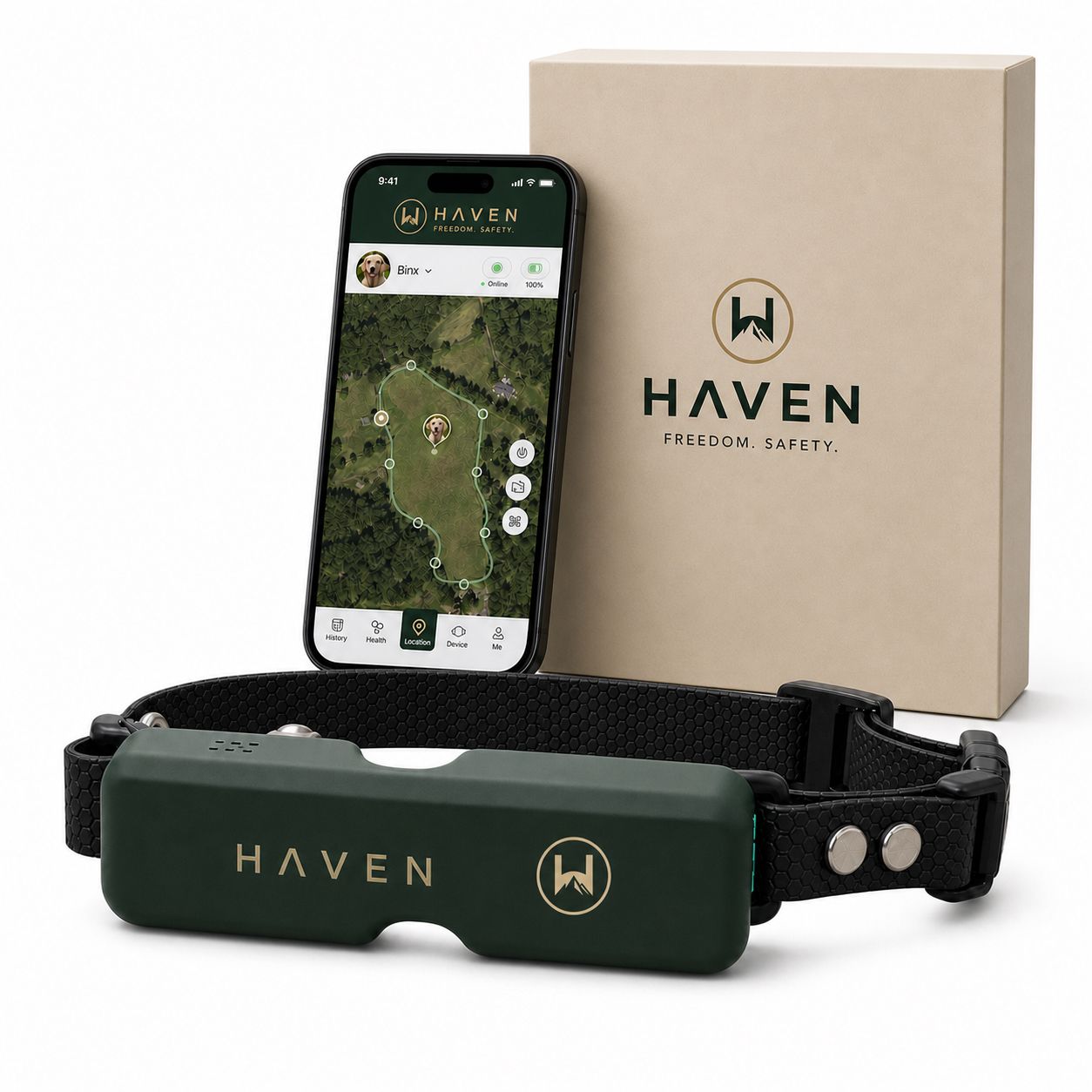
The app is where you actually build the fence. You draw or walk your boundary on a map, set how far the warning zone sits inside your true property line, and in stronger systems, save that boundary logic directly onto the collar rather than relying entirely on the cloud. That distinction matters more than most buying guides admit. A collar that stores its fence map onboard keeps working even when the phone is out of range or the cellular signal drops, which is exactly the scenario rural owners worry about most.
Cellular connectivity is optional on the better systems, and it’s worth understanding what it actually buys you:
- Live location tracking so you can see exactly where your dog is on a map in real time, not just whether they’ve crossed a line.
- Escape notifications sent straight to your phone the moment a boundary breach happens.
- Remote boundary updates that let you adjust the fence shape without walking the property again.
- Historical location data useful for figuring out how your dog actually moves through the yard over weeks, not just one walk.
None of those four features are required for basic containment to function. That’s an important point, because a lot of marketing blurs the line between “the fence works” and “the app has features,” and those are two different products bundled into one collar.
The technical detail that separates a reliable collar from a frustrating one is the receiver itself. Multi-constellation GNSS, meaning the collar pulls signal from GPS, GLONASS, Galileo, and similar systems rather than GPS alone, gives the device more satellites to triangulate against at any given moment. Dual-band antennas, which read both frequency bands satellites broadcast on, cut down the kind of signal bounce that happens near buildings, dense trees, or metal roofing. Neither spec guarantees perfection, but both meaningfully reduce the odds of a false correction on a day when the sky isn’t perfectly clear.
How Accurate Is a GPS Dog Fence, Really?
Reliable, but not flawless, is the honest answer, and the gap between the two matters more for training than for containment. A peer-reviewed review of animal tracking technology confirms what most owners eventually notice on their own: GPS accuracy varies meaningfully by environment and by the hardware inside the device. That’s not a knock on any single product, it’s a property of how satellite positioning works everywhere on Earth.
GPS drift is the technical term for small, temporary shifts in a device’s calculated position, usually a few feet, caused by satellite geometry, atmospheric interference, or signal reflection. Reliability is a different question: it’s whether those alerts happen consistently in the same spot every time your dog approaches the same part of the yard. A collar can have moderate drift and still be highly reliable if that drift is small and predictable. A collar with erratic reliability, alerting five feet from the line one day and fifteen the next, is the one that actually confuses dogs and undermines training.
Several environmental factors push accuracy around:
- Tree canopy blocks and scatters satellite signal, which is why heavily wooded lots see more variance than open fields.
- Buildings and metal structures create reflection effects sometimes called multipath, bouncing signal before it reaches the receiver.
- Terrain, especially hills, valleys, and ravines, can block line-of-sight to satellites low on the horizon.
- Weather, particularly heavy cloud cover or storms, adds minor atmospheric interference, though this effect is smaller than canopy or terrain.
By the numbers: Owners on lots smaller than roughly half an acre should be cautious, because normal satellite variance can make a GPS boundary genuinely impractical on very small properties unless the vendor builds in tight drift filtering.
So what actually separates a dependable product from a shaky one? The American Kennel Club’s evaluation guidance points owners toward three concrete signals: does the manufacturer publish accuracy and reliability data across varied environments, is the boundary configurable enough to build in a safety margin, and does the training support match how the dog actually learns. Independent, third-party testing carries more weight than a spec sheet alone, since any manufacturer can claim tight accuracy in ideal conditions. What you want to see is performance data gathered under canopy, near buildings, and on uneven terrain, the actual conditions most yards present.
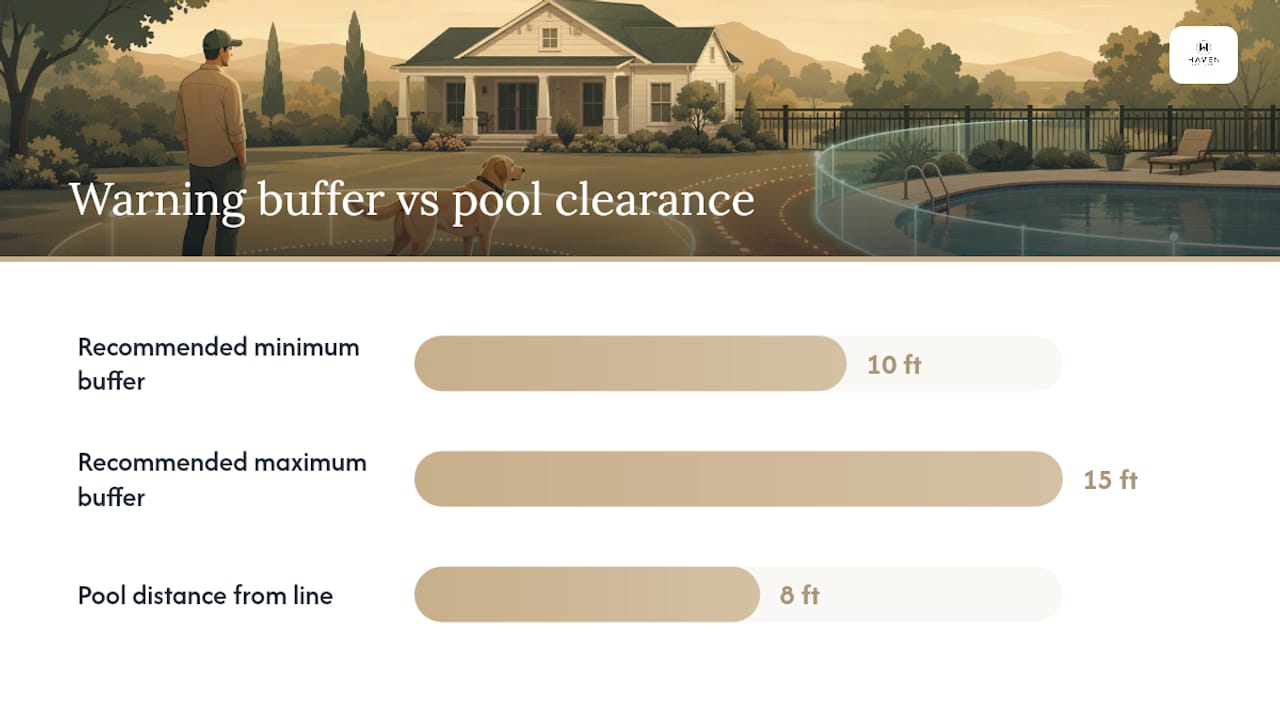
Practically speaking, geofencing tends to be reliable enough for daily use on open-to-moderate lots of half an acre or more, with a buffer zone of at least 10 to 15 feet built into the warning threshold. On a wooded quarter acre with a pool eight feet from the property line, the margin for error shrinks fast, and that’s where a physical barrier around the highest-risk hazard still makes sense even if the rest of the yard runs on GPS. For a deeper look at how these numbers hold up in real yards, Havenfreedom’s accuracy testing guide breaks down specific scenarios.
How Do You Set Up and Train a GPS Dog Fence?
Before you touch the app, walk the property with fresh eyes. Note where trees thin out and where canopy is heaviest, check whether your house or a neighbor’s shed sits between the yard and open sky, and confirm the collar fits snugly enough that it can’t slip past your dog’s ears but loose enough for two fingers to slide underneath comfortably. Charge the collar fully and confirm it’s running the latest firmware before day one, since outdated software is a common, avoidable cause of erratic alerts.
From there, a structured plan beats trial and error. The American Kennel Club’s guidance on GPS fence setup backs a progressive approach that builds trust before it introduces any correction:
- Draw the boundary in the app, or walk the perimeter with the collar if your system supports that method, then review the shape on the map for any gaps near hazards.
- Place physical flags along the visible boundary line for the first two weeks, so your dog has a visual reference that matches the invisible one.
- Run tone-only sessions for at least several days, letting your dog learn what the warning sound means with zero correction attached.
- Introduce graduated warnings, moving from tone to vibration only after the tone response is consistent and predictable.
- Add correction only after warnings are reliable, and only if your dog isn’t already responding to tone and vibration alone, since many dogs never need that final step.
- Expand the boundary gradually, giving your dog more freedom in stages as their response to warnings becomes second nature rather than doing the full yard on day one.
Buffer zones deserve real attention here. A gap of 10 to 15 feet between the warning threshold and an actual hazard, a road, a pool, a neighbor’s yard, absorbs normal satellite variance without turning into a safety risk. Set your warning zone tighter than that near low-risk edges of the property and wider near anything genuinely dangerous.
Pro Tip: Run your first week of training in the same weather and lighting conditions you’ll actually use the fence in day to day. A boundary that tests perfectly on a clear Saturday afternoon can behave differently during a gray, overcast Tuesday morning walk, and you want to know that before your dog is testing the edges unsupervised.
Troubleshooting matters just as much as the initial setup. If alerts feel inconsistent, spiking near the same tree every time or firing randomly in open lawn, that’s usually a canopy or multipath issue, not a training failure, and it’s worth widening the buffer in that specific zone rather than blaming the dog. If your dog seems confused or anxious after a correction, pause and drop back a stage; a system that moves through warnings predictably will rebuild trust faster than pushing forward. For a full walk-through with troubleshooting built in, Havenfreedom’s 14-day training plan covers this stage by stage, and the boundary training guide is a solid companion for dogs that need extra repetition.
Geofencing vs. Physical Fences: Which Wins?
Neither option is universally better, they solve different problems. A GPS fence’s biggest strength is flexibility: you can reshape a boundary in minutes instead of tearing out and relocating fence posts, which matters enormously on irregularly shaped lots, rural acreage, or properties where a permanent structure would be expensive or restricted by an HOA.
Here’s where each approach actually shines:
- Geofencing wins on large or oddly shaped properties, where a physical fence would cost thousands and take weeks to install.
- Geofencing wins for renters and frequent movers, since there’s nothing to build and nothing to leave behind.
- Physical fences win near constant, severe hazards, a pool, a busy road, a steep drop, where zero margin for satellite variance is acceptable.
- Physical fences win in dense tree cover or deep valleys, where GPS signal quality is consistently marginal no matter how good the receiver is.
- A hybrid approach often wins in practice: GPS containment for the bulk of the yard, paired with a short physical barrier around the one or two spots where a mistake would be genuinely dangerous.
The honest downside of any GPS system is that it depends on electronics that can fail: a dead battery, a firmware glitch, or a genuine satellite outage all create windows where containment isn’t guaranteed the way a solid wire or wooden fence is. That’s a real tradeoff, not a reason to dismiss the category, but it’s why the buffer-zone strategy from the training section isn’t optional for anyone with a hazard near the property line. For dogs that split time between a home yard and travel, Havenfreedom’s guide on portable containment covers how the flexibility argument plays out on the road, not just at home.
What Does a GPS Dog Fence Cost, and Do You Need a Subscription?
Hardware prices vary with the receiver quality inside the collar. Basic single-band GPS units sit at the low end, while multi-constellation, dual-band collars with ruggedized housings and stronger antennas command a premium, because that hardware genuinely costs more to build and performs better under canopy and near structures.
The bigger decision isn’t the upfront price, it’s whether you need a subscription at all. On the better systems, the fence itself, the actual containment function, runs entirely on the collar with no monthly fee required. What a subscription adds is everything built on top of connectivity:
- Live tracking so you can locate your dog on a map from your phone in real time.
- Instant escape alerts pushed to your phone the second a boundary is crossed, rather than you noticing the dog is gone.
- Cloud-based history and remote map edits, useful if you want to tweak the boundary without walking back outside.
Worth weighing: Ready underscores why live tracking earns its keep for some owners even when basic containment doesn’t need it, a dog that slips out during a storm or a wildfire evacuation is far easier to recover fast when you get an alert the moment it happens, not an hour later.
If your dog is calm, well trained on the boundary, and stays mostly in a fenced-in area anyway, the no-subscription fence mode alone may be all you need. If your dog is an escape artist, you travel with them often, or peace of mind while you’re away from the yard matters to you, live tracking is worth the recurring cost. It’s a decision based on your dog’s risk profile, not a feature everyone needs by default.
How Do You Choose the Right GPS Dog Fence?
Start with your property, not the product. Measure roughly how much open ground you have, note how much of it sits under tree canopy, and be honest about whether any part of the yard has a genuinely dangerous edge, a pool, a busy street, a steep slope. That single walk-through tells you more about which system will work than any spec sheet.
From there, run through a compact checklist before you buy anything:
- Property size and canopy coverage, since both directly affect signal reliability.
- GNSS specs, specifically whether the receiver supports multiple satellite constellations and dual-band signal reading.
- Buffer-zone configurability, meaning you can widen the warning threshold near real hazards and tighten it elsewhere.
- Structured training resources, a written or app-guided plan beats a collar that ships with no instructions beyond “turn it on.”
- Battery life and charging cadence, since a collar that dies mid-day defeats the entire purpose.
- Collar fit and weight, particularly for smaller breeds who can’t comfortably carry a bulky unit.
When you talk to a vendor or read their product page, ask direct questions: Do they publish independent testing data, or only their own internal claims? How do they define “accuracy,” a number in ideal open-field conditions, or a range across varied real-world terrain? Is the boundary logic stored on the collar itself, so containment survives a dead phone or a cellular dead zone, or does it live entirely in the cloud?
Watch for a few red flags. Vague accuracy claims with no supporting data, “highly accurate” without a number or a testing method behind it, should raise questions. A mandatory subscription just to activate basic containment is worth scrutinizing, since that model charges you monthly for something that doesn’t need connectivity to function. And a product with no structured training guide is asking you to figure out humane boundary training on your own, which is a harder job than it sounds.
Haven’s Training Resources and What to Do Next
Getting a dog fence right isn’t about buying the collar with the longest spec sheet, it’s about matching the hardware to your yard and then training the boundary correctly. Havenfreedom builds its setup process around that exact sequence: survey the property, draw the boundary, train in stages, then expand freedom once the response is consistent.
If you’re getting ready to set up a new system, a few resources cover the process end to end:
- The GPS dog fence setup guide walks through building a working boundary in under two hours, including the pre-checks that prevent most first-day frustration.
- The 14-day training plan covers the full progression from flags and tone-only practice through graduated corrections.
- The interference troubleshooting guide is worth bookmarking if alerts ever feel inconsistent near a specific part of the yard.
The collar itself is built around the checklist covered above: dual-band positioning for better performance under canopy and near structures, boundaries you can reshape from the app rather than dig up and move, and fence logic stored on the collar so containment doesn’t depend on your phone staying connected. Live tracking, escape alerts, and the sound-light-Bluetooth dog finder system may be available as an optional add-on plan, while the core containment fence works without any subscription at all.
If you’re deciding whether this is the right week to start, run what’s sometimes called the working boundary test first: walk your actual property line, note where canopy is heaviest, and confirm you have a realistic spot for flags during the first two weeks. Check collar fit against your dog’s neck size before committing to the full 14-day plan. That fifteen-minute walk-through will tell you more about how your setup will perform than reading another comparison chart.
Who Should Actually Try Dog Geofencing?
The ideal candidate for geofencing is the owner with a medium-to-large yard, decent sky visibility, and a dog motivated enough by tone and vibration alone that heavy correction never enters the picture. If that describes your situation, the flexibility argument, no digging, no permanent structure, a boundary you can reshape in an afternoon, is genuinely compelling and not just marketing language.
If you’re working with a small, heavily wooded lot, or you have a hazard sitting right on the property line, don’t force a pure GPS solution to do a job it isn’t built for. A short physical barrier around the one dangerous spot, paired with GPS for the rest of the yard, is smarter than pretending satellite variance won’t matter near a pool edge.
Training fairness is the part I’d push back on hardest against the conventional wisdom: a lot of owners rush to correction because they assume that’s how invisible fences work. It isn’t necessary for most dogs, and the tone-and-vibration stages alone handle the majority of cases when they’re run patiently. If you’re ready to move forward, the HAVEN Freedom collar is worth a look for exactly the property and training approach described above.
— Haven
HAVEN Freedom: What You Get and What Happens Next
Everything in this guide points to the same buying checklist: dual-band GNSS for canopy resistance, a configurable boundary with real buffer zones, structured training instead of guesswork, and no forced monthly fee just to turn on containment. The wireless boundary sets up without buried wire, the fence itself runs with no subscription required, and live tracking, escape alerts, and the sound-light-Bluetooth dog finder may be offered on an optional add-on plan for owners who want that extra layer of visibility when their dog is out of sight.
Before you buy, run the same property check covered earlier in this guide: measure your open space, note the canopy coverage, and identify any hazard that needs its own physical buffer regardless of which GPS system you choose. Once you’ve done that walk-through, you’ll know whether the offline fence mode alone covers your needs or whether the live tracking add-on is worth it for your dog’s risk level. Head to the HAVEN Freedom product page to check current specs, pricing, and subscription options, and start building your boundary this week.
Sources
- National Center for Biotechnology Information (NCBI) — PMC8465301
- AKC — How to evaluate a GPS dog fence
- Ready
FAQ
Do Geofences Work for Dogs?
Yes, for most dogs on medium-to-large properties with reasonable sky visibility, GPS geofences provide reliable containment when set up with proper buffer zones and progressive training.
What Is the Best Geofence for Dogs?
The strongest options use multi-constellation, dual-band GNSS receivers, store boundary logic on the collar itself, and back their accuracy claims with independent testing data rather than marketing language alone; HAVEN Freedom is built to that standard.
Do Electric Fences Actually Work for Dogs?
Traditional buried-wire electric fences can work, but they require permanent installation and don’t adapt to boundary changes the way GPS geofencing does, which is why many owners now prefer wire-free systems for flexibility.
Is There a Monthly Fee for a GPS Dog Fence?
Not necessarily. On systems like HAVEN Freedom, the core containment fence runs without any subscription, and a monthly plan is only needed for optional features like live tracking and escape alerts.
Why Does My GPS Dog Fence Give Inconsistent Alerts?
Inconsistent alerts usually trace back to environmental interference, heavy tree canopy, nearby buildings, or hilly terrain, rather than a training problem, and widening the buffer zone in that specific area typically resolves it.
Recommended
Keep reading
e collar humane
Humane E Collar Training: 7 Steps, Starting With a Vet Check
See how humane e collar training starts with a vet check, conditions tone and vibration, uses rewards, and reserves static stimulation as a last...
Read the postcoyote safety for dogs
Protect Your Dog from Coyotes in 14 Days with a GPS Boundary
Keep your dog safe from coyotes with immediate steps, yard fixes, hazing, and a 14 day GPS boundary plan you can start today.
Read the postYour adventure starts here
Ready to give your dog more room to roam?
Give your dog more freedom to explore — and give yourself the reassurance of knowing they're never far away.
