

GPS boundary training for dogs works reliably when three things align: a system with accurate, consistent positioning; a property with reasonable sky visibility; and a committed few weeks of training. If your dog is an escape artist or just loves to roam, a wireless GPS collar can create a real, learned boundary without a single foot of buried wire. Here’s what to check before you buy, and how to train it right.
Before you go further, decide where you are:
-
Ready to shop? Jump to the buyer checklist.
-
Already have a collar? Go straight to the setup and training plan.
Key Takeaways
GPS boundary training works when accurate positioning, open sky, and consistent training come together over 1–3 weeks.
| Point | Details |
|---|---|
| Predictability drives learning | Alerts must fire at the same location every pass; drift above 5 feet breaks the training loop. |
| Premium accuracy matters | Premium systems hold boundaries to roughly 2–5 feet in open conditions; budget units can drift 15 feet. |
| Train tone-first for 7 days | Spend the first period on tone-only recall before introducing vibration or correction. |
| Check environment before mapping | Open sky gives the best results; re-map boundaries away from dense canopy and building edges. |
| Havenfreedom fits the checklist | No subscription for the fence or adjustable alerts, dog finder, escape alerts, and live tracking as an optional add-on. |
Table of Contents
How does a GPS wireless boundary system actually work?
The system has three moving parts: the collar on your dog, a mobile app on your phone, and the satellite network overhead. You draw a custom boundary in the app, and the collar uses GPS (and often a secondary positioning signal like LTE or Bluetooth) to track your dog’s real-time location against that mapped line.
When your dog approaches the boundary, the collar fires a sequence of alerts:
-
Tone: An audible beep that signals “you’re getting close.”
-
Vibration: A physical buzz that reinforces the warning.
-
Optional static correction: A mild, adjustable stimulus used only if the dog continues past the warning zone.
The dog learns to associate the tone with the boundary edge and turns back before the vibration or correction ever fires. That’s the goal: a dog who self-corrects at the tone. The AKC notes that accuracy (where the boundary maps) and reliability (whether alerts trigger consistently) are distinct requirements, and both matter because dogs learn through repetition.
GPS fences work best on open land or light canopy. Deep tree cover, tall buildings, and narrow ravines reduce satellite signal quality. The AKC’s guidance on GPS dog fences confirms that sky visibility is a primary suitability factor.
Why predictability matters more than any other spec
A dog can’t learn a boundary it can’t predict. If the tone fires at 10 feet from the line one day and 25 feet the next, the dog has no reliable cue to respond to. Learning stalls, and frustration builds on both ends of the leash.
AKC expert guidance is direct on this point:
Consistent warnings delivered at the same location every time are the most critical factor for effective GPS containment. Inconsistent alerts confuse dogs and slow learning significantly.
GPS drift is the main threat to that consistency. All GPS systems drift slightly as satellite geometry shifts throughout the day. Premium systems manage drift to a few feet in open conditions. Budget units can drift significantly farther, which means the alert fires in a different spot every time. Field testing data confirms this gap between system classes.
| System class | Typical boundary accuracy (open sky) | Accuracy under moderate tree cover |
|---|---|---|
| Premium | 2–5 feet | 5–10 feet |
| Mid-range | 5–15 feet | 10–25 feet |
| Budget | 15 feet | Unreliable |
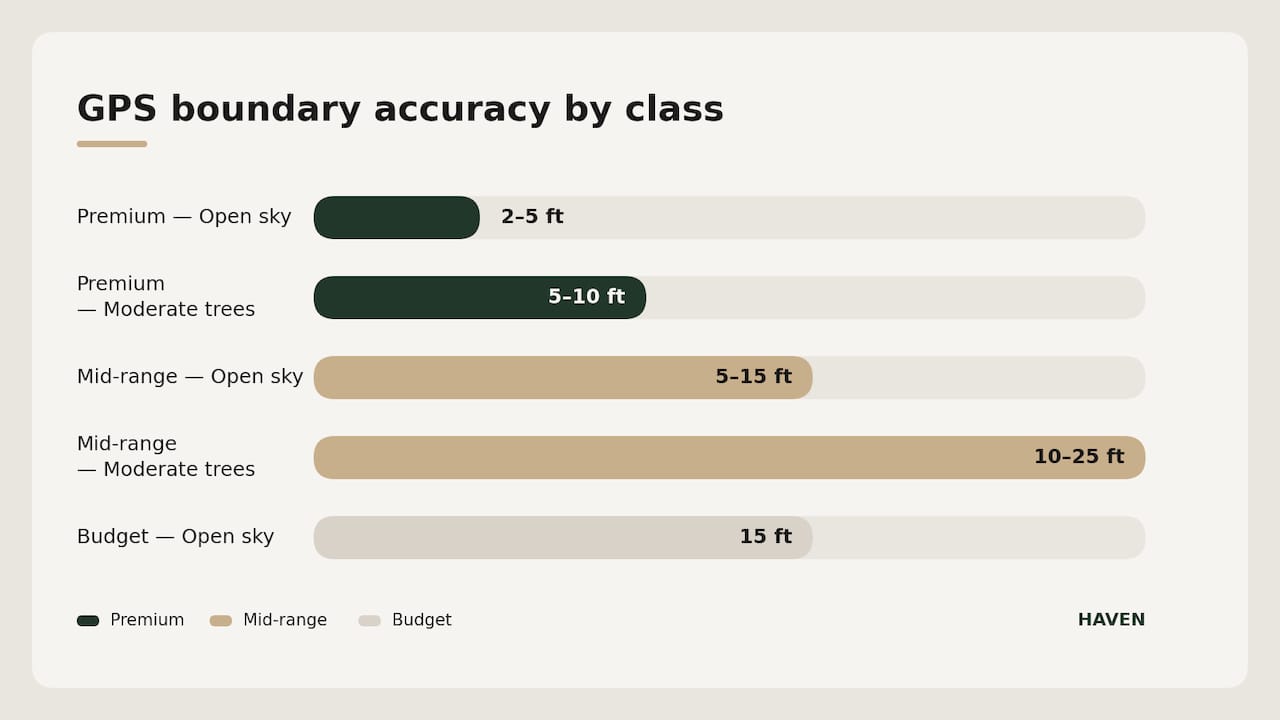
That 2–5 foot figure matters practically: it means the tone fires at roughly the same spot on every pass, which is what makes the boundary learnable.
What to look for in a GPS fence collar before you buy
Not all GPS collars are built for containment training. Use this checklist when evaluating options.
Non-negotiables:
-
Published accuracy specs: Ask for measured data, not marketing language. “Accurate” means nothing without a number.
-
Consistent alert timing: The collar must fire alerts at the same location on repeated passes. Ask vendors if they publish escape or drift data.
-
Environmental performance notes: Does the system have a mode for wooded areas? How does it perform under moderate canopy?
-
Training resources: Does the vendor offer a training guide, video library, or trainer consultation?
-
Escape alerts: Real-time notification when your dog crosses the boundary.
-
Waterproofing: Dogs don’t avoid puddles. The collar needs a real waterproof rating.
-
Battery life: At least 24 hours of active use. Check charging time too.
-
Collar fit and weight: Confirm the collar fits your dog’s neck size and that the unit weight is appropriate for your dog’s breed.
-
Warranty and support: What’s covered, for how long, and how responsive is the support team?
Pro Tip: Before committing to a boundary location, walk the mapped line yourself with the app open and watch where the warning zone activates. If it shifts more than a few feet between passes, reconsider the system or the location.
The AKC’s buyer guidance recommends requesting published performance data from vendors rather than relying on spec-sheet claims alone. Vendors who publish escape transparency data are signaling confidence in their product.
| Checklist item | What to verify |
|---|---|
| Accuracy spec | Measured feet/meters, not “precise” |
| Alert consistency | Same location on repeated passes |
| Environmental mode | Wooded/canopy setting available |
| Escape alerts | Real-time push notification |
| Training support | Guide, video, or trainer access |
| Waterproofing | IP rating listed |
| Battery life | 24+ hours active use |
| Warranty | Duration and what’s covered |
How to set up and train your dog to a GPS boundary
A staged, three-week training program is the approach most field guides and product experts recommend. Rushing into corrections is the most common cause of training failure.
Week 1 (Days 1–7): Tone only
-
Map your boundary in the app with a warning zone of at least 5 feet inside the hard boundary.
-
Walk your dog on a long leash along the boundary. Let the collar tone fire naturally.
-
The moment the tone sounds, call your dog back with a cheerful recall cue and reward with a high-value treat.
-
Repeat 10–15 minutes per session, twice daily.
-
Goal by Day 7: Dog turns back reliably at the tone without leash pressure.
Days 8–14: Introduce vibration
-
Enable vibration as the second alert step.
-
Continue leashed boundary walks. If the dog hesitates at the tone but doesn’t turn, the vibration reinforces the cue.
-
Reward every successful turn-back. Keep sessions positive and short.
Week 3 (Days 15–21): Supervised off-leash
-
Move to supervised off-leash sessions in the boundary zone.
-
Stay close enough to intervene. If the dog approaches the boundary, let the system work and reward the turn-back.
-
Optional static correction can be introduced at the lowest setting if the dog consistently ignores tone and vibration, but most dogs won’t need it by this stage.
Independent reviews confirm that a GPS fence reliably contains a dog on open or lightly wooded land when accurate positioning, suitable sky visibility, and one to two weeks of consistent training are all present.
Common failure modes and how to troubleshoot them
These are the problems owners run into most often, and the first checks to run.
Signal drift or false corrections:
-
Move the boundary away from tree lines, building edges, or metal structures.
-
Re-map the boundary on a clear day when satellite geometry is strong.
Dog ignoring the tone:
-
Go back to Week 1 leashed sessions. The tone association may not be solid yet.
-
Increase treat value during recall rewards.
-
Shorten sessions to avoid fatigue.
Escape response workflow:
-
Use the collar’s dog-finder feature immediately (sound, light, Bluetooth radar if available).
-
Check the app’s escape alert log to see when and where the boundary was crossed.
-
Recall your dog using a familiar command.
-
After recovery, do not punish. Return to supervised leashed sessions for 2–3 days.
-
Report repeated escapes to the vendor and ask for support guidance.
What does a GPS fence collar actually cost to run?
The hardware purchase is the main upfront cost. Beyond that, the model varies by vendor.
-
Fence-only systems: Some collars include boundary functionality with no subscription required. You pay once for the hardware and the fence works.
-
Live tracking and app features: Real-time location tracking and escape push alerts typically require a monthly connectivity plan. These are optional add-ons, not requirements for the fence itself.
-
Battery: Most premium collars run 24–48 hours per charge. Build a daily charging habit (charge overnight) to avoid gaps in coverage.
-
Waterproofing maintenance: Rinse the collar after heavy mud or saltwater exposure. Check the charging port seal periodically.
-
Warranty: Confirm whether the warranty covers manufacturing defects.
| Operational factor | Typical range |
|---|---|
| Battery life (active use) | 24–48 hours |
| Charging time | 2–3 hours |
| Boundary accuracy (premium) | 2–5 feet (open sky) |
| Monthly tracking subscription | Varies by vendor |
The Havenfreedom how-it-works page confirms that the fence functionality operates without a subscription, with live tracking and premium app features such as escape alerts available as paid add-ons.
Is a GPS fence collar safe and right for your dog?
A GPS fence is appropriate for most healthy adult dogs over roughly 8-10 pounds. It’s not the right tool for every situation.
Good candidates:
-
Dogs over -10 lbs with a well-fitted collar
-
Dogs 6 months or older with basic recall training
-
Dogs on properties with reasonable sky visibility
Use with caution or consult a trainer first:
-
Dogs with severe anxiety or fear-based reactivity
-
Dogs who have never had any recall or basic obedience training
-
Properties with heavy tree cover or significant GPS interference
Safety rules:
-
Always start with tone only. Never begin with static correction.
-
Supervise every session for the first three weeks.
-
Keep correction settings at the lowest effective level.
-
Remove the collar for extended crating or indoor time.
-
If your dog shows signs of fear, stress, or repeated boundary failures after three weeks of consistent training, stop and consult a certified professional trainer or your veterinarian.
How Havenfreedom meets the buyer checklist
Havenfreedom’s GPS collar maps directly to the criteria above. Here’s how each checklist item lines up with what the HAVEN Freedom collar offers.
| Buyer checklist item | HAVEN Freedom feature |
|---|---|
| No subscription for fence | Fence works without a monthly plan |
| Live tracking | Available as optional add-on |
| Escape alerts | Real-time push notification with an active plan |
| Dog finder | Sound, light, and Bluetooth radar |
| Adjustable alerts | Tone, vibration, optional static correction |
| Waterproofing | Yes- IP67 |
| Training mode | Adjustable correction levels- Tine, Vibration and static |
| Activity tracking | Activity and bark monitoring included |
The dual-band positioning system targets the accuracy consistency that makes boundary learning possible. The no-subscription fence model means you’re not paying monthly just to keep the boundary active.
What using a GPS boundary with an adventurous dog is actually like
The first week feels slow. You’re walking the boundary line twice a day, treating every tone-recall like it’s the most exciting thing that’s ever happened, and your dog is mostly confused. By Day 5 or 6, something clicks. The dog hears the tone and turns back before you’ve even reached for the treat bag.
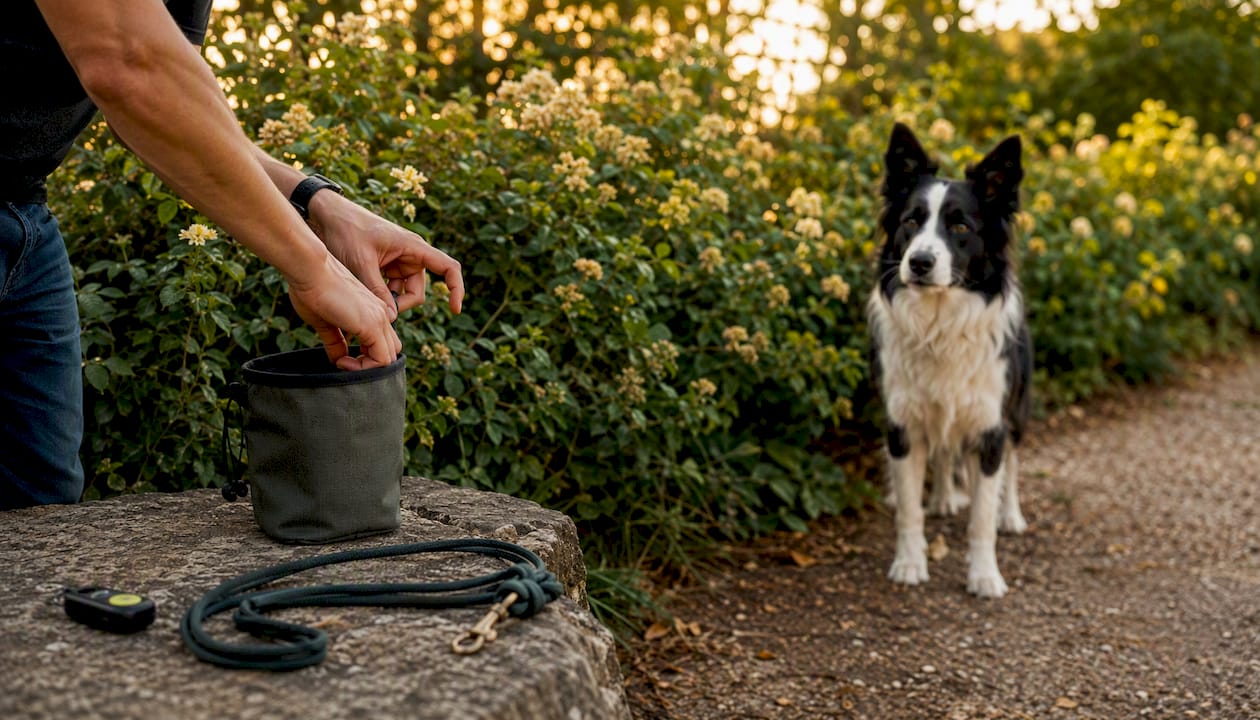
The honest hiccup: on one morning session under a dense oak canopy, the warning zone shifted a few feet and the tone fired later than usual. The dog crossed the line before turning back. The fix was straightforward: re-map the boundary on an open section of the yard and keep the warning zone wider near the tree line. One adjustment, no drama.
By Week 3, the boundary holds without supervision for normal outdoor time. That’s the payoff. Not a perfect system, but a reliable one when you set it up right.
Ready to get started with HAVEN Freedom?
The clearest path to a contained, confident dog starts with the right collar and a week of tone-only sessions. Havenfreedom built the HAVEN Freedom collar for exactly this: adventurous dogs who need real boundaries without buried wire or a monthly fence bill.
Pick up the HAVEN Freedom GPS collar and start with the how-it-works guide to map your first boundary. Use tone-only mode for the full first week. The training resources and support team are there if you hit a snag.
Sources
Recommended
Keep reading
en
Puppy E-Collar Age: When Is It Safe, and What to Use First
No vet-backed minimum age exists for shock collars on puppies. See what vets advise, what to do before 6 months, and how a GPS...
Read the postcharge dog collar camping
Charging a Dog Collar at Camp: Skip Bedding, Use a Hard Surface
Charge a dog collar safely at camp with a power bank, original cable, and solar or car backup. Follow National Park Service battery safety...
Read the postYour adventure starts here
Ready to give your dog more room to roam?
Give your dog more freedom to explore — and give yourself the reassurance of knowing they're never far away.
