

GPS dog fences can absolutely be accurate enough to keep a dog safely contained, but only when three things line up: a quality positioning system, open sky over your property, and a dog that’s actually been trained to respect the boundary. Skip any one of those and even a good collar will drift or lag right when it matters.
The numbers: premium systems hold a boundary to roughly 2 to 5 feet under good conditions. Mid-range units run 5 to 15 feet. Budget collars can drift 15 to 30 feet or more once you’re under trees or near a building.
- The single biggest caveat: accuracy numbers assume clear sky. Canopy, terrain, and nearby structures change the math fast.
- Do this first: walk your own property line with the collar before you trust it with your dog.
Key Takeaways
GPS dog fence accuracy depends less on a single spec number than on matching system quality, land conditions, and training to your specific property.
| Point | Details |
|---|---|
| Know your real range | Expect 2 to 10 feet of accuracy on most systems, worse under canopy or near buildings. |
| Double your buffer | Set safety buffers at roughly twice the collar’s rated accuracy near roads, pools, or drop-offs. |
| Reliability beats raw accuracy | A consistent, timely alert matters more for training than a marginally tighter position fix. |
| Test before you trust | Walk your boundary line with the collar across multiple days and weather conditions before relying on it full time. |
| HAVEN Freedom’s approach | Havenfreedom’s GPS collar pairs dual-band positioning with customizable boundaries and no subscription required for fence function. |
Table of Contents
- Understanding GPS Dog Fence Accuracy Benchmarks
- What Causes GPS Drift Near Trees and Buildings?
- Accuracy vs. Reliability: Why Both Matter
- How to Test GPS Fence Accuracy on Your Property
- When Should You Choose a Wired Fence Instead?
- How HAVEN Freedom Addresses These Accuracy Concerns
- Sources
Understanding GPS Dog Fence Accuracy Benchmarks
Accuracy numbers only mean something once you translate them into distance from a real hazard, like a road, a pool, or a neighbor’s property line. A collar rated for 5 feet of accuracy doesn’t guarantee your dog stops 5 feet from the line. It means the system’s read on the dog’s position could be off by that much in either direction, which is why the buffer zone you set matters as much as the spec sheet.
Here’s roughly what the market looks like:
- Best-case, premium hardware: 2 to 5 feet under open sky, using multi-constellation receivers and solid signal filtering.
- Typical mid-tier systems: 2 to 10 feet, still workable for most yards but with more variance near obstructions.
Refresh rate matters just as much as raw accuracy. If a collar only updates its position every 3 to 5 seconds, a fast dog can cover real ground between fixes. A Labrador at a dead run covers 15 to 20 feet per second, so a slow refresh rate turns a “small” positional error into a genuine gap in coverage.
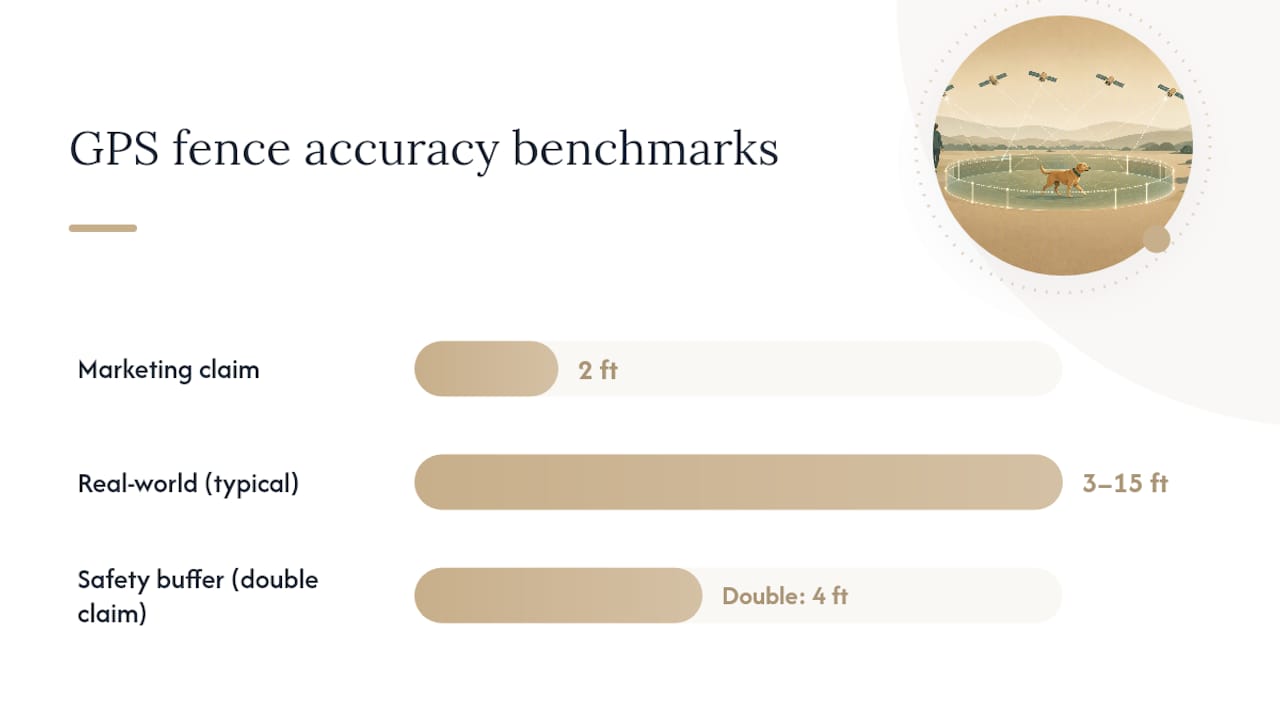
The practical rule of thumb: whatever accuracy figure a system claims, double it for your buffer zone near anything genuinely dangerous. A collar rated for 5 feet should get a 10 foot buffer from the road, not 5.
What Causes GPS Drift Near Trees and Buildings?
Three categories drive whether a GPS fence holds its line or wanders: the environment, the hardware, and how you actually run the thing day to day.
- Environmental interference. Tree canopy scatters and delays satellite signals. Buildings and terrain create multipath reflection, where a signal bounces off a wall before reaching the receiver, confusing the collar about where it actually sits. Heavy weather and ionospheric disturbances add smaller but real errors on top of that.
- Hardware and software quality. Single-constellation receivers (GPS only) perform worse than multi-constellation systems that also pull from GLONASS or Galileo satellites. Antenna design and the firmware’s filtering algorithm decide how well the system smooths out noisy readings instead of reporting every jitter as real movement.
- Operational factors. A low battery can throttle how often a collar checks in. A loose-fitting collar changes antenna orientation against the sky. Outdated firmware misses bug fixes that improve filtering, and a dropped cellular or Bluetooth connection delays alerts even when the GPS fix itself is fine.
Pro Tip: Check your dog’s collar fit monthly. A collar that’s rotated even 30 degrees off center can measurably change how well the antenna sees the sky, especially in wooded terrain.
Satellite geometry plays a role too. When too few satellites are visible or they’re clustered in one part of the sky rather than spread out, the fix quality drops, even in open terrain, even with premium hardware.

Accuracy vs. Reliability: Why Both Matter
Accuracy tells you where the collar thinks your dog is on the map. Reliability tells you whether the alert actually fires, on time, every time, in the same spot. A system can be accurate to 3 feet and still be unreliable if it takes six seconds to process that position and send a warning, because industry guidance treats these as separate, equally important factors.
This distinction is what actually teaches a dog to respect a boundary. Most systems use a staged warning architecture: an audio tone first, then vibration if the dog keeps moving, with a static correction as a last resort on some collars. That escalation only works if it happens the same way every single time.
A dog that gets a tone at 10 feet from the line one day and a tone at 3 feet the next day hasn’t learned a boundary. It’s learned that the fence is unpredictable, which is worse than no fence at all for training purposes.
Expect a training period of roughly one to two weeks for a dog to reliably associate the warning tone with the boundary itself.
- Start with the dog on a long leash so you can correct manually if the alert fires late.
- Walk the boundary with your dog daily during week one, letting them hear and feel the warnings in context.
- Watch for false corrections near the edge; if they happen more than occasionally, your buffer zone is too tight for that spot.
How to Test GPS Fence Accuracy on Your Property
Don’t take any accuracy claim on faith. Test it the way you’d test a new smoke detector, deliberately and more than once.
- Survey your sky first. Stand at several points along your intended boundary, especially the wooded and shaded ones, and check how much open sky you can see straight up. Do this at different times of day since shadows and satellite positions shift.
- Walk the boundary with the collar. Set your intended line, then physically walk it wearing or carrying the collar, logging where the alert actually fires versus where you expected it to.
- Repeat across days and conditions. Test on a clear day and again after rain or wind. One clean test tells you almost nothing about consistency.
- Log every false correction. Note exactly where and when the collar warned early, late, or not at all.
- Set staged buffers based on results. If your test shows 8 feet of drift near the tree line, your warning zone there needs to start well before your actual property boundary.
Pro Tip: Retest after any major storm and again each fall when leaves drop or spring when canopy fills back in. Foliage density changes signal paths more than most owners expect, per guidance from GPS fence maintenance recommendations.
Keep the collar charged on a consistent schedule and update firmware as soon as it’s available. Both directly affect how often the system checks position and how well it filters noise.
When Should You Choose a Wired Fence Instead?
GPS containment isn’t the right call for every yard. A buried or wired fence still makes more sense in certain situations, and being honest about that upfront saves owners from a bad surprise.
- Small or narrow lots, especially ones bordering a busy road, where even a few feet of drift removes your entire safety margin.
- Dense forest with no consistent sky gaps, where signal quality never gets reliable enough to trust.
- Dogs that bolt at full speed toward a known trigger, since a slow refresh rate combined with high speed can outrun the warning zone.
- Properties with a pool or steep drop right at the property line, where the margin for error needs to be closer to zero.
Wired fences trade flexibility for permanence: harder to install, harder to move, but they don’t depend on satellite visibility. Many owners land on a hybrid approach, wired fencing near the highest-risk edges and GPS for the open acreage where a physical fence isn’t practical at all.
How HAVEN Freedom Addresses These Accuracy Concerns
Havenfreedom built its GPS dog fence and tracking collar around the exact factors covered above. It uses dual-band positioning and multi-constellation designed to reduce the kind of drift that comes from single-constellation receivers, and boundaries are fully customizable so you can build the wider buffer zones a wooded or bordered property actually needs.
- No subscription required for the fence itself; a plan only unlocks live tracking and app features.
- Live tracking and escape alerts cover the reliability side, not just positional accuracy.
- Sound, light, and Bluetooth dog finder for fast recovery if a boundary is ever crossed.
- Adjustable training modes (tone, vibration, optional static correction) built for the staged, predictable escalation dogs actually learn from.
Statistic Callout: Run the same walk-the-boundary test outlined earlier on your own land before relying on any collar, HAVEN Freedom included, for full-time containment.
A practical checklist before you trust any GPS fence
Run three checks before you rely on this technology with your dog: survey your property’s sky visibility, physically walk-test the boundary more than once, and commit to the one to two week training window instead of skipping straight to full off-leash trust. Questions about setup or testing on your specific property are worth working through before you buy.
Try HAVEN Freedom on Your Own Property
Most GPS collars ask you to trust a spec sheet. Havenfreedom asks you to test it instead, which is exactly what the walk-the-boundary routine above is built for.

The HAVEN Freedom collar pairs dual-band positioning with customizable boundaries and live escape alerts, and the containment fence itself works without any monthly subscription. Run the same sky survey and boundary walk covered in this guide on your own yard, log where the warnings actually fire, and decide from real data rather than a marketing claim. If your property has open acreage with reasonable sky visibility, this is the moment to see how it performs on your own land.
Sources
Recommended
Keep reading
en
Puppy E-Collar Age: When Is It Safe, and What to Use First
No vet-backed minimum age exists for shock collars on puppies. See what vets advise, what to do before 6 months, and how a GPS...
Read the postcharge dog collar camping
Charging a Dog Collar at Camp: Skip Bedding, Use a Hard Surface
Charge a dog collar safely at camp with a power bank, original cable, and solar or car backup. Follow National Park Service battery safety...
Read the postYour adventure starts here
Ready to give your dog more room to roam?
Give your dog more freedom to explore — and give yourself the reassurance of knowing they're never far away.
