

Most dogs learn to respect a wireless boundary in about 14 days, using two 10 to 15 minute sessions daily (roughly 4 hours and 40 minutes total). The method that works: tone-first positive reinforcement, flag and long-line proofing, then distraction testing before you ever grant supervised freedom.
Start today with these three moves:
-
Fit the collar and confirm the tone location by walking the perimeter.
-
Place flags every 10 feet at the boundary line.
-
Book two short sessions on your calendar, morning and evening, for the next two weeks.
A GPS collar with a dedicated training mode, like HAVEN Freedom, makes each of these steps easier to run and track.
Key Takeaways
Wireless fence boundary training succeeds when tone-first repetition, staged proofing, and a stable GPS-mapped perimeter replace guesswork and rushed correction.
| Point | Details |
|---|---|
| Timeline | Plan for 14 days with two 10 to 15 minute sessions daily, about 4 hours 40 minutes total. |
| Core teaching method | Mark the moment your dog turns from the tone, then reward immediately, before any correction is used. |
| Graduation rule | Require two separate clean sessions with zero boundary contact before thinning flags or dropping the long line. |
| Troubleshooting | Re-test the perimeter for drift and repeat the last phase rather than pushing forward when a dog struggles. |
| Recommended equipment | HAVEN Freedom pairs stable GPS mapping with a tone-only mode and per-dog profiles for this exact 14-day plan. |
Table of Contents
Equipment and Setup Checklist for Wireless Fence Boundary Training
Before Day 1, gather a properly fitted receiver collar, charged batteries, a stack of visible marker flags, a 20 to 30 foot long line, and high-value treats your dog rarely gets otherwise. A second person to help watch the dog’s reaction while you manage the leash speeds things up considerably.
Traditional wireless transmitters broadcast a circle that can drift with terrain, walls, or interference. GPS-based systems define the boundary in software instead, which tends to hold its shape more consistently across a season of weather changes and yard obstacles.
Test the setup before any training begins:
-
Turn on the collar and walk it slowly toward the property line.
-
Note the exact spot where the tone activates.
-
Place a flag at that point, then repeat every 10 feet around the yard.
-
Confirm the tone at four separate boundary points, not just one, since signal behavior can vary by location.
Pro Tip: Walk the boundary at a different time of day than you originally mapped it. Morning dew, afternoon heat, and metal patio furniture can all shift where a traditional wireless tone triggers.
The 14-Day Step-by-Step Training Plan
Training breaks into five phases, and each one has a pass criterion your dog must hit before you move forward. Skipping ahead because a dog “seems to get it” is the single most common reason boundary training fails.
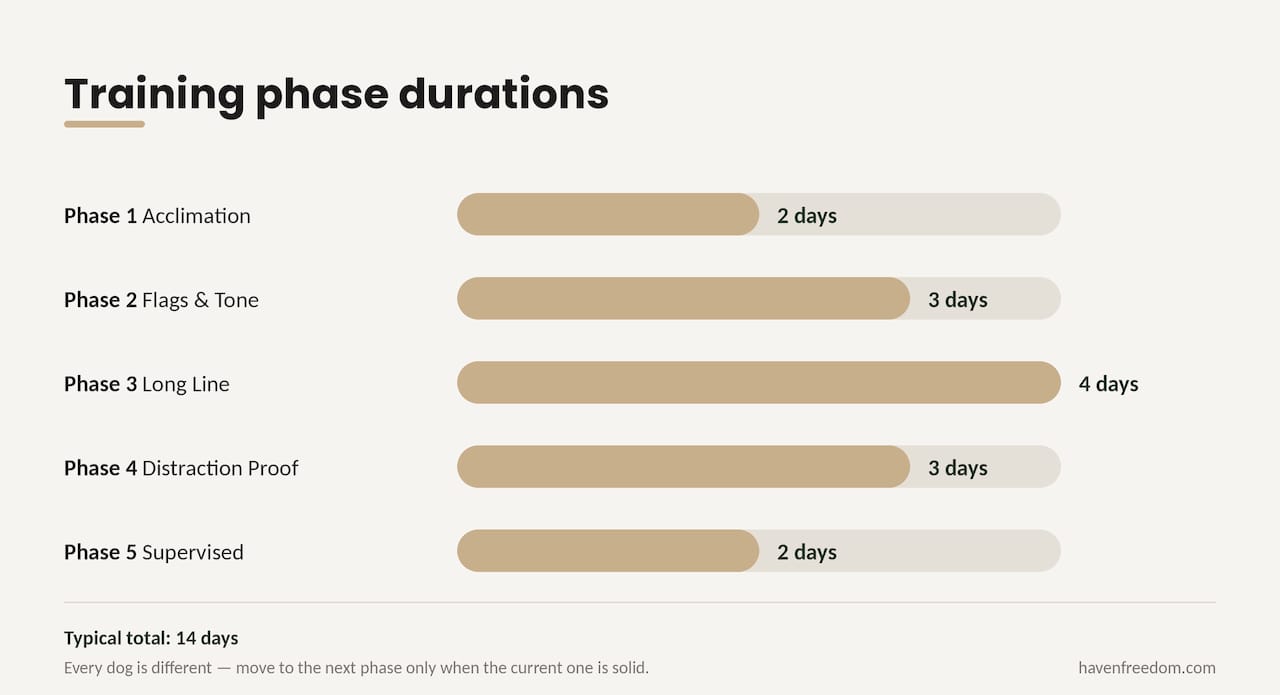
Phase 1: Collar acclimation (Days 1 to 2). Put the collar on during meals, play, and normal house time with the fence function off. You’re not teaching anything yet, just removing the novelty of wearing gear on the neck. Pass criteria: your dog ignores the collar within a few minutes of putting it on, both sessions, both days.
Phase 2: Flag and tone introduction (Days 3 to 5). Walk your dog on a regular leash toward a flagged boundary point. The moment the tone sounds, stop, say a consistent cue like “no” or “back,” and guide your dog away from the line. Mark the exact instant your dog turns back toward the yard, then reward immediately with a treat and praise. This mark-and-reward sequence is the core mechanic of the entire program, and it works better than any correction on its own. Pass criteria: your dog responds to the tone alone (before reaching the flag) in at least four of five approaches, across both sessions on Day 5.
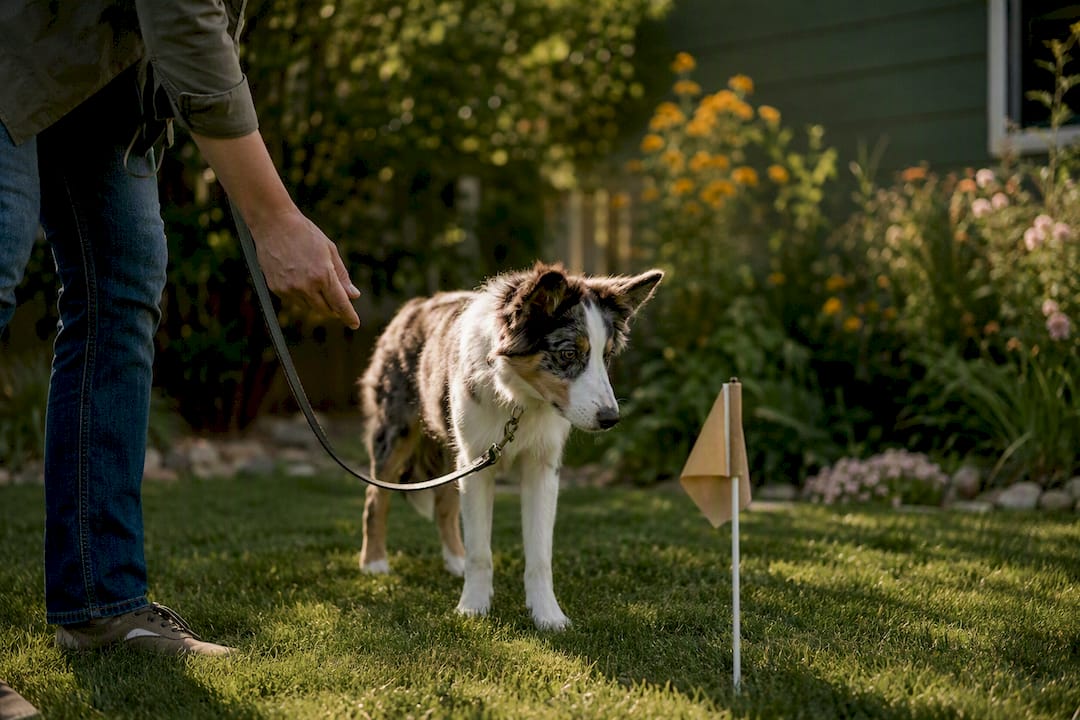
Phase 3: Boundary pressure with the long line (Days 6 to 9). Switch to the 20 to 30 foot long line and let your dog approach the boundary with less direct guidance from you. Your job shifts from leading to observing. If your dog hears the tone and turns back on their own, mark and reward generously. If they push through, gently redirect with the line and repeat. Run this from multiple approach angles, not just one path to one flag. Pass criteria: two clean sessions in a row where your dog self-corrects at the tone from at least three different angles, with no need for you to physically redirect.
Phase 4: Distraction proofing (Days 10 to 12). Add real-world temptation, a bouncing ball, a squirrel decoy, another person walking by, while your dog is on the long line near the boundary. This phase reveals whether the training actually holds under pressure or only works in a quiet yard. Pass criteria: your dog turns back at the tone even with an active distraction present, in both sessions across two separate days.
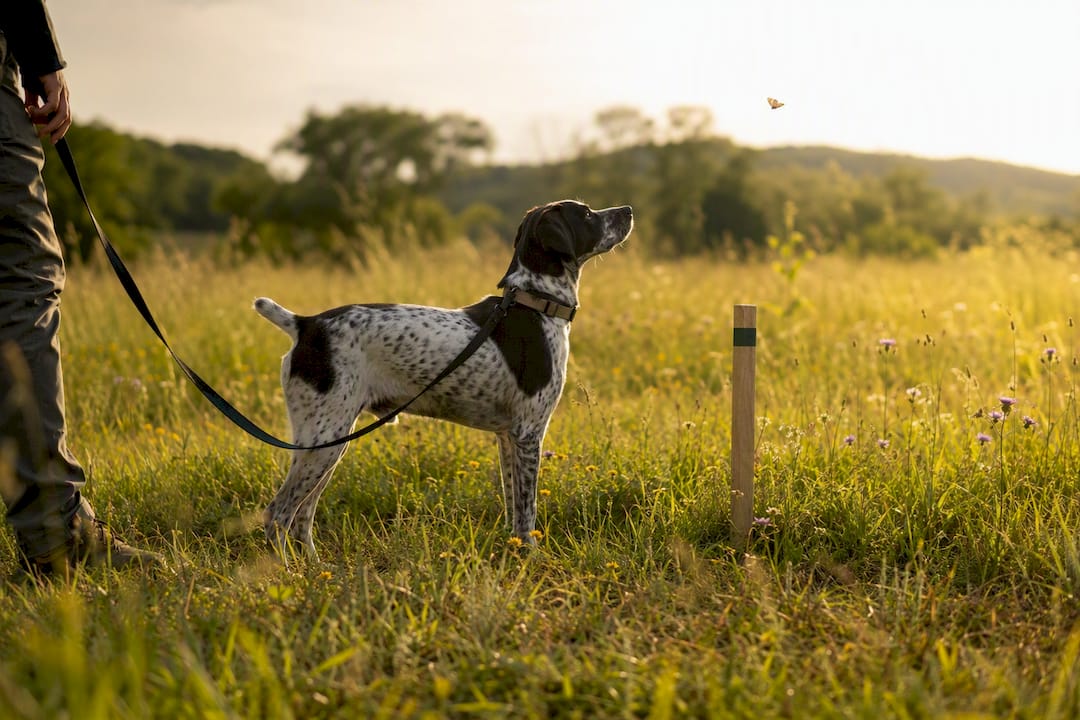
Phase 5: Supervised freedom and graduation (Days 13 to 14). Drop the long line but stay outside with your dog, watching closely. Let them move naturally through the yard while you observe boundary approaches without intervening unless necessary. Only after two separate clean checks with zero boundary contact should you begin thinning the flags. Pull one every few days rather than all at once, since flags are a visual aid to fade out gradually, not a permanent yard fixture.
Here’s the schedule at a glance:
| Days | Phase | Session focus |
|---|---|---|
| 1 to 2 | Acclimation | Wear the collar, zero fence function |
| 3 to 5 | Tone introduction | Leash walks to flagged points, mark and reward |
| 6 to 9 | Long-line pressure | Multiple angles, less guidance from you |
| 10 to 12 | Distraction proofing | Add real-world temptations near the line |
| 13 to 14 | Supervised freedom | Drop the line, watch, then thin the flags |
Common Problems and Troubleshooting During Training
Even with a solid plan, setbacks happen. Here’s how to handle the ones that come up most.
-
Boundary seems to have drifted: Re-walk the perimeter, reflag at the actual tone points (not where the flags used to be), and repeat the last phase until your dog is consistent again.
-
Dog freezes or shows stress near the line: Stop the session entirely. Spend a day rebuilding confidence with play in the center of the yard, then reintroduce the tone at a lower intensity with more frequent rewards.
-
Dog seems to ignore the tone altogether: Go back to long-line proofing rather than pushing forward. Lowering the correction level and adding more distraction-free repetitions almost always beats trying to advance faster.
Pro Tip: A dog that “ignores” the tone is often confused, not defiant. Add three extra sessions at the current phase before assuming you need a stronger correction.
Safety and Best Practices for Wireless Fence Training
Static correction, when a collar offers it, works as a backstop, never the primary teaching tool. Teach the tone response first, and if you introduce correction at all, start at the lowest level your dog can detect.
-
Check collar fit daily: snug enough that you can’t slide it over the head, loose enough to fit two fingers underneath.
-
Limit wear to a maximum of 12 hours in any 24-hour period, and reposition the collar on your dog’s neck every 1 to 2 hours. Rotating the collar a couple of inches around the neck takes five seconds and prevents almost every skin problem owners report with containment collars.
-
Remove the collar during long stretches indoors or overnight unless it’s designed for extended wear.
-
Watch for signal interference near metal sheds, chain-link fencing, or large vehicles parked close to the boundary.
-
Skip training sessions during storms, fireworks, or other high-stress events near the yard line.
Yard conditions matter too. If you’re working with artificial turf, keeping the surface clean affects how comfortable your dog is spending time near the boundary, and proper turf maintenance reduces one more variable competing for your dog’s attention during proofing sessions.
Why a GPS-Based Collar Fits This Training Plan
A stable, software-defined boundary matters more than most owners realize during the early phases. When the perimeter shifts day to day the way older wireless transmitters can, your dog associates the tone with an inconsistent line instead of a fixed one, and progress stalls. GPS mapping removes that variable.
Features that map directly onto the plan above:
-
A tone-only training mode for Phases 2 through 4, so no correction is active while the association is still forming.
-
Per-dog profiles, useful for households running this program with more than one dog on different timelines.
-
Dual-band GPS positioning that holds its shape regardless of nearby structures.
-
Optional tracking add-ons for recovery, in case a dog clears the boundary before training is complete.
Readers ready to see the device built around this exact training flow can review the full feature set before starting Day 1.
What we tend to see
Most wireless fence guides treat the 14-day timeline as a formality, something to mention before rushing into gear reviews. That’s backward. The timeline is the entire point. Dogs that graduate early almost always regress within a month, because the owner skipped the distraction-proofing phase or pulled the long line too soon.
The overrated part of this whole process is the static correction itself. Owners buy a containment collar assuming the shock is what teaches the dog. It isn’t. The tone is what teaches the dog, and the correction, when used at all, only backs up a lesson that should already be mostly learned. Skip the tone-first phases and you’re not training a boundary response, you’re just training avoidance of pain, which breaks down the moment a squirrel outweighs the fear.
If you take one thing from this plan, prioritize the mark-and-reward mechanic in Phase 2 over everything else. Get that timing right and phases three through five mostly take care of themselves.
Get a Collar Built for This Exact Training Plan
A boundary that holds its shape and a collar with a real tone-only mode are the two things that make this 14-day plan work, and they’re the two things a lot of wireless systems get wrong. HAVEN Freedom pairs dual-band GPS mapping with a dedicated training mode and per-dog profiles, so multi-dog households can run separate timelines without mixing up settings.
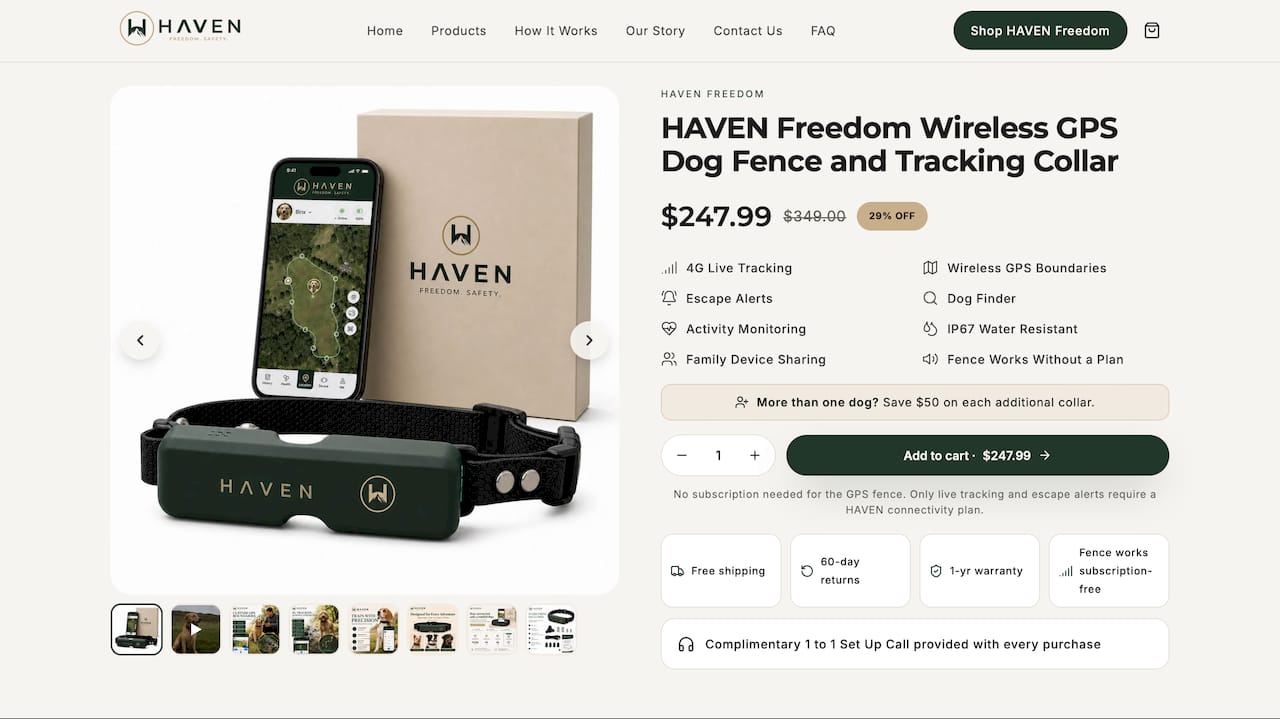
The fence function itself requires no ongoing subscription. A monthly plan is only necessary if you want live tracking, escape alerts, or the sound-and-light dog finder on top of the core containment features. Check the HAVEN Freedom collar and start mapping your dog’s boundary before your first session.
Sources
Recommended
Keep reading
en
Road Trip Dog Containment: Keep Your Dog Safe in the Car and at Every Stop
How to contain a dog on a road trip: crash-tested restraints in the car, plus safe setups at rest stops, campsites and rentals, including...
Read the posten
Puppy E-Collar Age: When Is It Safe, and What to Use First
No vet-backed minimum age exists for shock collars on puppies. See what vets advise, what to do before 6 months, and how a GPS...
Read the postYour adventure starts here
Ready to give your dog more room to roam?
Give your dog more freedom to explore — and give yourself the reassurance of knowing they're never far away.
