

Dog travel containment, in the sense that matters for adventurous owners, means GPS-enabled wireless boundary collars that create a virtual fence, track your dog’s location, and alert you the moment they cross a line. Paired with structured training, these systems give dogs supervised freedom at a campsite, cabin, or rental property without buried wires or a physical barrier. The HAVEN Freedom Wireless GPS Dog Fence and Tracking Collar is one option built specifically for this kind of portable, travel-friendly setup.
TL;DR:
- Dual-band GPS systems provide more reliable boundary accuracy under wooded or urban environments compared to single-band units.
- Traversing property boundaries can be set by walking or drawing on an app, with training essential to prevent boundary failure.
- Heavy satellite cover and obstructions can cause boundary drift of 2 to 5 feet, making GPS containment a safety aid rather than an infallible barrier.
- Hardware prices vary based on accuracy features and subscription plans, with some systems like HAVEN Freedom offering core functions without recurring fees.
- Proper collar fit, thorough training, and understanding satellite limitations are key to effective and safe dog containment during travel.
Table of Contents
- How Does GPS Dog Travel Containment Actually Work?
- Is a GPS Collar Right for Your Dog and Property?
- Setting Up and Training Your Dog on the Boundary
- What Are the Limits of GPS Dog Containment?
- What Does a GPS Dog Fence Really Cost?
- What Should You Check Before Buying a GPS Collar?
- Our Take on Safe, Supervised Freedom for Traveling Dogs
- Give Your Dog Freedom Without the Fence Wires
- Sources
- FAQ
How Does GPS Dog Travel Containment Actually Work?
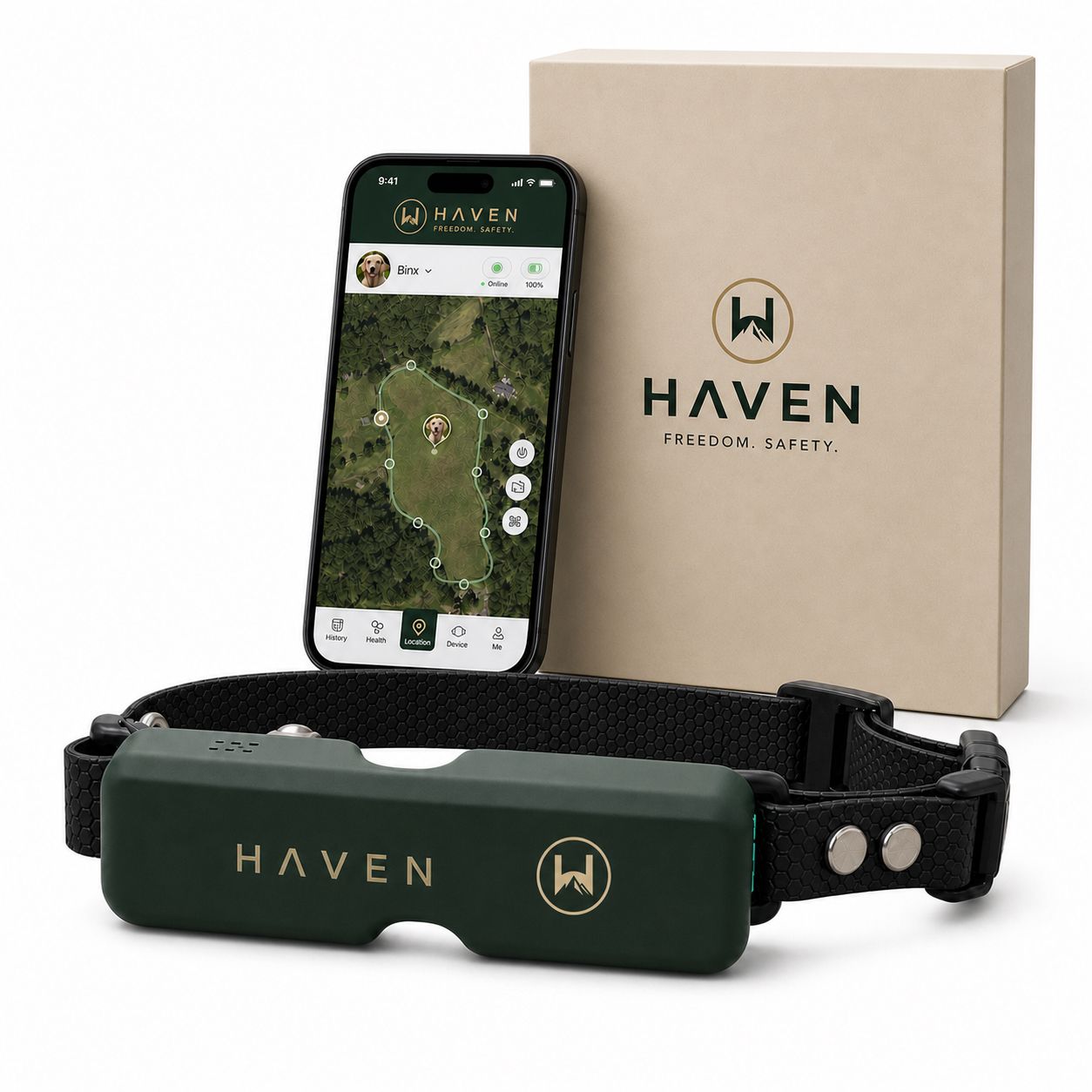
A GPS boundary collar uses satellite positioning to figure out where your dog is standing, then compares that location against a virtual fence you drew on your phone. Cross the line, and the collar reacts. Cheaper single-band units rely on one satellite frequency and lose precision fast under tree cover. Dual-band or multi-satellite systems pull signal from more sources at once, which is why they hold their line more reliably in wooded campsites or near buildings, according to comparisons of GPS fence technology.
You typically set the boundary one of two ways: walk the perimeter yourself while the collar records your path, or draw the shape directly on a map inside the app. Traveling owners tend to prefer the drawing method since it works even when you can’t physically walk a property line, like a wooded lot bordering a lake. Most systems let you save multiple fences, so a boundary you built for your backyard stays on file next to one for a rental cabin.
At the edge of the boundary, the sequence is usually the same:
- An audible tone plays as a warning cue
- Vibration follows if the dog keeps moving toward the line
- An optional, adjustable static correction activates on some models as a last step
- Your phone gets an escape alert in real time so you know immediately, not after the fact
Recovery tools round out the system. Live tracking updates your dog’s position on a map, while finder tools combining sound, light, and Bluetooth radar help you close the distance fast if a dog does get loose, a detail Healthy Pet’s explainer calls out as a standard feature on modern systems.
Is a GPS Collar Right for Your Dog and Property?
GPS containment shines on large, irregular, or multi-location properties where burying a wire loop would be expensive or simply impossible, like a rented cabin or a campsite you visit once a season. It’s also the only practical option if you need different boundaries in different places, since the fence lives in software instead of the ground.
Some quick fit checks before you buy:
- Property type: works best on half-acre-plus lots, wooded land, or anywhere you travel between locations
- Dog size and temperament: most collars are built for dogs above a minimum neck size and weight, and a dog with strong prey drive needs more training reps before earning boundary freedom
- Owner lifestyle: a strong fit for frequent travelers, cabin owners, and renters who can’t install permanent fencing
- When to skip GPS: a small, flat, obstruction-free yard under a quarter acre often does fine with a wired or radio fence, since those systems can hold inch-level precision that GPS doesn’t match
Setting Up and Training Your Dog on the Boundary
Start with fit. The collar should sit snug enough that the contact points touch skin without pinching, roughly two fingers of space under the strap. Charge it fully before the first walk, then build your boundary in the app, either by walking the perimeter or drawing it on the map. Once the fence is saved, walk it yourself, without the dog, to confirm the line matches what you expected on the ground.
Training comes next, and skipping this step is the single biggest reason GPS fences fail in the real world. The AKC notes that introducing a boundary collar without a structured protocol is often ineffective, since dogs need consistent, positive reinforcement to connect the tone and vibration to a boundary line rather than treat them as random noise.
A simple four-step protocol works for most dogs:
- Introduce the tone on a leash, rewarding the dog heavily the instant they hear it and turn away from the line
- Add vibration once the tone response is reliable, again pairing it with treats and praise
- Run supervised boundary sessions off leash but within arm’s reach, letting the dog test the edge naturally
- Reinforce recall every session, since a dog that comes back on command recovers from mistakes faster than one that doesn’t
Keep sessions short, 10 to 15 minutes, two or three times a day, rather than one long marathon. Short, frequent, and consistently positive is the formula the AKC’s guidance keeps coming back to, and it matches how most dogs actually learn.
Pro Tip: Run your first few boundary sessions at feeding time. A hungry dog pays closer attention to the reward, which speeds up how fast the tone and vibration become meaningful signals instead of background noise.
If the collar slips during play, tighten the fit and recheck it after every swim. A distracted dog usually needs a lower-distraction location for a few sessions before returning to the real test environment. Apparent boundary drift, where the line seems to move, is almost always a satellite accuracy issue rather than a software bug. Our boundary training guide walks through the full protocol in more depth if you want a printable reference.
What Are the Limits of GPS Dog Containment?
No GPS system is perfect, and pretending otherwise sets owners up for a bad surprise. Dense tree canopy, tall buildings, and even heavy weather can bend satellite signal enough to shift where the collar thinks your dog is standing.
Premium systems with dual-band or multi-satellite positioning typically hold accuracy to roughly 2 to 5 feet, while budget single-band units can drift noticeably more under heavy tree cover or near large structures. That gap is worth knowing before you rely on a fence near a road or a drop-off.
A few practical things to plan around:
- Charge the collar fully before any outdoor session and treat a low-battery alert as a hard stop, not a suggestion
- Look for waterproof ratings if your dog swims or you’re traveling somewhere wet
- Some premium units add a forest or dense-canopy mode specifically to fight signal loss under trees, a feature worth checking on the spec sheet
- If your dog does leave the boundary, use live tracking to find their last known position first, then switch to sound and light finder tools once you’re close
The honest takeaway: GPS containment reduces risk significantly, it doesn’t eliminate it. Treat the collar as a strong second layer of safety, not a replacement for supervision in unfamiliar terrain.
What Does a GPS Dog Fence Really Cost?
Hardware prices for GPS boundary collars generally scale with positioning accuracy and finder features. Entry-level units cover the basics, a virtual fence and simple alerts, while higher-priced hardware adds dual-band positioning, canopy modes, and more sophisticated finder tools like Bluetooth radar.
The subscription question trips up a lot of first-time buyers. Some vendors bundle core boundary function into the one-time hardware price and reserve a monthly plan strictly for real-time cellular tracking and faster location updates. Others lock the entire fence behind a recurring fee, which changes the math considerably for anyone on a budget.
Before buying, ask yourself these questions:
- Does the boundary itself work without a monthly plan, or is that core function paywalled?
- What update frequency does the subscription actually buy you, and does it matter for how you use the collar?
- Are escape alerts included free, or do they require the paid tier?
- What happens to boundary function if you cancel the subscription later?
HAVEN Freedom’s boundary works without any subscription. A plan is only needed if you want live cellular tracking and advanced app features, which is worth knowing if you’re a traveler who mainly needs the fence to work reliably at each new stop. Our cost breakdown guide covers exact price bands in more detail.
What Should You Check Before Buying a GPS Collar?
A little due diligence before checkout saves a lot of frustration later. Run through this list on any product page you’re considering:
- Accuracy claims: does the listing state a real drift range, or just vague marketing language?
- Battery life: how many hours of active use per charge, and how long does a full charge take?
- Collar fit: what’s the minimum neck size and weight, and does it fit your dog’s build?
- Training resources: does the brand provide a structured training guide, not just a manual?
- Finder features: sound, light, and Bluetooth radar, or just a basic last-known-location ping?
- Subscription policy: what works free, and what requires a paid plan?
- Warranty and return window: how long do you have to test it in real conditions?
- Privacy policy: how is your dog’s location data stored and shared?
If a company offers a demo or trial period, use it to walk a real perimeter and watch how fast live updates actually refresh. That single test tells you more than any spec sheet.
Our Take on Safe, Supervised Freedom for Traveling Dogs
We built HAVEN Freedom around portability first: dual-band positioning that holds up under real-world tree cover, finder tools that actually work when a dog slips the line, and app features you can add if you want them, never features you’re forced to pay for just to use a fence. Read our training guides before your first trip, and never treat any collar as a substitute for supervision in new terrain.
— Haven
Give Your Dog Freedom Without the Fence Wires
The HAVEN Freedom Wireless GPS Dog Fence and Tracking Collar is built for exactly the travel scenario this guide covers: a boundary you can set up in a new place in minutes, with no wires to bury and no waiting for an installer. Dual-band positioning keeps the virtual fence accurate under tree cover, live tracking and escape alerts tell you the moment something’s wrong, and the sound, light, and Bluetooth radar finder system helps you close the gap fast if your dog does wander.
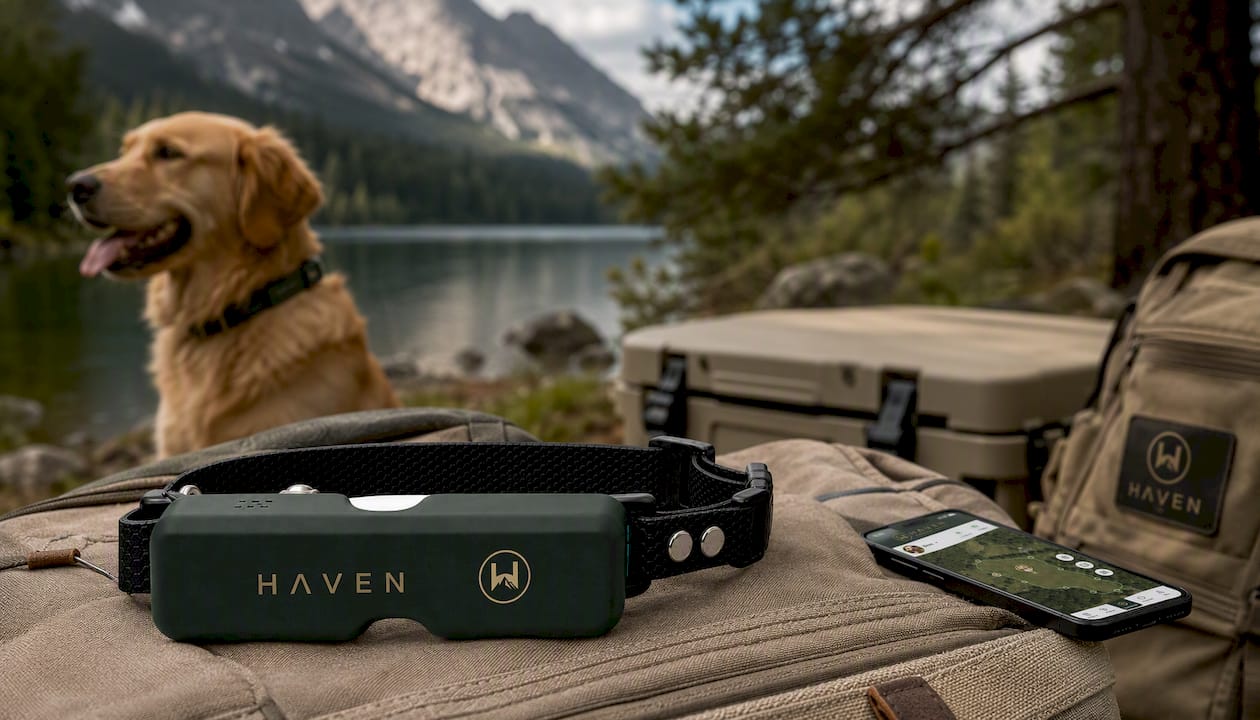
The core boundary works without a monthly plan. If you want real-time cellular tracking and advanced app features on top of that, a subscription is there as an add-on, not a requirement. Check the product page for current specs and start building your first boundary before your next trip.
Sources
- What is a GPS Dog Fence and How Do They Work? — AKC
- How GPS fence technology helps keep active dogs safe outdoors — Healthy Pet
- GPS vs Wireless vs Wired Dog Fence: Best Type? — My Little and Large
FAQ
How Long Does It Take to Train a Dog on a GPS Fence?
Most dogs learn the tone and vibration cues within one to two weeks of short, daily sessions, though dogs with strong prey drive or high distractibility may need longer.
Does Tree Cover Really Affect GPS Fence Accuracy?
Yes. Dense canopy can bend satellite signal enough to shift boundary accuracy, though dual-band and multi-satellite systems hold up noticeably better than single-band budget units.
Do I Need a Subscription for a GPS Dog Fence to Work?
Not always. Some systems, including HAVEN Freedom, let the core boundary function work without a monthly plan, reserving subscriptions for live cellular tracking and faster updates.
Is a GPS Collar Safe for Small Dogs?
Check the manufacturer’s minimum weight and neck size first, since most GPS collars are sized for medium and larger dogs and may not fit safely on very small breeds.
What Happens if My Dog Crosses the Boundary?
You get an immediate escape alert on your phone, and finder tools like sound, light, and Bluetooth radar help you locate and recover your dog quickly.
Recommended
Keep reading
en
Puppy E-Collar Age: When Is It Safe, and What to Use First
No vet-backed minimum age exists for shock collars on puppies. See what vets advise, what to do before 6 months, and how a GPS...
Read the postcharge dog collar camping
Charging a Dog Collar at Camp: Skip Bedding, Use a Hard Surface
Charge a dog collar safely at camp with a power bank, original cable, and solar or car backup. Follow National Park Service battery safety...
Read the postYour adventure starts here
Ready to give your dog more room to roam?
Give your dog more freedom to explore — and give yourself the reassurance of knowing they're never far away.
