

A GPS dog fence typically costs between a few hundred dollars and around $1,000 upfront for the hardware, and whether you’ll owe anything after that depends almost entirely on which system you buy. Some require a monthly subscription just to keep the containment boundary active. Others, like Haven’s collar, run the fence boundary without any required plan and reserve subscriptions for optional live tracking and app features.
Here’s the short version before you dig in:
-
One-time hardware cost: $450–$1,000 for a single-dog GPS collar system.
-
Subscription cost (when required): ongoing monthly fees are commonly charged for live tracking and other connected features, typically ranging from low to mid tens of dollars per month.
The math that matters most: if a system charges $150/year in mandatory subscription fees, it adds $750 over five years on top of whatever you paid at checkout. A no-subscription system priced $200 higher at purchase usually saves money by year three or four.
Key Takeaways
A GPS dog fence costs $450–$1,000 upfront, and the subscription policy determines whether that’s the full cost or just the beginning.
| Point | Details |
|---|---|
| Upfront hardware range | GPS dog fence systems typically cost $450–$1,000. |
| Subscription math | A $180–$300/year mandatory plan adds $900–$1,000 over five years on top of hardware cost. |
| Crossover point | No-subscription systems typically become cheaper than subscription-required alternatives by year three to four. |
| Battery and maintenance | Plan $50–$75/year for battery wear and accessories; collars with 12–48 hour runtimes need near-daily charging. |
| Havenfreedom option | HAVEN Freedom runs the containment boundary with no required subscription; live tracking is an optional add-on. |
Table of Contents
How much does a GPS dog fence cost upfront?
Hardware is where most of the sticker shock lives, and the range is wide for a reason. Budget systems and premium dual-band collars are solving meaningfully different problems.
Price tiers and what each one actually includes
| Tier | Typical Upfront Price | What’s Usually Included |
|---|---|---|
| Budget | ranges from low hundreds to mid hundreds | Single collar, basic app, limited boundary accuracy, short battery life |
| Mid-range | mid to high hundreds | Single collar, improved GPS accuracy, longer battery, basic warranty |
| Premium | from mid hundreds up to around $1,000 | Dual-band GPS, live tracking hardware, escape alerts, longer warranty, robust app |
Editorial pricing guidance puts GPS collar systems at roughly $450 to $1,300 for most buyers, with the upper end reserved for systems that include dual-band receivers and no mandatory subscription. A cost calculator from UseCalcPro puts GPS collars generally in the higher hundreds to around $1,000 range when you factor in the full hardware package, compared to wireless base stations at $150–$600 and buried-wire professional installations at $950–$8,500 depending on acreage.
Pro Tip: GPS is the only containment type with zero installation cost. No trenching, no professional labor, no permit headaches. That alone closes a lot of the upfront price gap with buried-wire systems.
What pushes the upfront price higher
A few line items catch buyers off guard:
-
Extra collars: Most systems sell the base kit for one dog. Additional collars typically add a moderate extra cost, often a few hundred dollars.
-
Large-dog hardware: Heavier-duty collars for dogs over 60 lbs sometimes carry a small premium or require a different model.
-
Replacement accessories: Charging cables, contact points, and mounting hardware are usually sold separately after the warranty period.
-
Professional setup assistance: GPS systems are designed for DIY, but some buyers may pay a modest fee for a trainer or technician to configure boundaries and train the dog to the system.
Dog size matters more than people expect. A collar rated for a 10-lb dog won’t sit correctly on a 90-lb Labrador, and the fit affects both correction delivery and GPS antenna positioning. Buying the wrong tier because it’s cheaper often means buying again.
What are the ongoing costs of a GPS dog fence?
This is where two systems with similar sticker prices can diverge by hundreds of dollars over three years. The subscription question is the single most important thing to clarify before you buy.
Subscription types: required vs. optional
Some GPS fence systems require an active subscription for the containment boundary to function at all. Miss a payment, and your dog’s fence effectively turns off. Other systems, including HAVEN Freedom, keep the boundary active without any plan and only require a subscription if you want live 4G tracking or escape alerts pushed to your phone.
That distinction is not a minor footnote. It’s the difference between a one-time purchase and a recurring obligation.
Recurring cost scenarios
GPS collars commonly run 12–48 hours per charge, which means daily or near-daily charging for active dogs. Over two to three years, battery capacity degrades, and field reports confirm that planning for eventual battery replacement or reduced runtime is realistic budgeting, not pessimism.
One-year and three-year cost examples
No-subscription system (e.g., $999 upfront):
-
Year 1: $999 hardware + $50 accessories = $1,049
-
Year 3: Add ~$75 in battery/maintenance = ~$1,124 total
Subscription-required system (e.g., $699 upfront + $180/year):
-
Year 1: $699 + $180 subscription + $50 accessories = $929
-
Year 3: $699 + $540 subscriptions + $75 maintenance = ~$1,314 total
By year three, the subscription-required system has already cost more. Analysts tracking GPS fence comparisons note the crossover typically lands between year four and five depending on the membership tier, but mid-tier plans accelerate that timeline.
Pro Tip: Before you buy, ask one question: “Does the containment boundary stay active if I cancel the subscription?” If the answer is no, add the full annual subscription cost to every year of your ownership math.
What factors make one GPS fence cost more than another?
Two buyers can spend very different amounts on what looks like the same product category. Here’s what actually drives the price difference.
-
Property size and shape: Larger acreage requires a system with strong signal range. Irregular shapes (L-shaped lots, narrow corridors) stress boundary accuracy and may require premium hardware to hold the line reliably.
-
Tree cover and terrain: GPS accuracy degrades under heavy canopy or in valleys, and editorial testing consistently identifies tree cover as the top containment failure mode for GPS systems. Buyers on wooded properties often need dual-band receivers, which push hardware costs toward the premium tier.
-
Number of dogs: Each additional dog means an additional collar. A two-dog household buying a $999 system might spend $1,300–$1,400 once the second collar is added.
-
Collar battery life: A collar that needs charging every 12 hours creates daily friction and faster battery wear. Longer-runtime collars tend to cost more upfront but reduce replacement frequency.
-
GPS hardware quality: Single-band GPS uses one satellite signal source. Dual-band systems like HAVEN Freedom’s use two, which improves accuracy in challenging terrain. The hardware difference shows up directly in price and in real-world boundary reliability.
-
Warranty and support: A two-year warranty with live support costs the manufacturer more to back, and that cost is priced in. A 90-day warranty on a cheap collar is a different risk profile than a full-year warranty on a more expensive system.
Pro Tip: If your property has significant tree cover, don’t buy based on open-field accuracy specs. Ask the vendor specifically how the system performs under canopy, and confirm the return window is long enough to test it on your actual property before you’re committed.
How do you choose the right GPS dog fence for your budget?
Work through these steps before you reach the checkout page.
-
Set a hard budget cap that includes both hardware and three years of any required subscription. A $500 collar with a $200/year mandatory plan costs $1,100 over three years. A $900 no-subscription collar costs $900.
-
Measure your acreage and note tree cover. If you have more than half an acre of wooded property, budget for a dual-band system.
-
Confirm the subscription policy in writing. Ask whether containment stays active without a plan. Get a direct answer, not a marketing summary.
-
Check the collar’s tested battery runtime. Manufacturer specs often reflect ideal conditions. Look for independent reviews that report real-world runtimes.
-
Verify the collar weight and fit for your dog’s size. A collar that’s too heavy or too light for the dog’s neck won’t deliver consistent correction or accurate GPS readings.
-
Read the return and trial policy before you buy. A 60-day return window gives you enough time to test real-world boundary accuracy on your property.
Questions to ask before purchasing
-
Does the containment boundary work without an active subscription?
-
What is the collar’s real-world battery runtime under normal use?
-
How does accuracy hold up under tree canopy or near property edges?
-
What does the warranty cover, and for how long?
-
Is there a trial period or return window if the system doesn’t work on my property?
-
How many dogs can the system support, and what does each additional collar cost?
Red flags to watch for
-
Containment is disabled when the subscription lapses
-
Warranty shorter than 12 months with no stated support channel
-
No return or trial period offered
-
Accuracy specs listed only for open fields with no canopy disclosure
-
Vague subscription terms that don’t specify what features require a plan
Buyer guides and comparison posts consistently flag the subscription-disables-containment issue as the most common post-purchase complaint. It’s worth a direct question every time.
Real-world cost scenarios: what will you spend over 1, 3, and 5 years?
Three property types cover most buyers. Here’s how the numbers play out across each one.
Annual recurring includes estimated battery/maintenance costs of $50–$75/year. Subscription costs reflect mid-tier plans.
Small yard, budget GPS: The low sticker price is real, but the mandatory subscription adds up fast. At $180/year, you’ve spent $1,200 over five years on a system that cost $300 at checkout. That’s four times the hardware cost in subscription fees alone.
Suburban 1-acre, no-subscription GPS: The mid-range no-subscription system costs more on day one but levels off quickly. By year three, total spend is under $300, and by year five, you’re still well under what the subscription-required alternative costs.
Suburban 1-acre, subscription-required GPS: Starts cheaper than the no-subscription option, but crosses over by year two. By year five, the gap is $700.
Large rural property, premium GPS: The highest upfront cost in the table, but the flattest cost curve. Maintenance is the only recurring line item, and the dual-band accuracy justifies the premium on a large or wooded property.
Pro Tip: To run your own numbers: take the hardware price, add $50/year for maintenance, then add your annual subscription cost multiplied by the number of years you plan to own the system. Compare that total against a no-subscription system using the same formula. The crossover year is usually obvious within 30 seconds.
The subscription trap is the real cost story
The GPS dog fence market has a pricing structure that rewards careful reading. Upfront price is the number vendors lead with. Subscription cost is the number that determines what you actually spend.
Most buyers anchor on the hardware price and treat the monthly fee as a small add-on. But $15/month is $900 over five years. On a $500 collar, that’s nearly double the purchase price paid again in subscription fees, for features that may or may not matter to how you use the system day to day.
The more defensible approach is to decide upfront which features you actually need. Live tracking is genuinely useful if your dog is an escape artist or if you travel with them. But if your primary goal is containment, and the boundary works without a plan, you may never need to pay a subscription at all. Systems that separate containment from tracking give you that choice. Systems that bundle them together take it away.
Warranty length and support quality are the other underweighted factors. A collar that fails at month 13 on a 12-month warranty is a $700–$1,000 replacement cost. A one-year warranty with a real support channel is worth paying for, especially on a system you’re planning to own for many years.
Havenfreedom fits the no-subscription math better than most
Most GPS fence buyers don’t need live tracking every day. They need a reliable boundary that keeps their dog safe, a collar that holds a charge through a full day outdoors, and a system that doesn’t send them a bill every month just to keep the fence on.
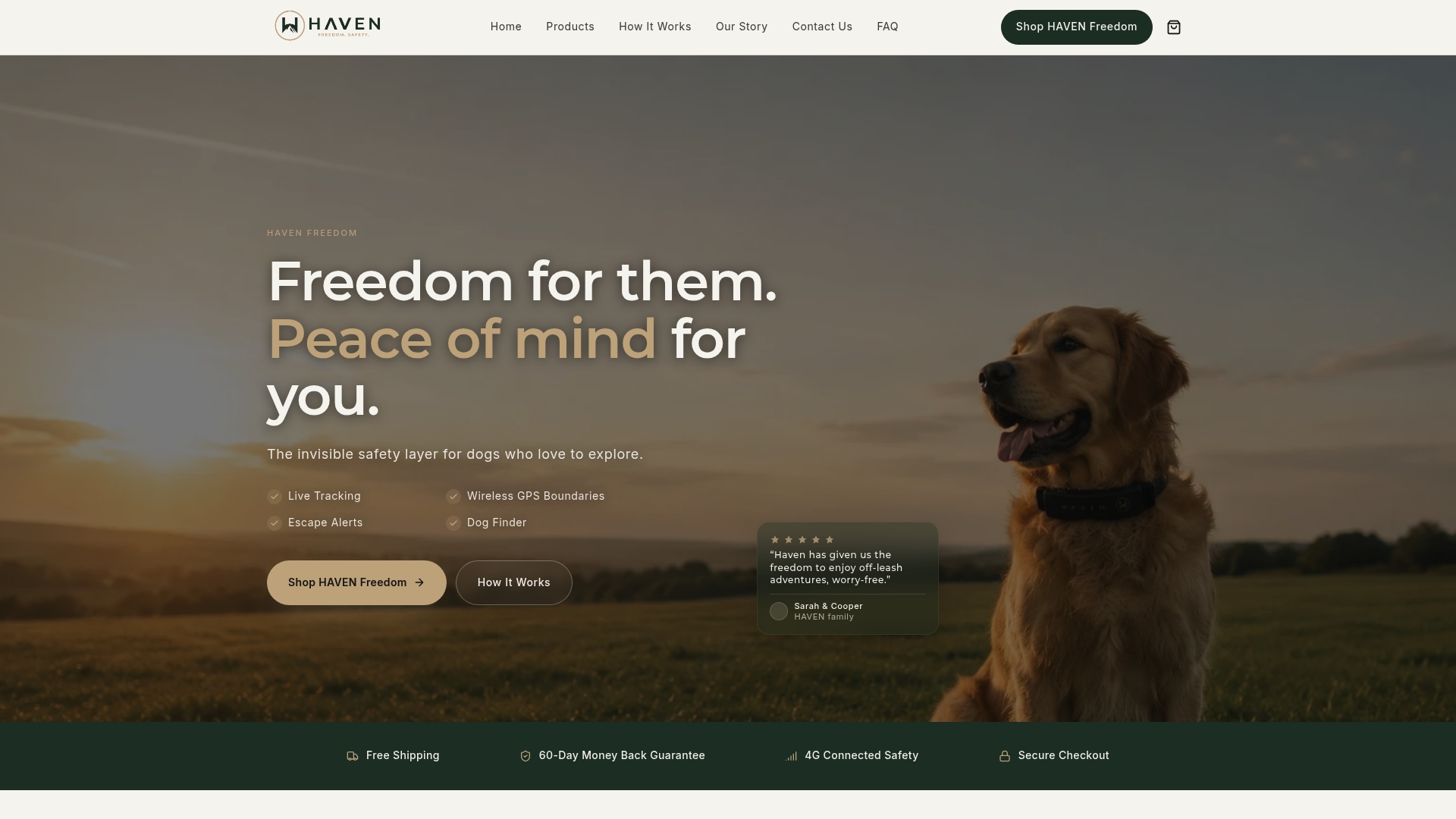
That’s the problem HAVEN Freedom was built to solve. The HAVEN Freedom GPS collar uses a dual-band positioning system to create customizable wireless boundaries with no buried wire and no required subscription for the containment function. Live 4G tracking, escape alerts, and full app features are available as optional add-ons, so you pay for them only if you want them. The collar also includes a dog finder system combining sound, light, and Bluetooth radar, activity and sleep tracking, and a training mode with adjustable tone, vibration, and optional static correction.
For a single-dog household on a suburban or rural property, the three-year math is straightforward: one hardware purchase, optional subscription only if you want live tracking, and maintenance costs that stay flat. Compared to a subscription-required system at $240/year, the savings over three years can easily exceed $600.
Check the current price, warranty terms, and trial policy directly on the product page before you finalize your budget.
Sources
These are the sources used to build the cost figures and comparisons in this article. Each one is worth checking directly for current prices, since hardware costs and subscription rates change.
Recommended
Keep reading
dog travel containment
Travel Ready Freedom: GPS Dog Containment, No Subscription
Learn how training-first, travel-ready GPS boundaries and finder tools let dogs roam safely without buried wires. HAVEN Freedom's core boundary works...
Read the postdog fence app setup
Working Boundary in 30 Minutes: Vendor Neutral Dog Fence App Setup
Vendor neutral, app first checklist to pair your GPS collar, walk and save the boundary, then test it. Finish setup in 20 to 30...
Read the postYour adventure starts here
Ready to give your dog more room to roam?
Give your dog more freedom to explore — and give yourself the reassurance of knowing they're never far away.
