

For most yards, a portable exercise pen or a no-dig heavy-duty panel system is your fastest, safest temporary dog boundary. If your dog jumps or digs, add height (48 inches minimum) or a buried skirt. For renters, travelers, or oddly shaped yards, a wireless or GPS collar like the HAVEN Freedom skips stakes entirely and still keeps a dog contained.
TL;DR:
- Heavy-duty no-dig metal panels are ideal for long-term or weather-exposed yards, offering greater durability than plastic mesh for weeks of use.
- GPS and wireless collars are best suited for irregularly shaped, wooded, or rental properties, but require proper boundary training and cannot replace physical barriers near hazards.
- For dogs that dig or jump, a minimum height of four feet and buried skirts or heavy wire are necessary to prevent escape, especially for determined or breed-specific jumpers.
- Portable ex-pens or exercise pens are quick, versatile options for short-term containment during trips or temporary yard setups, but must be checked regularly for security.
- Proper anchoring and thorough training are critical for all boundary types to ensure safety and reduce failure risks, especially in windy conditions or on uneven terrain.
Table of Contents
- What Are the Best Types of Temporary Dog Boundaries?
- How Do You Choose the Right Temporary Boundary for Your Dog?
- How Do You Set Up and Anchor a Temporary Dog Boundary Safely?
- What Should You Know About Wireless and GPS Dog Boundaries?
- Why Cheap Fixes Usually Cost More Than Doing It Right the First Time
- A Wire-Free Option Worth Considering: HAVEN Freedom
- Sources
- FAQ
What Are the Best Types of Temporary Dog Boundaries?
Picking the right containment style starts with knowing what each type is actually built to do. Some are made for an afternoon at the campsite. Others can hold a determined 70-pound dog through a full season of yard work.
Plastic and safety mesh is the cheapest and lightest option, and it shows up constantly in “DIY dog fence ideas” searches for good reason. It rolls up, weighs almost nothing, and sets up in minutes with a handful of stakes. The catch: it’s a barrier of last resort for small, calm dogs. Determined chewers snap through it, and larger dogs push straight over or under it. Industry guidance is blunt about this: lightweight plastic mesh often fails for determined or large dogs, and anyone keeping a boundary up for more than a few days should look at heavier materials instead.
Wire or welded mesh, and no-dig metal panels, solve the durability problem mesh can’t. These panels interlock, stand upright without buried posts, and hold their shape in wind and rain far better than plastic sheeting. For a temporary yard for dogs that needs to survive weeks or a full renovation project, powder-coated steel panels are usually the better durability-to-portability tradeoff. They cost more upfront and take longer to assemble than mesh, but they don’t fail the first time a dog leans into them.
Portable panels and exercise pens (ex-pens), along with freestanding kennels, give you a contained, gated space you can move, resize, or fold flat for storage. Ex-pens set up fast and offer solid security for supervised use, and you can link multiple pens together to expand the footprint. The tradeoff is in the connectors: linked pens are only as strong as their weakest joint, so every seam and stake needs checking before you walk away.
Wireless transmitters and GPS collars work on a completely different principle. Instead of a physical wall, they create an invisible perimeter the dog learns to respect through tone, vibration, or (in some systems) a mild correction. A standard wireless transmitter usually projects a circular boundary from a base unit, which limits you to round or oval shapes. GPS-based systems, GPS collars let you draw a boundary shaped to match your actual yard or campsite instead of forcing your space into a circle. Both approaches are genuinely portable and skip the anchoring work entirely, but they require a real training period and work best layered on top of force-free training methods, not as a replacement for them.
Tie-out stakes round out the low end of the cost spectrum. A stake, a cable, and a swivel clip will hold a dog in a rough radius for next to nothing, but strength and durability vary enormously between products. Tie-outs are best treated as a short, supervised solution, not something you leave a dog with for hours unattended.
Here’s how these options line up by common use case:
- Weekend camping trip: ex-pen or tie-out stake, both packable and quick to strike camp.
- Backyard renovation lasting weeks: no-dig metal panels for durability against weather and foot traffic.
- Renting or frequent moves: wireless or GPS boundary, since there’s nothing to install or leave behind.
- Irregularly shaped yard or wooded lot: GPS collar, because it maps to your actual property line instead of a fixed circle.
- Small, calm dog for a few hours: plastic mesh is fine, and it’s the cheapest way to make a temporary fence in a pinch.
Pro Tip: If you’re torn between two options, ask which failure mode you can live with. A physical fence that fails means a gap or a knocked-over panel. A wireless boundary that fails means a missed correction. Pick the containment type whose worst-case scenario you’re better equipped to catch quickly.
How Do You Choose the Right Temporary Boundary for Your Dog?
The right pet boundary solution depends on four things: your dog’s physical capabilities, your yard’s terrain, how long you need containment, and what the product actually delivers versus what it advertises. Skip any of these and you’ll likely end up buying twice.
-
Measure your dog’s real jump height, not shoulder height. A dog’s excited, motivated jump clears far more than its standing height suggests. Watch your dog jump during play or high excitement and add several inches of margin. For genuinely jump-prone breeds, a fence height of at least four feet is generally recommended by experts as a baseline, and taller is safer for anything over that.
-
Check for digging behavior before you buy. A dog that digs will test the base of any physical barrier within days. If digging is a known habit, plan for a buried skirt or heavy wire apron along the base, not just a tall panel.
-
Walk your site and note the ground type, slope, and hazards. Hard-packed soil, gravel, or concrete patios won’t hold standard stakes. Sloped yards create gaps under panels that a determined dog will find fast. Look for anything a scared or excited dog could get tangled in, too, especially with tie-out cables.
-
Decide how long you actually need this setup. A weekend trip and a three-month home renovation call for different products entirely. Buying durable no-dig panels for a two-day visit is overkill; buying flimsy mesh for a season-long project is a guaranteed second purchase.
-
Confirm the specs before checkout, not after. Panel height, stake depth requirements, material gauge, and gate placement all vary by brand and matter more than the marketing photos suggest.
Watch for a few red flags when comparing products. Panels advertised only by length, with no stated height, are usually shorter than what a mid-size dog needs. Reviews mentioning bent stakes or panels blown over in wind point to lightweight materials that won’t hold up outdoors. And any wireless system that claims instant, no-training containment is overselling; every credible source on wireless and GPS fencing treats training as mandatory, not optional.
Trust signals worth looking for include clearly stated panel height and gauge thickness, manufacturer guidance on stake depth by soil type, and, for GPS or wireless products, a documented training program rather than a vague “easy setup” claim. A temporary pet barrier that tells you exactly how to anchor it on your specific terrain is worth more than one that just looks good in a product photo.
How Do You Set Up and Anchor a Temporary Dog Boundary Safely?
Getting a temporary boundary to actually hold comes down to anchoring correctly for your ground type and giving your dog time to learn where the line is.
Start with the physical install. For soft or grass-covered ground, standard stakes driven at an angle (not straight down) resist pull-out far better than vertical stakes. On hard-packed dirt, gravel, or patio surfaces where stakes won’t bite, switch to weighted bases or sandbag anchors, and check every panel for wind uplift points before leaving your dog unattended. Lightweight mesh in particular can become a hazard in windy conditions if it isn’t properly weighted at the base and corners.
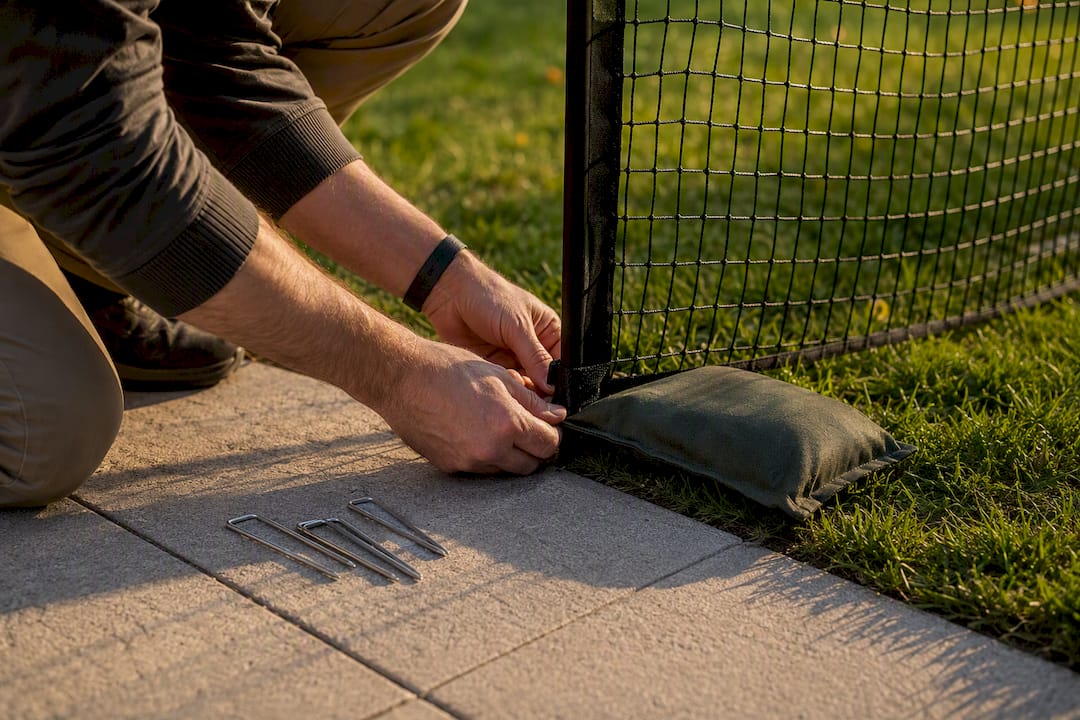
For diggers, add a buried wire skirt extending outward from the base of the fence, or lay chicken wire flat along the ground just inside the perimeter. Dogs generally won’t dig through a surface that resists their paws immediately, so the skirt does most of the work without needing to be deep. For jumpers, the fix is simpler: go taller. If your dog clears a 40-inch panel with room to spare, don’t compromise on height to save money.
Here’s a quick pre-departure checklist for any temporary setup:
- Every stake or weighted base is seated firmly with no wobble.
- Panel overlaps and connectors are locked, not just resting against each other.
- Gates latch fully and don’t swing open under a nose-push.
- Ground contact is continuous, with no visible gaps a paw or snout could fit through.
- Wireless or GPS boundary signal has been walked and confirmed at every edge point.
Training matters as much as the hardware. Containment success is roughly half barrier and half training, which means even a well-built fence can fail if your dog has never been taught to respect a boundary. Start with short, supervised sessions at the edge of the containment area, rewarding your dog for staying inside it. Most dogs need daily practice over one to two weeks before you can trust the boundary unsupervised, and electronic or GPS boundaries typically follow a similar or slightly longer timeline since the dog has to learn an invisible line instead of a visible one.
Pro Tip: Do a “storm test” the first night any temporary fence is up. Walk the perimeter after dark with a flashlight, checking for anything that shifted during the day, before you trust it overnight.
Once the boundary is live, don’t set it and forget it. Inspect physical fences daily for gaps, loose stakes, and storm damage, and never leave a dog unsupervised for long stretches behind a lightweight temporary barrier, no matter how well it held up the day before.
What Should You Know About Wireless and GPS Dog Boundaries?
Wireless and GPS systems solve a problem physical fences can’t: shape and portability. A standard wireless transmitter broadcasts a circular boundary from one base unit, so your containment area is locked into that shape no matter how your yard is laid out. GPS collars break that constraint by letting you draw a boundary that follows your property line, a campsite, or an irregular clearing instead of forcing a circle onto it.
That flexibility comes with a training requirement that’s easy to underestimate. Wireless and GPS fences work best layered on top of force-free training, not as a substitute for it. A sensible approach starts with tone and vibration alerts only, giving your dog roughly two weeks to build a reliable association between the warning signal and the boundary edge before you consider stronger correction settings, and only if the dog genuinely needs it.
These systems earn their keep in specific situations:
- Renters who can’t install permanent fencing without violating a lease.
- Frequent travelers who need containment that packs into a bag.
- Owners with irregularly shaped or heavily wooded yards where standard panels don’t fit well.
Physical fencing still wins when the priority is absolute physical separation, such as keeping a dog away from a pool, a road, or another animal. No wireless boundary replaces a solid barrier in those cases. For everyone else, a documented 14-day boundary training plan and a straightforward app-based setup process make the difference between a boundary that works and one that gets ignored.
Why Cheap Fixes Usually Cost More Than Doing It Right the First Time
Most advice on temporary containment treats hardware and training as separate purchases. They aren’t. A cheap mesh panel and a well-trained dog will often outperform an expensive system paired with zero boundary work, and that’s the piece most quick-fix guides skip entirely.
The bigger mistake we see is buying for the trip you’re on instead of the dog you actually have. A jumper doesn’t become a non-jumper because you’re only camping for one weekend. If your dog clears 40 inches at home, it clears 40 inches at the campsite too.
Where a GPS collar earns its place isn’t as a replacement for good fencing. It’s for the situations physical fencing genuinely can’t solve well: rentals, travel, and yards too irregular for standard panels. Buy for your dog’s real behavior first, then pick the containment style that fits your situation.
— Haven
A Wire-Free Option Worth Considering: HAVEN Freedom
If your yard doesn’t fit standard panels, or you’re renting and can’t stake anything into the ground, the HAVEN Freedom Wireless GPS Dog Fence and Tracking Collar skips the hardware problem entirely. There’s nothing to bury, stake, or store between trips.
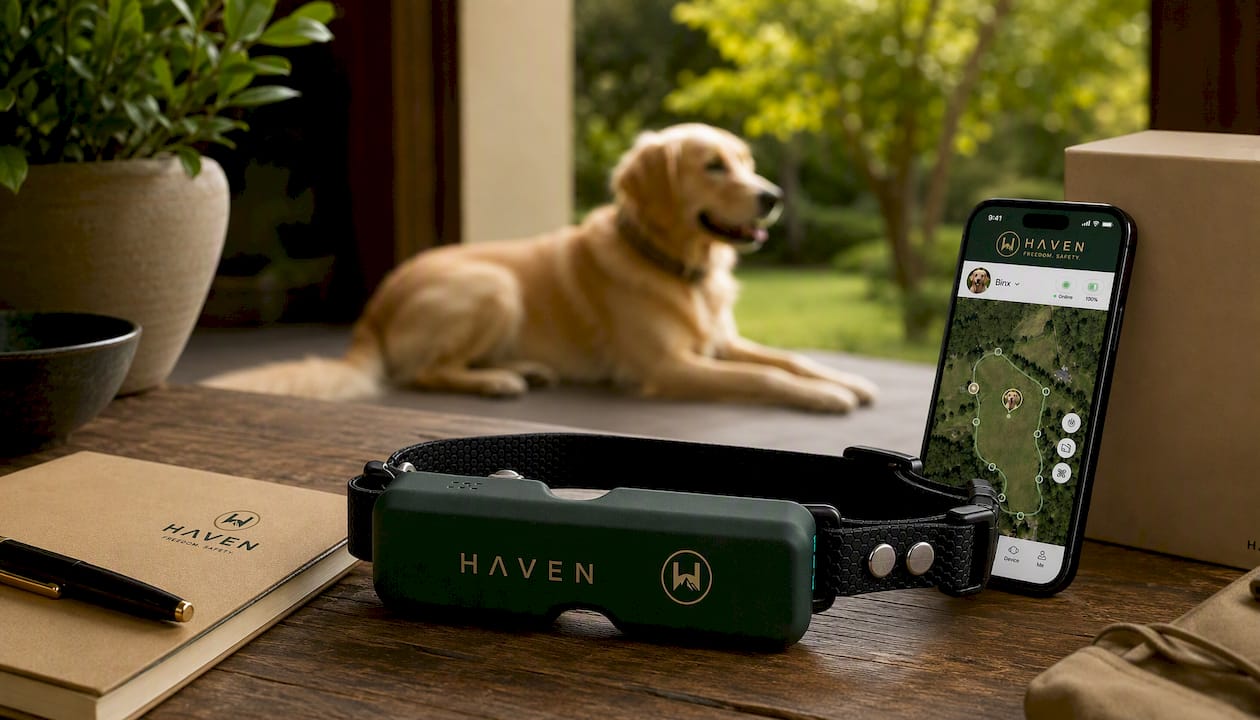
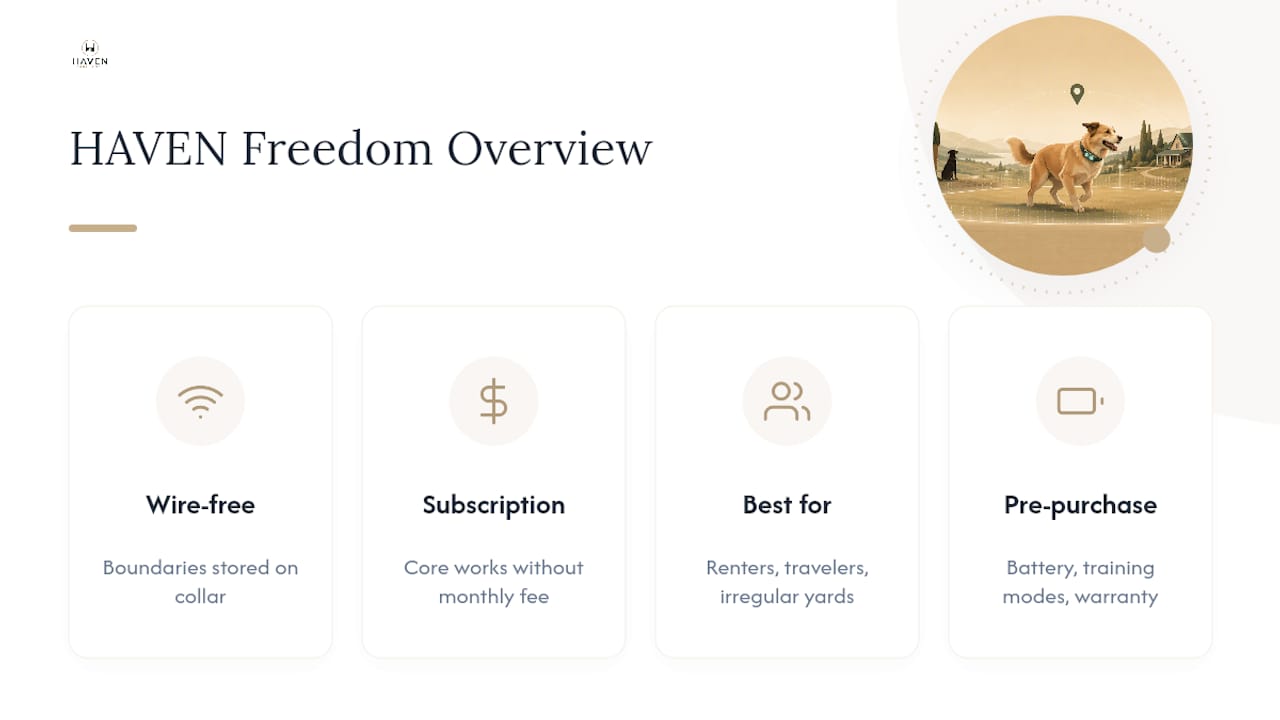
The collar stores customizable boundaries directly on the device, no buried wire required, and the core fence functionality works without a monthly subscription. A plan is only needed if you want live tracking, escape alerts, and additional dog finder features that help locate your dog fast if it does get loose. That combination makes it a fit for renters who can’t install fencing, travelers who need containment that fits in a bag, and anyone with a yard too irregular for standard panels.
Before buying any GPS collar, check battery life against how you’ll actually use it, confirm the training mode options match what your dog needs, and look at what support and warranty coverage the brand offers if you hit a setup question. You can compare current options and pricing on the HAVEN Freedom product page.
Sources
Fence height and training guidance in this article draw on the Whole Dog Journal’s temporary fencing guide, Forbes Vetted’s wireless dog fence coverage, and Double Dog Run’s guide to tie-out and containment options. For hands-on setup steps, see Haven’s full guide library, including its GPS fence setup walkthrough.
- Temporary Fences for Dogs - Whole Dog Journal
- Best Wireless Dog Fences 2026 - Forbes Vetted
- Pet Containment Options – Double Dog Run
FAQ
What Can I Use as a Temporary Fence for My Dog?
Portable exercise pens, no-dig metal panels, plastic or wire mesh, and wireless or GPS collars are all viable temporary dog boundary options, with the right choice depending on your dog’s size, jump height, and how long you need containment.
What Is a Good Temporary Barrier for Dogs?
For most dogs, a heavy-duty no-dig panel system or an exercise pen offers the best balance of security and portability, while jump-prone dogs need barriers at least four feet tall.
What Are Some Good Temporary Gates for Dogs Outside?
Look for ex-pen or panel systems with a dedicated locking gate panel rather than a simple overlap, since gate failures are one of the most common causes of escapes in linked panel setups.
What Is the Cheapest Way to Make a Temporary Fence?
Plastic safety mesh and tie-out stakes are among the most affordable options, best suited for calm, small dogs and recommended only for short-term supervised use.
Does a GPS Collar Work as Well as a Physical Fence?
A GPS collar like HAVEN Freedom works well for containment in yards, campsites, and rentals where physical fencing isn’t practical, but it requires a training period and isn’t a substitute for physical separation near hazards like pools or roads.
Recommended
Keep reading
e collar humane
Humane E Collar Training: 7 Steps, Starting With a Vet Check
See how humane e collar training starts with a vet check, conditions tone and vibration, uses rewards, and reserves static stimulation as a last...
Read the postcoyote safety for dogs
Protect Your Dog from Coyotes in 14 Days with a GPS Boundary
Keep your dog safe from coyotes with immediate steps, yard fixes, hazing, and a 14 day GPS boundary plan you can start today.
Read the postYour adventure starts here
Ready to give your dog more room to roam?
Give your dog more freedom to explore — and give yourself the reassurance of knowing they're never far away.
