

Off-leash freedom is earned. GPS collars and virtual fences are containment and recovery layers, not substitutes for training, and treating them as a shortcut is how dogs get lost or hurt. Before any dog goes leash-free, it needs a reliable recall under distraction, an emergency stop, a solid “leave it,” and a defined radius it will hold. Most dogs pick up boundary basics in a few weeks of short daily sessions, but proofing against real distractions takes months, not days.
TL;DR:
- Proper training for off-leash freedom requires weeks of short, daily sessions focused on recall, emergency stop, and boundary holding skills.
- The first stage involves indoor name recognition, visual boundary flag-walking, and long-line proofing at increasing distances before supervised off-leash practice.
- Collars should be used only after a dog reliably responds to cues, and a clear readiness rubric must be passed before unsupervised off-leash time.
- GPS accuracy is less critical than a dog’s understanding of tone cues, and physical buffers are essential to account for signal drift and environmental interference.
- Hardware is only 20% of success; training solidifies boundary and recall responsiveness, making GPS collars a backup rather than a substitute for groundwork.
Table of Contents
- What Is Off-Leash GPS Training, Exactly?
- How Do You Train a Dog for Off-Leash GPS Work?
- Getting the Gear and Handling Right
- What Are the Real Limits of GPS Collars and Virtual Fences?
- Haven’s 14-Day Training Framework and What the Collar Actually Does
- The Part Most Guides Get Backwards
- Consider HAVEN Freedom for Training and Backup Together
- Sources
- FAQ
What Is Off-Leash GPS Training, Exactly?
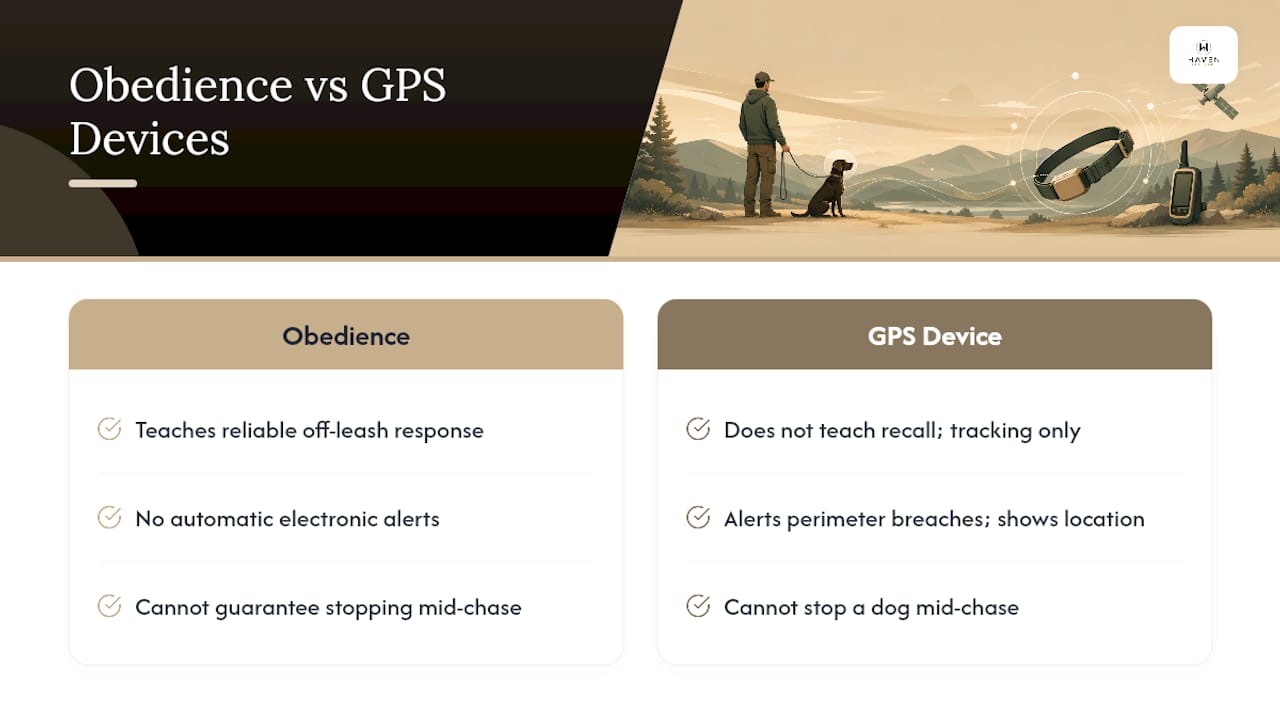
Off-leash GPS training combines two separate systems that owners often confuse: obedience training that teaches a dog to respond reliably without a leash, and a GPS-enabled boundary or tracking device that alerts you if the dog crosses a line or wanders off. GPS dog training only works when the training half comes first. A tracking collar for dogs can warn you the moment a dog leaves a set perimeter and help you find that dog fast, but it cannot teach a recall, and it will not stop a dog mid-chase.
That distinction matters because most containment failures trace back to skipped groundwork, not device malfunction. A structured protocol changes that. Manufacturer plans and independent trainers generally converge on a similar arc: short sessions for the first one to two weeks focused on name recognition and boundary awareness, followed by supervised off-leash trials once the dog passes a readiness check. A well-known example is the 14-day GPS fence training protocol that many collar brands publish, which uses Day 14 as a supervised off-leash milestone rather than a finish line for full independence.
How Do You Train a Dog for Off-Leash GPS Work?
The training itself unfolds in stages, and skipping ahead is the single most common mistake owners make.
1. Foundations (days 1 to 3). Start indoors with name response and short-distance recall. Reward instantly when your dog turns toward you, even for a half-hearted glance. This phase has nothing to do with the collar yet. It builds the attention habit everything else depends on.
2. Flag-walking the boundary (days 3 to 7). Once you set a GPS boundary or install a wireless fence line, place visual flags along the perimeter so your dog can see it before feeling any correction. Walk the line together on a regular leash, and reward heavily every time the dog turns back on its own. This step matters more than people expect. A dog that understands the visual and audio warning cue before it ever feels a vibration learns the boundary faster and with far less stress.
3. Long-line progression (weeks 2 to 3). Move to a 15-foot long line clipped to a well-fitted harness, never a flat collar, and practice recall with mild distractions nearby. Once your dog responds consistently at 15 feet, stretch to 30 to 50 feet in a low-distraction area for proofing. The line should drag loosely rather than pull taut. According to a staged plan for off-leash reliability, this progression from short line to long line to a dragging line inside a securely fenced yard is the bridge that gets a dog ready for true off-leash work, and skipping it is the single biggest reason dogs don’t come back when called.
4. Escalation and readiness testing (weeks 3 to 4). Introduce the collar’s tone or vibration cue only after your dog reliably turns back from a visual flag. Escalate one level at a time, tone first, then vibration, and only add static correction if the dog shows no observable reaction at the lower setting. Many dogs never need to go past tone or vibration at all.
Before removing the leash for supervised off-leash sessions, run your dog through a short readiness rubric:
- Recalls within 2 to 3 seconds when called from 30 feet, even with mild distraction present
- Stops walking or running on an emergency “wait” or “stop” cue
- Releases an item or backs off a smell on “leave it” or “drop it” within 5 seconds
- Holds a defined radius without testing the boundary repeatedly during a 10 minute walk
If your dog fails any one of these, don’t move to full off-leash time. Spend another week on that specific skill instead of pushing the whole program forward at once. Trainers who use this scoring approach consistently note that isolating the weak link, rather than repeating the full sequence, gets dogs to reliable off-leash behavior faster.
Daily sessions should run 10 to 15 minutes, once or twice a day, with distractions added gradually: a familiar person walking by, then a stationary dog at distance, then movement and noise together. Rushing distraction exposure is the fastest way to undo weeks of progress.
Pro Tip: If your dog blows through the tone warning two sessions in a row, don’t jump straight to a stronger correction. Go back to flag-walking for two or three sessions first. Most “collar failures” are actually a dog that never fully learned the visual cue.
Getting the Gear and Handling Right
Gear choices decide whether training sessions build trust or cause a setback.
- Clip every long line to a Y-front harness, never to a flat collar. A hard stop at the end of a line can injure a dog’s trachea if the line is attached to the neck.
- Choose a biothane long line over nylon or cotton webbing. It resists water, doesn’t fray, and slides through grass without tangling the way rope lines do.
- Hold the line in loose coils, not wrapped around your hand or wrist. A sudden lunge can cause serious rope burn or a dislocated finger if the line is wrapped tight.
- Wear gardening or work gloves during long-line sessions, especially with a strong puller.
- Set flags with an inward safety buffer, keeping the working boundary 15 to 25 feet inside any hazard like a road, pond, or property line.
- Keep the usable training area at least 30 by 30 feet so GPS positioning has room to breathe without the dog constantly bumping the edge.
Roughly 20% of a successful GPS fence setup is the hardware itself; the other 80% is the training that teaches the dog what the hardware means. That ratio is worth remembering every time a session feels slow.
Have a battery and signal failure plan before you ever go off-leash. If a collar loses charge or drops GPS signal mid-session, revert immediately to a leash or step back inside a physical fence line. Never treat a low-battery warning as something to finish the walk before addressing. If your device sends an escape alert, respond immediately rather than waiting to see if the dog returns on its own. Supervision is not optional during any off-leash phase; a dog that has passed every readiness test still needs eyes on it, and any sign of regression, whether that’s ignoring a recall or testing the boundary repeatedly, means going back to the long-line phase rather than pushing forward.
What Are the Real Limits of GPS Collars and Virtual Fences?
GPS accuracy drifts. Dense tree cover, buildings, hills, and even heavy cloud cover can shift a collar’s reported position by several yards, which is exactly why the inward safety buffer matters more than any spec sheet claim about precision. A boundary drawn right at the edge of a driveway or pond, with no buffer, is a boundary that will eventually fail on a day with bad signal conditions.
It also helps to separate two things owners often blend together: containment and tracking. A virtual fence boundary is a training feature, while live tracking and escape alerts are typically tied to an optional subscription plan. Subscribing to live tracking gives you a map and a location history. It does not make the containment boundary itself any more reliable, and it will not stop a dog from crossing the line in the first place.
The most common mistakes that undo otherwise solid setups:
- Skipping the proofing phase and assuming a dog that behaves in the backyard will behave at the park
- Accidentally teaching the tone cue as a “treat is coming” signal by rewarding at the exact moment the tone sounds, rather than after the dog turns back
- Ignoring low-battery or weak-signal warnings because the walk “felt fine” the last few times
- Assuming one successful off-leash session means the dog is done training
For dogs with a strong prey drive, a history of bolting, or a breed profile like sighthounds built for speed and independent hunting, a long-term long-line setup or permanent supervised management plan may simply be the safer long-term answer rather than full off-leash freedom. A physical fence remains the most predictable containment option for dogs that never fully settle into boundary training, and larger properties often do best with a hybrid approach that pairs a physical fence with GPS tracking for backup.
Haven’s 14-Day Training Framework and What the Collar Actually Does
A wireless boundary protocol can be built around the same staged logic covered above, stretched across two weeks: days 1 to 4 focus on flag-walking and tone recognition, days 5 to 9 add supervised leash-free time inside the flagged perimeter, and days 10 to 14 introduce mild distractions before any unsupervised trust is extended. Confident, food-motivated dogs often move through it faster; nervous or reactive dogs should slow down and repeat phases rather than push the calendar.
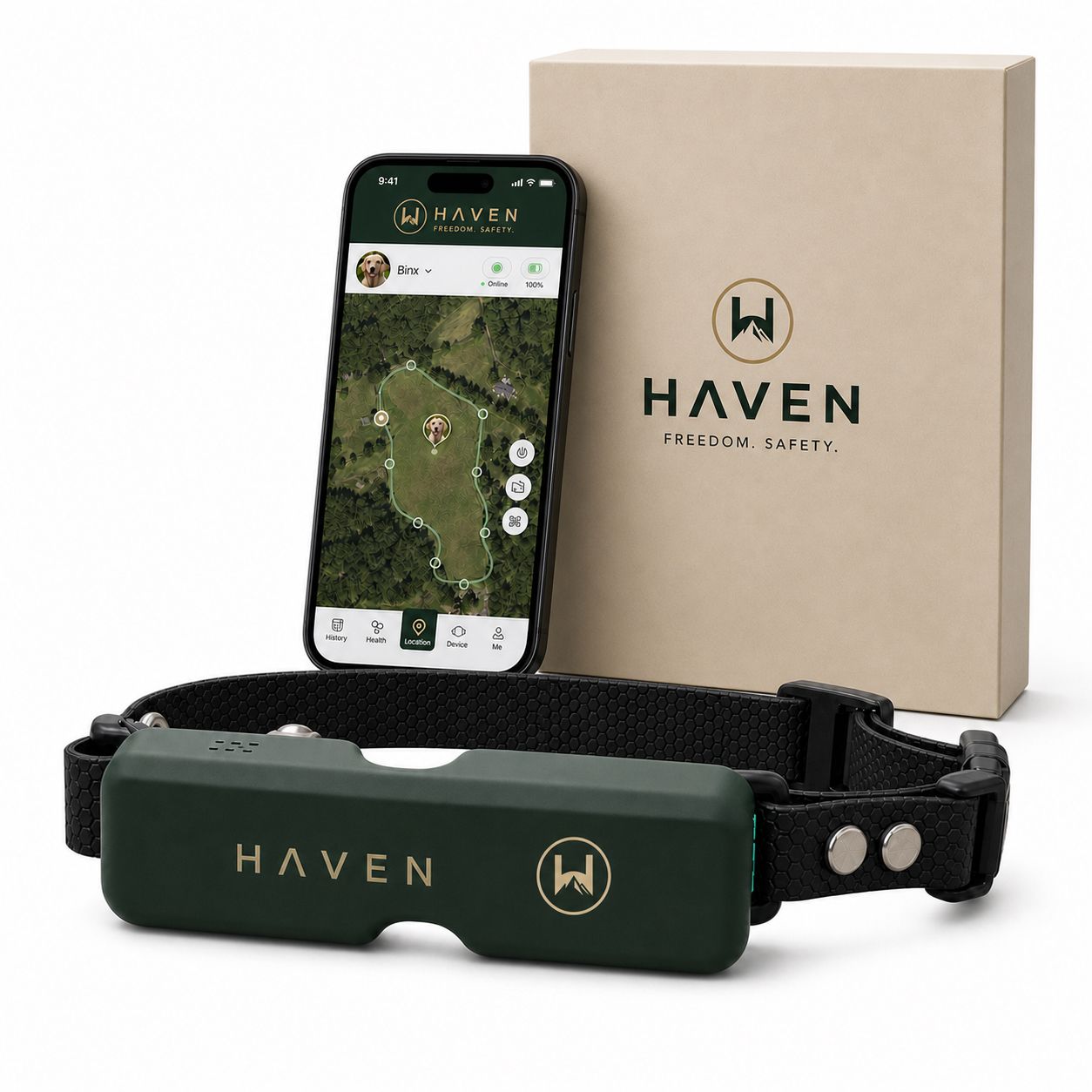
The HAVEN Freedom collar itself uses a dual-band positioning system to draw a boundary without buried wires, and its training mode lets you set tone, vibration, and optional static feedback independently, matching the tone-first escalation rule covered earlier. Relevant capabilities to check against a collar setup may include:
- Wireless boundary that stores locally on the collar and can work without a monthly plan
- Adjustable training modes for tone, vibration, and optional static correction
- Sound, light, and Bluetooth radar dog finder for recovery if a dog does get loose
- Optional live-tracking plan for real-time location and escape alerts
Setup checklists and a downloadable version of the 14-day plan are available through Havenfreedom’s wireless fence boundary training guide.
The Part Most Guides Get Backwards
Most articles on this topic sell the technology first and mention training as an afterthought, a paragraph near the bottom about “don’t forget to train your dog too.” That order is exactly wrong. The GPS layer is insurance against a training gap, not a replacement for closing it.
The overrated idea is accuracy. Owners obsess over GPS precision down to the foot, when the real variable that determines whether a dog stays safe is whether it responds to a tone cue before it ever tests the edge of the yard. A collar accurate to three feet is worthless if the dog has never been taught what the tone means.
What actually predicts success is boring: short daily sessions, a readiness rubric you’re honest about, and a willingness to repeat a phase instead of rushing it. If your dog fails one of the four readiness checks, that single skill deserves a full week of focused work before you touch the leash again. Do that, and the technology becomes exactly what it should be: a backup, not a crutch.
— Haven
Consider HAVEN Freedom for Training and Backup Together
If a dog has passed the readiness checks above and a boundary is being set up for the long term, some wireless boundaries use a training-first approach. Such boundaries may require no buried wires, set up portably in a new yard or campsite, and work without a required monthly plan. Live-tracking and escape-alert features can be available as optional add-ons for owners who want mapping and instant alerts layered on top.
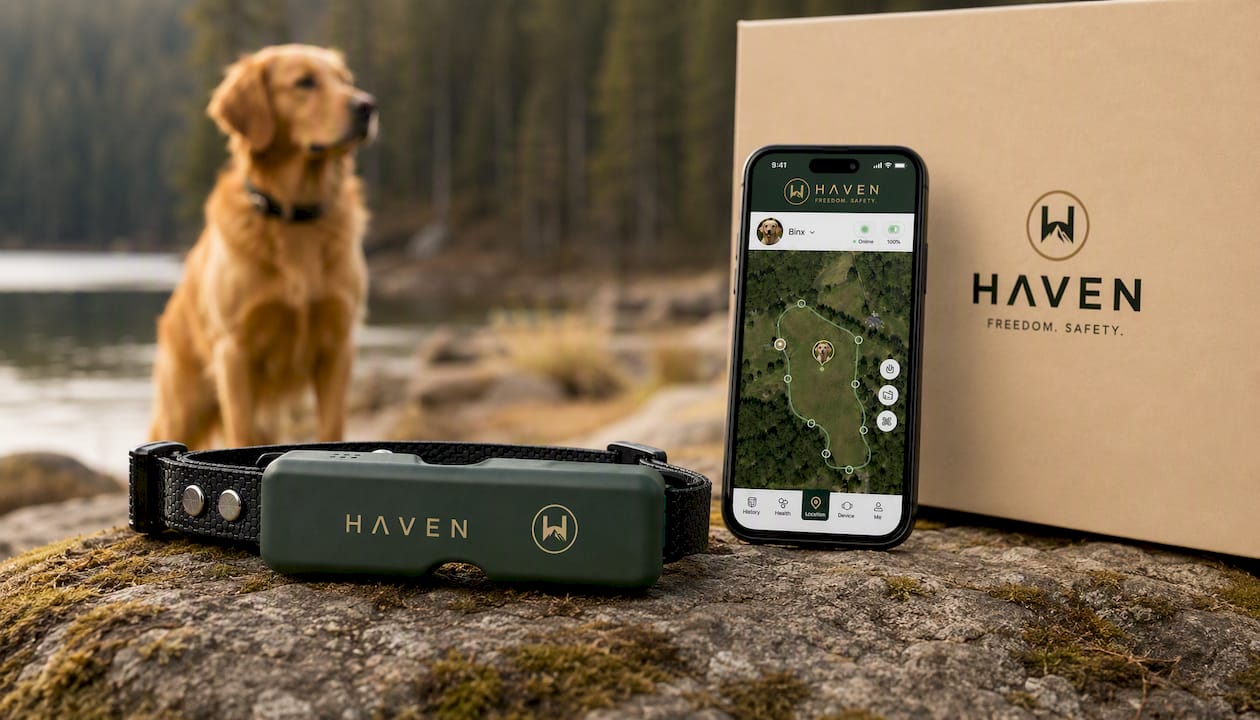
Before buying, confirm three things: harness fit for long-line work, whether your yard layout gives enough setback from roads or water, and whether you want the optional live-tracking plan or just the standalone boundary. The HAVEN Freedom Wireless GPS Dog Fence and Tracking Collar is priced at $349 as a one-time purchase, with no subscription required for the fence itself. Browse the full collection of models and accessories to see which setup fits your dog and your yard, then start the 14-day plan this week.
Sources
The 14-day GPS fence training protocol lays out a day-by-day manufacturer timeline. The boundary setup guide covers flagging, drift, and setback math in detail. The staged off-leash training plan breaks down long-line progression and readiness testing step by step. Always follow the specific protocol that ships with your own collar model first.
- The First 14 Days of GPS Fence Training — Halo Collar blog
- How to Set Up a GPS Dog Fence (Boundary Training That Actually Contains Your Dog) | PetPalHQ
- Off-Leash Dog Training: A Staged Plan That Works — WebVet
FAQ
How Do You Train a Dog for a GPS Fence?
Start with flag-walking the boundary on a regular leash so the dog sees and hears the warning cue before feeling anything, then progress through a 15-foot long line, distraction proofing, and a readiness check before any supervised off-leash time. Most dogs need two to four weeks of short daily sessions to reach that supervised off-leash milestone.
Is It Illegal to Remove a Tracking Collar From a Hunting Dog?
Laws on tracking collars and hunting dogs vary significantly by state and by whether the dog belongs to someone else, so this isn’t a question with one universal answer. Check your state’s fish and wildlife or agriculture department for the specific rule that applies to your situation rather than relying on general guidance.
How Do I Train My Dog to Listen Off Leash?
Reliable off-leash listening comes from four core skills: a fast recall under distraction, an emergency stop, a solid “leave it,” and the ability to hold a set radius without repeatedly testing it. Build these through progressively longer long-line sessions before removing the leash, and don’t skip the proofing phase against real-world distractions.
What Is the Best GPS Training Collar for Dogs?
The right collar depends on whether you need a wire-free boundary, live tracking, or both, since features and subscription trade-offs vary by brand. The HAVEN Freedom Wireless GPS Dog Fence and Tracking Collar offers a wireless boundary with no required monthly plan, adjustable training modes, and an optional live-tracking add-on for $349.
Can GPS Collars Replace Recall Training?
No. A GPS collar shows you where a dog went and can warn it near a boundary, but it cannot teach a dog to come back when called. Recall and boundary response have to be trained separately through staged, distraction-proofed sessions before the collar becomes a reliable backup layer.
Recommended
Keep reading
e collar humane
Humane E Collar Training: 7 Steps, Starting With a Vet Check
See how humane e collar training starts with a vet check, conditions tone and vibration, uses rewards, and reserves static stimulation as a last...
Read the postcoyote safety for dogs
Protect Your Dog from Coyotes in 14 Days with a GPS Boundary
Keep your dog safe from coyotes with immediate steps, yard fixes, hazing, and a 14 day GPS boundary plan you can start today.
Read the postYour adventure starts here
Ready to give your dog more room to roam?
Give your dog more freedom to explore — and give yourself the reassurance of knowing they're never far away.
