

GPS-based collars are the wireless technology to prioritize on hilly yards, since traditional RF wireless fences rely on a straight-line signal that hills block or distort. If your yard has serious elevation changes, deep valleys, or dense canopy, in-ground wired fencing is still the most bulletproof containment option. For everything short of that, a GPS collar like the HAVEN Freedom Wireless GPS Dog Fence and Tracking Collar gives you customizable boundaries without buried wire. Check the setup and testing sections below before letting your dog roam unsupervised.
TL;DR:
- GPS collars like Havenfreedom’s use dual-frequency technology to improve accuracy under canopy and across elevation changes, making them suitable for moderate slopes and wooded areas.
- On steep or heavily wooded terrain, in-ground wired fencing remains the most reliable option because it follows the land’s actual contours without signal distortion.
- Properly mapping and testing boundaries on uneven land may reveal dead zones, requiring remapping or switching to wired fencing if more than two persist.
- Installation costs for GPS collars are lower on hilly land due to no trenching, but wired fencing entails higher labor and material expenses, especially on severe slopes.
- For properties with extreme elevation changes or a history of dog escapes, in-ground wired systems provide the highest security, while GPS collars serve well in less severe terrain with proper setup.
Table of Contents
- Why Do Hills Break Traditional Wireless Fences?
- RF Wireless vs. GPS vs. In-Ground Wired on Slopes
- Checklist: Is Your Hilly Yard Ready for a Wireless Fence?
- How to Set Up and Test a Wireless Fence on a Hill
- Training and Safety Rules for Sloped Yards
- Why Havenfreedom Is Our Top Pick for Hilly Properties
- How Wireless Fences Actually Perform on Different Hill Grades
- What Does a Hilly Yard Fence Actually Cost?
- When Should You Choose Wired Over GPS?
- Ready to Try a GPS Collar Built for Sloped Yards?
- Sources
- FAQ
Why Do Hills Break Traditional Wireless Fences?
A standard RF wireless fence works by broadcasting a radio signal outward from a single transmitter, forming a circle around your yard. That works fine on a flat lawn. Put the same transmitter on a hillside, and the signal behaves like light hitting a hill: it gets blocked on one side and bounces unpredictably on the other.
The result is a boundary that isn’t really a boundary. It’s patchy.
- Signal shadow: a slope or berm blocks the RF signal entirely on the downhill side, so your dog can walk straight through without any correction at all.
- Overshoot and bounce: the signal reflects off terrain, buildings, or even wet ground, triggering a correction when your dog isn’t actually near the line.
- Corner loss: irregular lots with hills at the edges often lose coverage exactly where you need it most, near property corners.
Any one of these failure modes undermines the entire premise of containment. A boundary a dog can slip through unnoticed isn’t a safety tool. It’s a false sense of security, and that gap is precisely why hands-on reviews of wireless pet fences consistently rate GPS-based systems higher than RF units once terrain gets involved.
RF Wireless vs. GPS vs. In-Ground Wired on Slopes
Picking the right technology for a hilly dog fence sloped yard comes down to matching the system’s strengths to your terrain.
RF wireless is the easiest to install and the cheapest option on the shelf. It’s genuinely fine for a flat, small, open yard with no obstructions. On hills, though, it’s the weakest performer of the three, because the single-point circular signal simply can’t account for elevation changes.
GPS-based collars map your actual boundary using satellite positioning instead of a broadcast circle, so they follow the real shape of your land rather than an idealized circle. That makes them far better suited to slopes, but they still need a clear enough satellite view and strong positioning hardware to hold accuracy. Dual-frequency GPS and dedicated forest-mode processing cut down the drift that used to plague GPS collars under tree cover or in valleys.
In-ground wired fencing remains the most reliable option for genuinely rough land, since the buried wire follows the actual contour of the ground instead of projecting a shape over it. The tradeoff is real: trenching, wire, and labor make it the most expensive and time-consuming to install.
- Flat or gently rolling yards can sometimes use RF wireless, but thorough testing is necessary before relying on it.
- Moderate slopes, mixed open and wooded terrain: GPS collar with dual-frequency and forest mode.
- Steep drops, ravines, or a dog with a serious escape history: in-ground wired, no substitute.
Checklist: Is Your Hilly Yard Ready for a Wireless Fence?
Before buying anything, walk your property and answer these honestly.
- Grade steepness. Is it a gentle rise or a genuine drop where you’d lose sight of your dog?
- Valleys and dips. Low spots often create dead zones for RF signals and can weaken satellite reception for GPS units.
- Tree canopy density. Heavy cover degrades GPS accuracy unless the collar has forest-mode compensation.
- Metal structures or lot shape. Sheds, fences, and irregular boundaries all complicate signal consistency.
- Your dog’s escape history. A dog that has never tested a boundary is a different risk profile than a known digger or jumper.
- Training level. Puppies and untrained adult dogs need more supervision regardless of the system.
Once you’ve assessed the property, look for these features on any GPS collar you’re considering: map-based custom boundary shapes, dual-frequency positioning, live app tracking, escape alerts, and a feedback hierarchy that starts with tone or vibration before static.
Pro Tip: If your walk-through reveals more than two dead zones after testing, that’s your signal to stop troubleshooting and switch to in-ground wired instead of buying a second GPS unit.
How to Set Up and Test a Wireless Fence on a Hill
Setup on uneven land takes more patience than a flat yard, but the process is straightforward if you follow it in order.
For RF systems, place the transmitter at the highest central point of the yard you can find, since elevation and centering both extend usable range and reduce shadow zones.
For GPS collars, the workflow looks like this:
- Walk the entire intended boundary line with the collar in mapping mode.
- Save the shape and preview it in the app before activating it live.
- Repeat the mapping pass in different conditions if your yard has significant canopy or elevation shifts, since satellite reception can vary.
Once the boundary is set, verify it before your dog ever tests it unsupervised.
- Walk the full perimeter yourself, collar in hand, in both wet and dry conditions.
- Log any spots where the app shows weak signal or inconsistent boundary detection.
- Mark dead zones on a mental (or literal) map and revisit them.
- Remap, reposition the transmitter, or switch technology classes if gaps persist after two or three attempts.
Guides on choosing a wireless pet fence back this same walk-the-boundary approach for a reason: you find the failure points before your dog does. If you want the mapping steps laid out in more detail, Havenfreedom’s GPS dog fence setup guide walks through the full process.
Training and Safety Rules for Sloped Yards
A wireless fence, GPS or otherwise, is a training aid. It is not a substitute for supervision, and treating it as set-and-forget is where most containment failures actually happen.
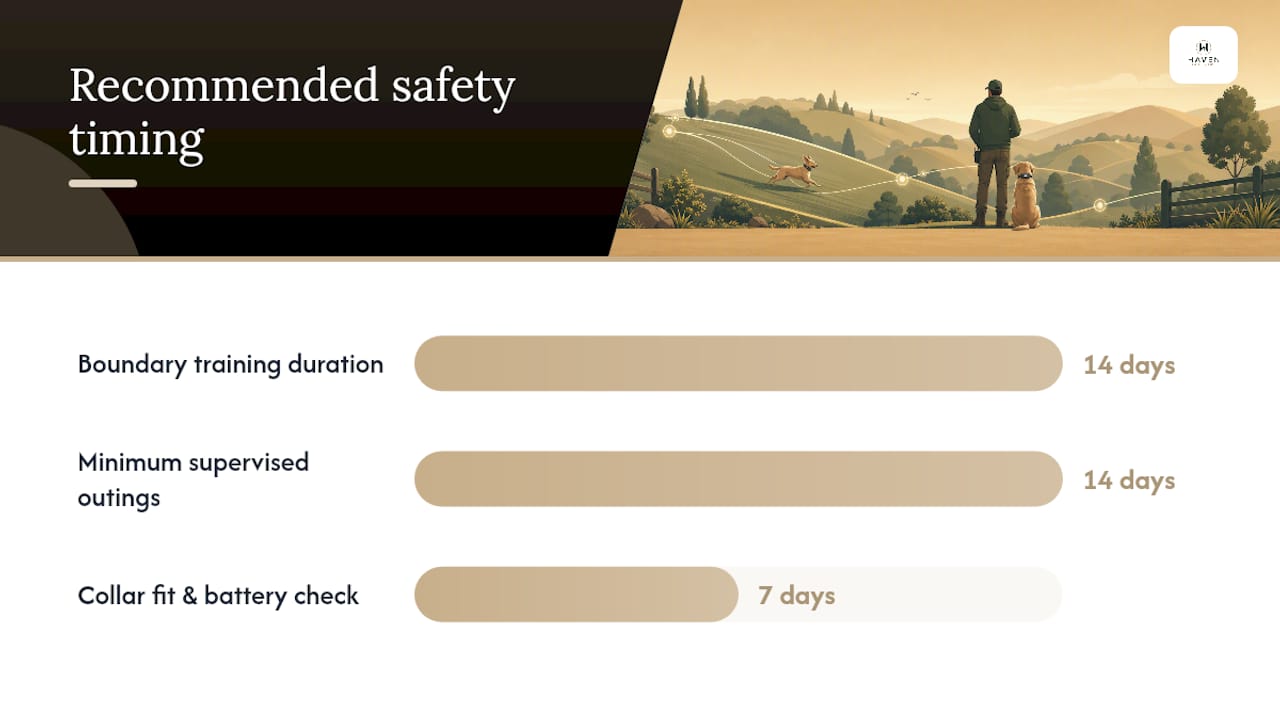
Start with a phased approach. Havenfreedom’s 14-day boundary training plan uses leashed walks along the boundary with tone and vibration cues before any static correction is introduced, building a dog’s understanding of where the line actually sits.
- Begin with tone or vibration only; only add static correction once your dog responds reliably.
- Supervise every outing for at least the first two weeks, especially near mapped dead zones.
- Check collar fit and battery weekly. A loose collar or a dying battery is a silent failure mode.
- Remap after major storms or seasonal canopy changes, since foliage density shifts GPS accuracy under trees.
The AKC’s guidance on evaluating GPS dog fences makes the same point: app-based verification and tracking exist because no wireless system holds a perfect boundary indefinitely. If your dog has a serious escape history or your land includes steep drop-offs a collar can’t reliably map, in-ground wired or physical fencing is the safer call.
Why Havenfreedom Is Our Top Pick for Hilly Properties
Among wireless options, the HAVEN Freedom Wireless GPS Dog Fence and Tracking Collar is built around the exact failure points that plague RF systems on hills.
- Dual-band positioning designed to hold accuracy better than single-frequency GPS under canopy and across elevation changes.
- Customizable boundary shapes that follow your actual property line, not an idealized circle.
- No buried wire required for the core fence features, so setup doesn’t involve trenching.
- Live tracking, escape alerts, and a sound, light, and Bluetooth radar dog finder for fast recovery if a boundary is crossed.
- Configurable feedback levels, from tone to vibration to optional static correction.
Havenfreedom backs the hardware with real guidance: the boundary training plan and the interference troubleshooting guide both exist because GPS drift and signal issues are real, not because they’re rare. Candidly, if your land has near-vertical drops or you need zero-fail containment for a dog with a serious bite or escape liability, in-ground wired fencing is still the more conservative choice. For the vast majority of hilly and uneven residential lots, though, Haven’s monitoring and mapping tools address the gaps that sink RF systems.
How Wireless Fences Actually Perform on Different Hill Grades
Terrain severity changes the story more than any single spec sheet. On a yard with a gentle, open slope, a properly mapped GPS collar tends to hold its boundary shape with minimal drift, since there’s a clear satellite view and no canopy interference to fight.
Owners with moderate hills and partial tree cover report a different pattern: boundary accuracy holds up fine in open sections but gets shakier near dense clusters of trees or right at the bottom of a valley, where satellite signal has to punch through more obstruction. That’s exactly the scenario dual-frequency and forest-mode processing were built to solve, and it’s why those features matter more than marketing copy about “GPS accuracy” in the abstract.
Steep terrain with dramatic elevation loss, the kind where you’d lose visual contact with your dog at the bottom of the yard, is where even good GPS collars start to strain. Reception can degrade at the low point of a ravine, and if your dog is prone to bolting, the margin for error narrows fast. This is the terrain profile where Forbes’ buyer guide is right to call wireless a last resort rather than a first choice, and where in-ground wired fencing earns its higher cost.
The pattern across gradients is consistent: the flatter and more open the land, the closer any wireless system gets to flawless. The steeper and more wooded it gets, the more the technology choice, and the mapping effort behind it, actually matters.
What Does a Hilly Yard Fence Actually Cost?
Cost and installation complexity scale almost directly with terrain difficulty, and that’s worth knowing before you commit to a system.
On flat yards, RF wireless is the cheapest and fastest option, often installed in an afternoon with a single transmitter and no digging. In-ground wired fencing on the same flat lot costs more upfront and takes a weekend or a paid installer, since you’re trenching wire around the full perimeter.
Hilly terrain flips that math. A GPS collar carries no trenching cost at all, since it maps boundaries through satellite positioning rather than physical wire. Your main investment is the collar itself and the time spent mapping and testing multiple passes across the terrain, which costs effort, not money.
In-ground wired fencing on hilly land is where installation complexity spikes hardest. The wire has to follow the actual contour of the slope, which means more trenching length, more careful routing around trees and rock, and often professional installation to avoid gaps in coverage. For a large or steep property, that labor cost can run well above what the same footprint of flat land would require.
Ongoing costs matter too. RF and GPS systems both run on batteries that need regular charging or replacement, and GPS units with live tracking and app features may carry an optional monthly plan for that connectivity, though the core fence function itself typically does not require one. Wired systems have no ongoing subscription but carry higher repair costs if a line breaks underground on rocky or root-heavy terrain.
For most hilly residential lots, a GPS collar delivers the best balance: lower installation complexity than wired, and far better terrain performance than RF.

When Should You Choose Wired Over GPS?
Mild, open slopes call for a GPS collar with dual-frequency positioning. Steep drops, deep valleys, or heavy canopy call for in-ground wired fencing instead. Verify every boundary yourself before trusting it, and lean on Havenfreedom’s mapping and training resources rather than a spec sheet’s promises.
— Haven
Ready to Try a GPS Collar Built for Sloped Yards?
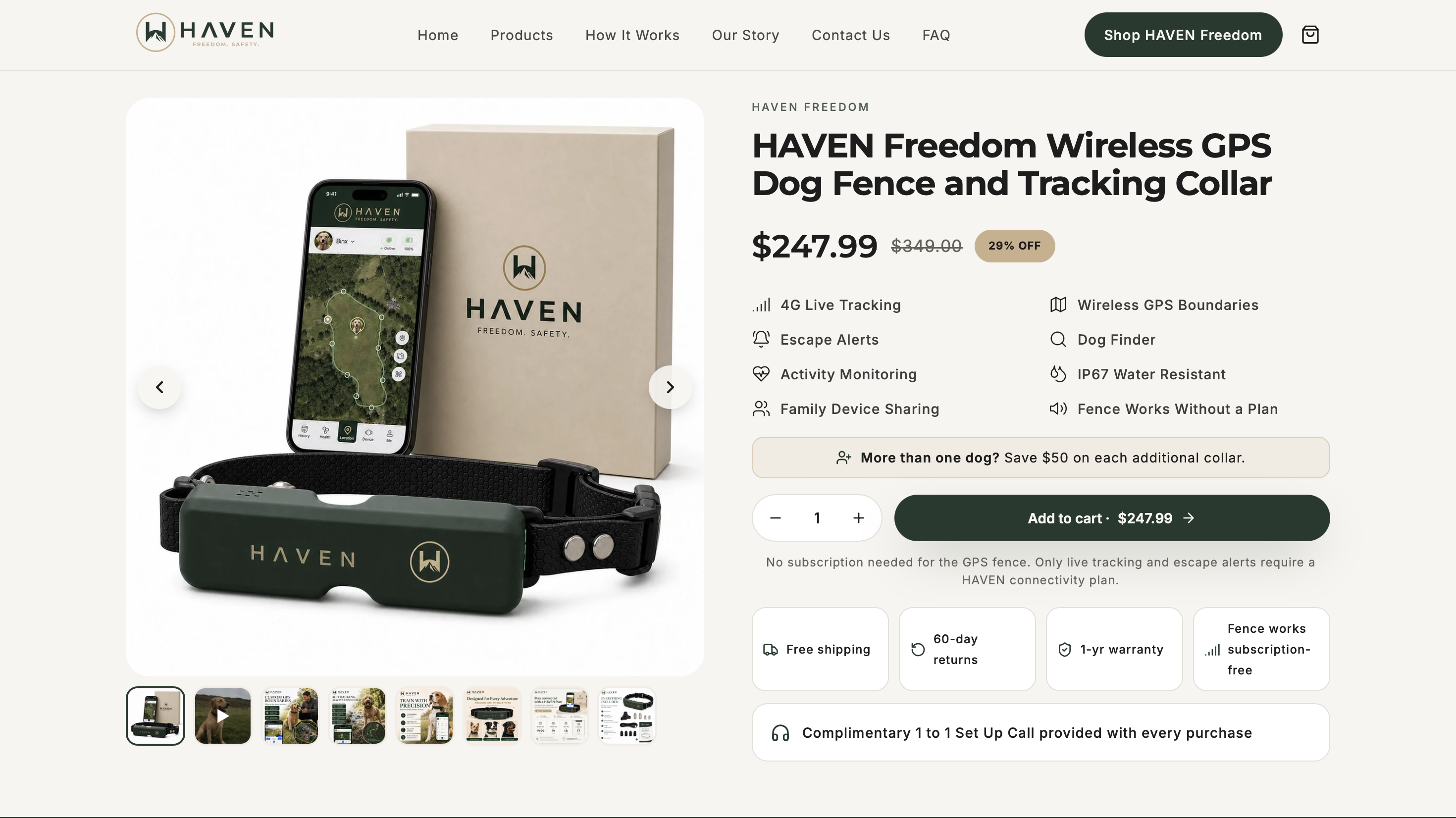
If RF wireless has already let you down on your hilly lot, you’re not choosing between options that all work the same way. Havenfreedom’s GPS collar maps your actual property, dual-frequency positioning and forest-mode processing hold accuracy under canopy where basic GPS units drift, and there’s no trenching required to get your boundary live. Start with the HAVEN Freedom Wireless GPS Dog Fence and Tracking Collar product page, then run the 14-day boundary training plan before letting your dog roam the yard unsupervised.
| Why Havenfreedom for hilly yards | What it means for you |
|---|---|
| Dual-band GPS positioning | Better accuracy under canopy and across elevation changes |
| No buried wire for core fence | Faster setup, no trenching labor |
| Custom boundary mapping | Boundary follows your actual land shape, not a circle |
| Live tracking and escape alerts | You know immediately if your dog crosses the line |
| 14-day training plan included | Structured, phased training instead of guesswork |
Sources
- AKC — How to evaluate a GPS dog fence
- The Smart Snout — Best Wireless Pet Fences of 2026: Hands-On Reviews & Buyer’s Guide
- Forbes — Best Wireless Dog Fences
- VCA Hospitals — The Pros and Cons of Invisible Fences for Dogs
- Tractor Supply — How to choose a wireless pet fence
FAQ
Can You Put a Fence on a Hill?
Yes. Physical fencing, in-ground wired systems, and GPS collars can all be installed on hilly land, but they handle elevation very differently. RF wireless struggles most because its signal can’t follow contours the way a wire or GPS-mapped boundary can.
What Breeds Struggle Most with Invisible Fences?
High-prey-drive and independent breeds, such as huskies, hounds, and some terriers, are more likely to push through a correction when motivated, according to VCA’s veterinary guidance on invisible fences. Any breed with a strong escape or chase instinct needs extra training and supervision regardless of the system.
What Is the Best Type of Fence for a Hill?
For genuinely steep or heavily wooded hills, in-ground wired fencing is the most reliable because the wire follows the land’s contour. For moderate slopes, a GPS collar like Havenfreedom’s, with dual-frequency positioning, is the strongest wireless option.
How Do You Fence a Hilly Yard?
Start by mapping the terrain’s steepness, valleys, and canopy density, then choose GPS for moderate slopes or wired for severe grades. Walk the full boundary in different weather conditions to confirm coverage before trusting the system unsupervised.
Do Wireless Fences Work Reliably Under Trees?
Standard GPS units can drift under heavy canopy, but dual-frequency GPS and forest-mode features are specifically built to reduce that drift and hold boundary accuracy in wooded terrain.
Recommended
Keep reading
e collar humane
Humane E Collar Training: 7 Steps, Starting With a Vet Check
See how humane e collar training starts with a vet check, conditions tone and vibration, uses rewards, and reserves static stimulation as a last...
Read the postcoyote safety for dogs
Protect Your Dog from Coyotes in 14 Days with a GPS Boundary
Keep your dog safe from coyotes with immediate steps, yard fixes, hazing, and a 14 day GPS boundary plan you can start today.
Read the postYour adventure starts here
Ready to give your dog more room to roam?
Give your dog more freedom to explore — and give yourself the reassurance of knowing they're never far away.
