

Do not leave your dog unattended at a campsite. Supervise them directly, crate them inside your tent or vehicle with proper ventilation, or keep them on a short leash within reach. Most campgrounds require dogs to be on a short leash and prohibit leaving pets alone, even briefly. GPS collars and wireless fences work as backup tracking tools, never as a substitute for physical control.
TL;DR:
- Most campgrounds require dogs to be on a short leash, typically six feet or less, to prevent wildlife disturbance and ensure safety.
- Leaving dogs unattended in vehicles can be lethal due to rapid temperature rises, and hot pavement can cause serious paw injuries even if the air feels mild.
- Electronic containment devices like GPS collars and wireless fences are supplemental tools and do not meet strict leash or control requirements on most public lands.
- Proper campsite containment includes supervision, crates, short leashes, or heavy-duty tie-outs, with daily checks of stakes to prevent escapes.
- Training dogs in recall, settle, and leash manners before camping helps manage their behavior amid distractions and reduces the risk of incidents.
Table of Contents
- What Are the Campground Rules for Dogs?
- What Are the Immediate Safety Risks at a Campsite?
- How Do You Physically Keep a Dog at Your Campsite?
- What Gear Do You Need for Campsite Control?
- How Do You Train a Dog for Camping Trips?
- Do GPS Collars or Wireless Fences Satisfy Campground Rules?
- Why a Hybrid Approach Beats Choosing Just One Tool
- Keep Your Dog Found, Not Just Contained
- Sources
- FAQ
What Are the Campground Rules for Dogs?
Most developed campgrounds run on the same basic leash standard: a short leash, typically around six feet or less. That number shows up across KOA’s pet policy and echoes through national park guidance, national forest rules, and state park handbooks. It’s not an arbitrary length. Six feet keeps a dog close enough to control near wildlife, other campers, and shared fire rings, without letting them drag a leash into the next site over.
Rules diverge more than most owners expect once you leave the paved campground loop. National parks tend to be the strictest: the National Park Service generally limits pets to roads, parking areas, picnic spots, and developed campgrounds, with most backcountry trails off-limits entirely. National forests, managed under USDA Forest Service guidance, tend to allow more trail access but still expect voice control or a leash depending on the district. State parks and private campgrounds fall somewhere in between, and policies can shift from one park unit to the next inside the same state.
These rules exist for three practical reasons:
- Wildlife protection. An off-leash dog chasing deer or investigating a den site creates real risk for both animals.
- Visitor safety. Not every camper wants a strange dog approaching their kids or their own pet.
- Noise control. Barking is one of the most common reasons campgrounds ask visitors to leave, according to the National Park Service.
Before you pack the car, call the specific campground or check its official website. A national forest district ranger station can tell you things a general FAQ page never will, like whether a particular loop allows off-leash time during shoulder season.
What Are the Immediate Safety Risks at a Campsite?
Heat kills faster than most campers realize. A car parked in direct sun can become hazardous quickly, which is why land managers strongly advise never leaving a dog in a vehicle, even with windows cracked. The USDA Forest Service warns that interior temperatures climb to lethal levels fast, and that window crack does almost nothing to slow it down.
Pavement and packed dirt can run 20 to 40 degrees Fahrenheit hotter than the air around them, according to the American Animal Hospital Association. A midday temperature that feels comfortable to you can still blister a dog’s paw pads on a sunbaked gravel road or fire pit apron.
Beyond heat, a campsite throws several hazards at a dog all at once:
- Ticks and other parasites hiding in tall grass and brush near tent pads.
- Wildlife encounters, from skunks to snakes to territorial deer during rutting season.
- Uneven terrain, exposed roots, and loose rock that can cause sprains during excited play.
- Campfire embers and hot grates left within reach of a curious nose.
Know the signs of heatstroke before you need them: heavy panting, bright red gums, stumbling, or vomiting. Colorado State University’s veterinary guidance recommends acting immediately if you see these symptoms. Cool the dog with water, move them to shade, and get to a veterinarian as soon as possible rather than waiting to see if it passes.
How Do You Physically Keep a Dog at Your Campsite?
Containment at a campsite comes down to five realistic options, and picking the right one depends on your dog’s temperament, the campground’s rules, and how long you’ll actually be away from the site.
- Stay with your dog. The simplest solution is also the most reliable: build your schedule around having someone at the site whenever the dog is out of a crate. Trade off hikes with a camping partner instead of both leaving at once.
- Use a crate inside your tent or vehicle. A well-ventilated crate, positioned in shade with airflow, gives a dog a secure spot during meals, campfire time, or a quick supply run. Never crate a dog inside a closed vehicle in warm weather, even briefly.
- Keep them on a short leash within arm’s reach. For calm dogs, a standard leash clipped to your belt or a picnic table leg (where permitted) works fine for short stretches.
- Use a long line under direct supervision only. A 15 to 30 foot line gives more room to roam but tangles easily around trees, fire rings, and other campers’ gear. Never use a long line as an unattended tether.
- Anchor with a heavy-duty tie-out stake, checked regularly. If the campground allows staking, use a corkscrew-style stake rated for your dog’s weight and inspect the swivel point for wear daily.
Pro Tip: Test any tie-out stake by putting your full body weight on the leash line before trusting it with your dog. A stake that pulls loose under 150 pounds of steady pressure won’t hold a 60-pound dog lunging at a squirrel.
Some situations call for leaving the dog home entirely. If your dog has a history of severe separation anxiety, resource guarding around strange dogs, or a bite history, a crowded weekend campground is not the place to work through it. Backcountry sites with no cell signal and long stretches of trail also raise the stakes if something goes wrong.
What Gear Do You Need for Campsite Control?
A short packing list prevents most on-site scrambling. Build it around three categories: restraint, comfort, and identification.
Restraint gear:
- A standard six-foot leash plus a well-fitted harness (better control than a collar alone during sudden pulls).
- A long line for supervised outdoor time.
- A rated tie-out stake or a portable exercise pen for larger dogs.
Comfort and shelter:
- A crate or a collapsible pop-up pen sized for your dog to stand and turn around.
- A shaded rest area, ideally a reflective tarp rather than direct tent fabric, which traps heat.
- A cooling mat and elevated food and water bowls to keep bugs and dirt out of meals.
Health and recovery:
- Up-to-date ID tags and a verified, registered microchip.
- Tick prevention treatment applied before the trip, not on arrival.
- An LED collar light for visibility after dark.
- Waste bags, always, even on remote sites where “nobody will notice” is never actually true.
The ASPCA’s camping guidance also recommends storing dog food securely at night, the same way you’d store your own food, since an open bag of kibble is exactly the kind of thing that draws a raccoon or bear into camp.
How Do You Train a Dog for Camping Trips?
A dog that’s rock solid in the backyard can fall apart at a busy campground. New smells, strange dogs passing by every few minutes, and a fire pit crackling nearby all add up to more stimulation than most home training accounts for. A CampWithPets analysis makes the point directly: even well-trained dogs shouldn’t be assumed calm in a brand-new environment.
Three skills matter more than any other before your first trip:
- Reliable recall around distraction. Practice calling your dog back while a friend rolls a ball, walks a dog, or plays music nearby. A campsite recall has to work over crackling fires and passing bikes, not just a quiet living room.
- A solid settle-on-cue. Teach your dog to lie down and stay on a mat or in a crate while you cook, chat, or pack up. This single skill prevents more campsite chaos than any leash ever will.
- Leash manners around strangers and dogs. Practice walking past other dogs at a normal distance without lunging, since campground paths put you closer to strangers than most neighborhood walks do.
Barking is worth tackling separately. Petful’s reporting on camping with dogs identifies it as the single most common reason campgrounds ask visitors to leave. Start desensitizing to outdoor noises, like footsteps and distant voices, a few weeks before your trip rather than hoping it resolves itself on-site.
If you’re planning to use boundary-based training as part of your setup, a structured approach helps. Havenfreedom’s 14-day boundary training plan walks through building reliable recognition of a set perimeter in stages, which pairs naturally with the settle and recall work above.
Pro Tip: Run your recall and settle drills in your actual campsite gear, harness, leash, and all, at least once before the trip. Dogs read context clues, and a dog that settles perfectly at home in regular clothes may act completely different once the gear signals “outdoor adventure.”
If your dog shows resource guarding, severe reactivity, or won’t settle after weeks of practice, a certified professional trainer is worth the cost before your next trip, not after a bad incident on-site.
Do GPS Collars or Wireless Fences Satisfy Campground Rules?
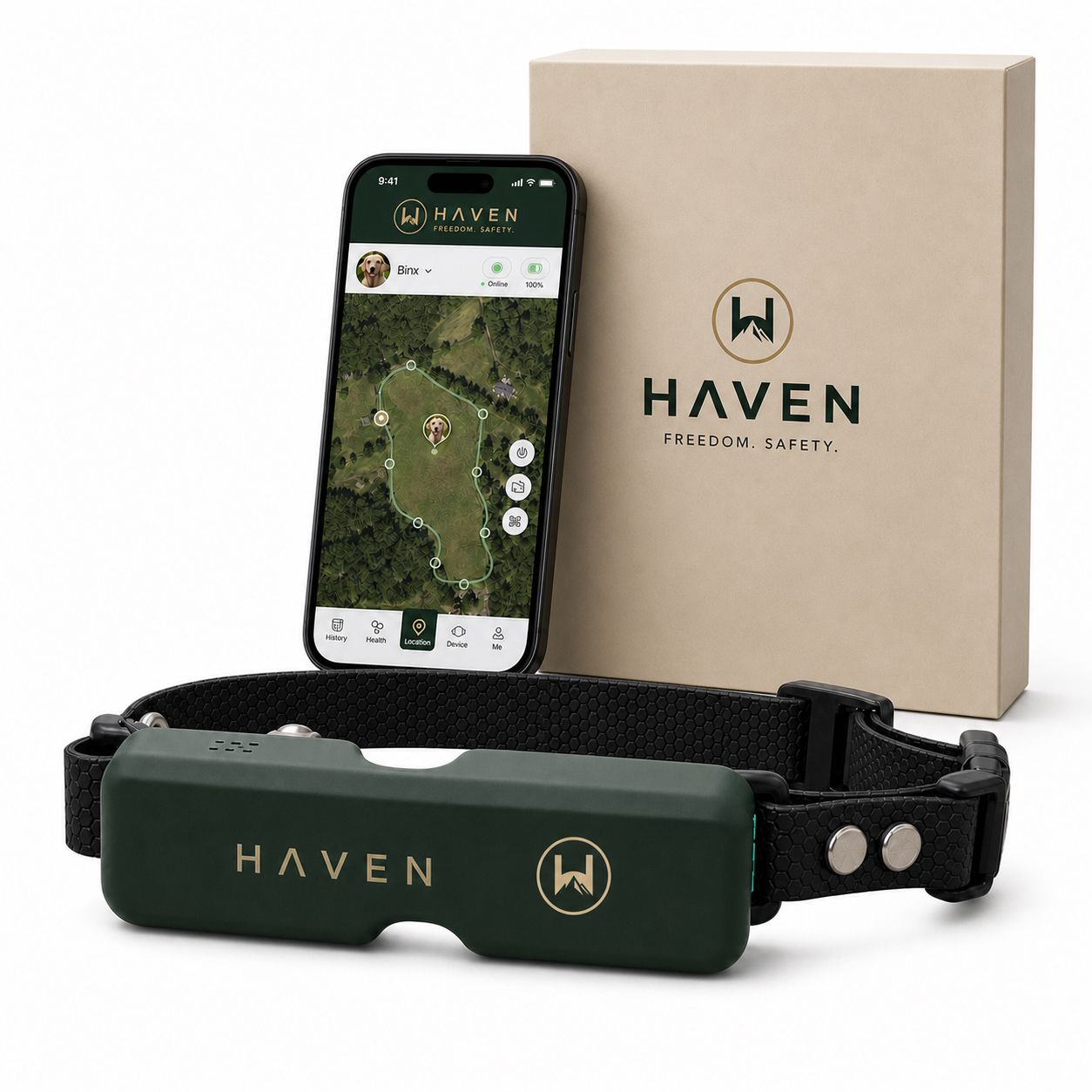
No. Most park and campground rules treat electronic containment as supplemental, not a substitute for a physical leash. Missouri State Parks explicitly states that electronic devices like wireless fences don’t meet leash or control requirements, and that pattern holds across most state and federal land managers.
That doesn’t make GPS collars useless at a campsite. It just means their real value shows up in a different role.
- Live tracking helps you locate a dog fast if a gate gets left open or a leash slips.
- Escape alerts notify you the moment a dog crosses a boundary you’ve set, even before you notice they’re gone.
- Dog-finder features, combining sound, light, and Bluetooth radar, cut down search time in wooded terrain where a bark can be hard to pinpoint.
The smartest workflow treats the leash or crate as your compliance tool and the GPS collar as your recovery tool. Before leaning on electronics at all, run through a quick check: confirm the campground’s actual policy, keep a physical leash within arm’s reach, and test signal strength and battery charge before letting your guard down. Havenfreedom’s guide on testing GPS containment for travel covers exactly this kind of pre-trip check.
| Tool | Meets leash rules? | Best use at a campsite |
|---|---|---|
| Standard short leash | Yes, in most parks and campgrounds | Primary compliance tool for walking and short stops |
| Crate or pop-up pen | Yes, when supervised or inside tent/vehicle | Meal times, campfire hours, brief errands |
| Tie-out stake | Case-by-case, check campground rules | Supervised rest periods at your own site |
| GPS collar or wireless fence | No, treated as supplemental only | Live tracking, escape alerts, and recovery backup |
Why a Hybrid Approach Beats Choosing Just One Tool
The mistake most new dog campers make is picking a single solution and expecting it to cover every hour of the trip. A leash alone doesn’t help if your dog slips a collar while you’re cooking dinner. A crate alone doesn’t help if you need your hands free at the trailhead. Havenfreedom’s position on this is straightforward: physical restraint handles compliance, and GPS technology handles recovery. Neither one replaces the other.
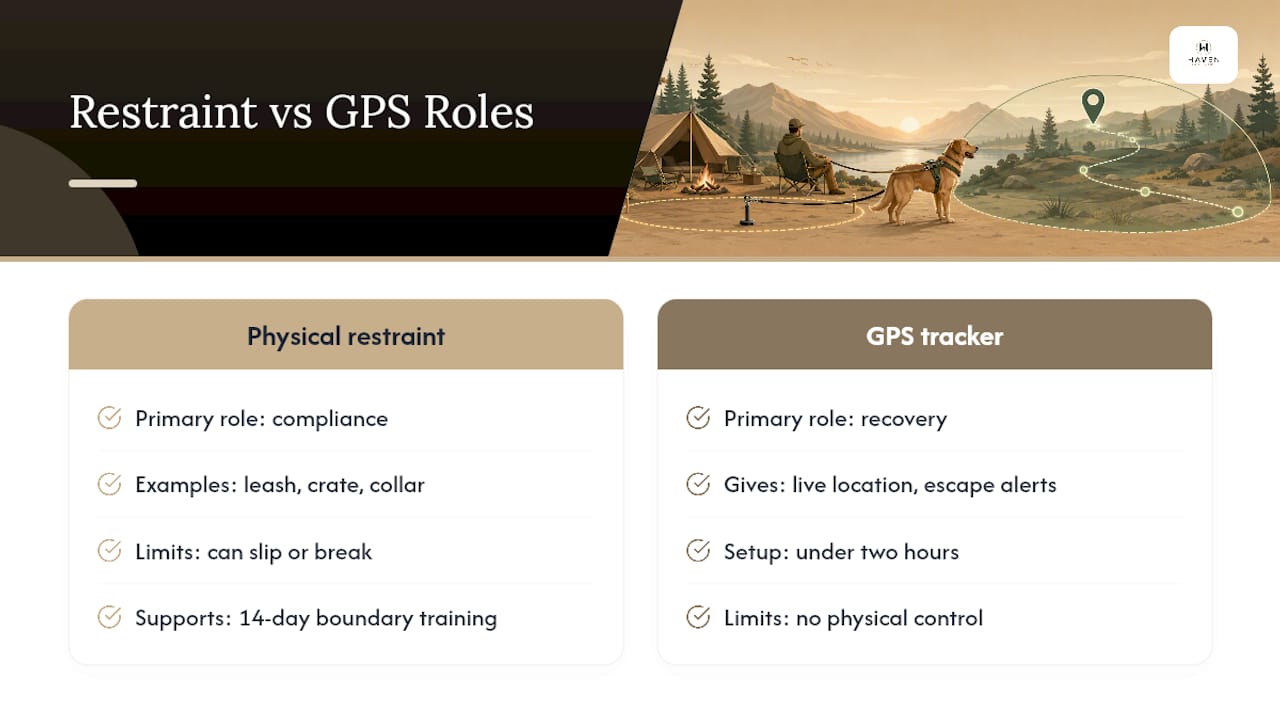
That layered approach matters most in the moments campers don’t plan for, a gate left open by a neighboring site, a startled bolt at a firework in the distance, a leash clip that fails at the worst time. A GPS setup you can get running in under two hours gives you a live location and an escape alert the instant something goes wrong, while a structured 14-day boundary training plan builds the underlying behavior that makes the whole system work smoothly at home before you ever pack the car.
None of this replaces judgment. No collar, crate, or leash substitutes for actually knowing your dog’s triggers and limits at a specific site. But owners who pair solid physical control with a tracking backup consistently report fewer scares and faster recoveries when something does go sideways, because they’re not relying on luck to notice a missing dog in time.
The goal isn’t more gadgets. It’s fewer unknowns.
Keep Your Dog Found, Not Just Contained
Leashes and crates handle the rules. The HAVEN Freedom Wireless GPS Dog Fence and Tracking Collar handles the part no leash can: knowing exactly where your dog is the second something goes wrong.
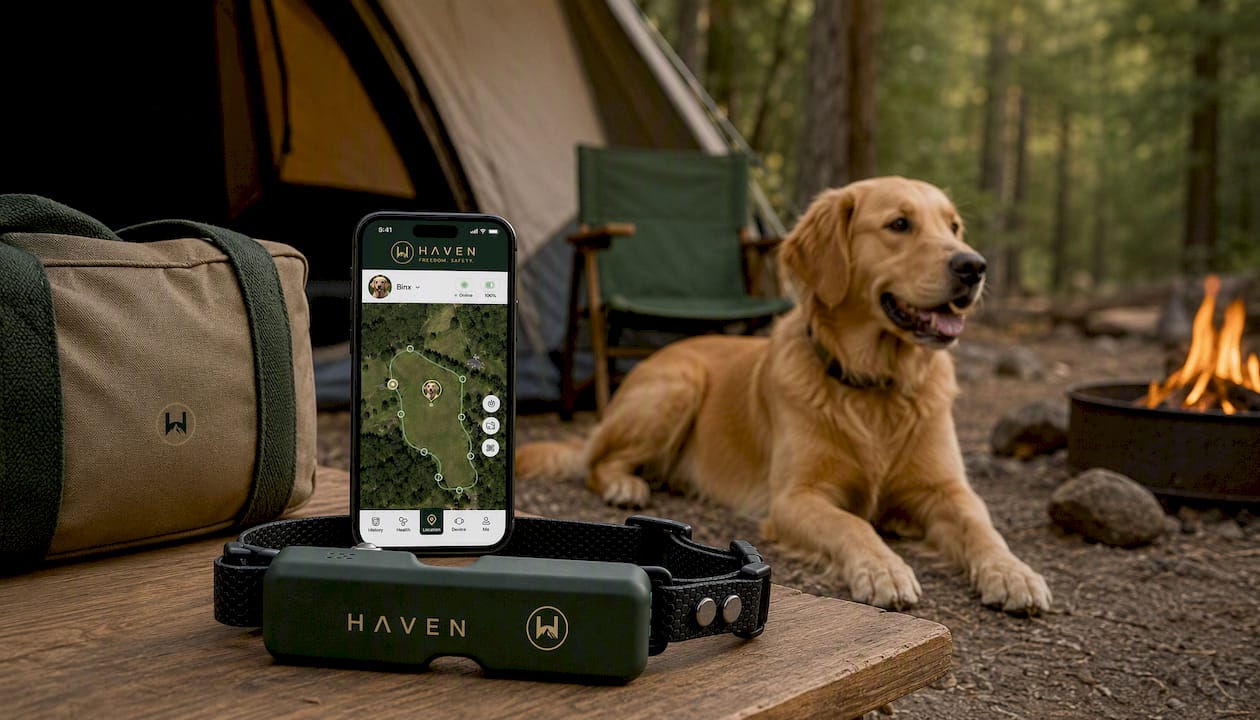
The collar uses dual-band positioning to build a custom wireless boundary around your site, no buried wire, no digging, and a setup you can finish in an afternoon. Once it’s active, you get live tracking, instant escape alerts if your dog crosses the line, and a built-in dog finder that combines sound, light, and Bluetooth radar to cut down search time if a leash ever slips at the worst moment. The fence itself runs with no required subscription; a plan only kicks in if you want the live tracking and app features running in the background.
It’s worth being honest about limits: many parks and campgrounds still require a physical leash regardless of what tech you’re running, so treat this collar as your recovery layer, not your compliance tool. For campers who want that extra layer of confidence anyway, the HAVEN Freedom GPS collar is ready to check out and set up before your next trip.
Sources
- KOA pet policy — Bringing your pets to a KOA campground
- Canine Campers: Bringing Dogs to the National Forest — USDA Forest Service
- Pets — Sequoia & Kings Canyon National Parks (NPS)
- Protect your dog from heat exhaustion and heat stroke — Colorado State University
FAQ
Can You Leave Your Dog Unattended at a Campsite?
No. Most campgrounds, including national parks and private chains, prohibit leaving dogs alone, and doing so risks both a citation and your dog’s safety around wildlife, heat, and other campers.
What Is the 3-3-3 Rule for Camping With Dogs?
There’s no single official 3-3-3 rule specific to camping with dogs; definitions vary online. The safer framework to follow is the documented six-foot leash standard and the never-leave-unattended rule that most parks and campgrounds actually enforce.
What Should You Do With a Dog at a Campsite All Day?
Rotate supervision with a camping partner, use a crate or pen during meals and downtime, and keep your dog on a short leash or long line whenever you’re both at the site together.
Do GPS Collars Count as Compliant Containment at Campgrounds?
No. Most state parks and land managers, including Missouri State Parks, treat electronic containment as supplemental only, not a substitute for a physical leash.
How Hot Does It Get Inside a Parked Car at a Campsite?
Interior temperatures can reach dangerous levels within minutes even on mild days, which is why land management agencies universally advise against leaving pets in vehicles at all.
Recommended
Keep reading
en
Road Trip Dog Containment: Keep Your Dog Safe in the Car and at Every Stop
How to contain a dog on a road trip: crash-tested restraints in the car, plus safe setups at rest stops, campsites and rentals, including...
Read the posten
Puppy E-Collar Age: When Is It Safe, and What to Use First
No vet-backed minimum age exists for shock collars on puppies. See what vets advise, what to do before 6 months, and how a GPS...
Read the postYour adventure starts here
Ready to give your dog more room to roam?
Give your dog more freedom to explore — and give yourself the reassurance of knowing they're never far away.
