

Yes, GPS fences work near buildings, but not with the same tight precision you’d get in an open field. The main caveat is GPS drift: signals bounce off glass, brick, and steel, which can shift a dog’s apparent position by several meters. The fix isn’t a perfect solution. It’s testing your specific location, building in buffer zones, and layering the boundary with training and supervision until you trust it.
TL;DR:
- GPS drift increases near tall buildings due to signal reflection and blockage, making boundaries less reliable without testing in urban settings.
- High-quality collars with dual-band GNSS and good antenna design significantly improve accuracy and filtering of reflected signals in city environments.
- Proper setup involves drawing buffers several feet inside property edges, testing regularly at different times, and logging false alerts to adjust boundaries effectively.
- Boundary training should focus on consistent warnings and gradual correction, paired with supervision and multiple test walks to confirm the fence’s reliability.
- The HAVEN Freedom Wireless GPS Dog Fence offers features suited for urban use, including configurable buffers, no subscription for fencing, and recovery tools like live tracking and escape alerts.
Table of Contents
- How GPS Fences Work in Urban Settings
- Why Buildings and City Streets Cause GPS Errors
- What to Look for When Choosing a System for City Use
- Setting Up a Reliable Boundary Near Buildings
- Training a Dog to Respect an Urban Boundary
- How to Verify Your Boundary Actually Holds
- Realistic Trade-Offs of Urban GPS Containment
- A Practical Option Built for This Checklist
- Sources
- FAQ
How GPS Fences Work in Urban Settings
A GPS fence lets you draw a virtual boundary on a map in an app, then relies on satellite positioning to track where the collar sits relative to that line. Cross the line, and the collar reacts, usually with a tone or vibration first.
In a city, the hardware matters more than the marketing copy suggests. Dual-band GNSS chips read signals on two frequencies instead of one, which helps filter out reflected signals bouncing off nearby structures. Antenna quality and how often the collar checks its position (the update rate) also affect how fast and accurately it catches a dog nearing a boundary.
It helps to separate two categories that get lumped together. A GPS fence collar is built for containment: it draws a line and reacts when a dog crosses it. A GPS tracker is built for recovery: it shows you where a dog is after it’s already loose. Technobark’s comparison points out that apartment dwellers often need the tracker function more than the fence function, since off-leash containment matters most in larger outdoor spaces, not hallways.
Why Buildings and City Streets Cause GPS Errors
Tall buildings create two separate problems, and they compound each other. The first is multipath interference: GPS signals hit a glass facade or metal siding and bounce before reaching the collar’s antenna, so the receiver calculates a position that’s off from the dog’s true location. The second is blockage. Courtyards, deep overhangs, and narrow gaps between buildings block direct line of sight to enough satellites that the fix quality drops, sometimes badly.
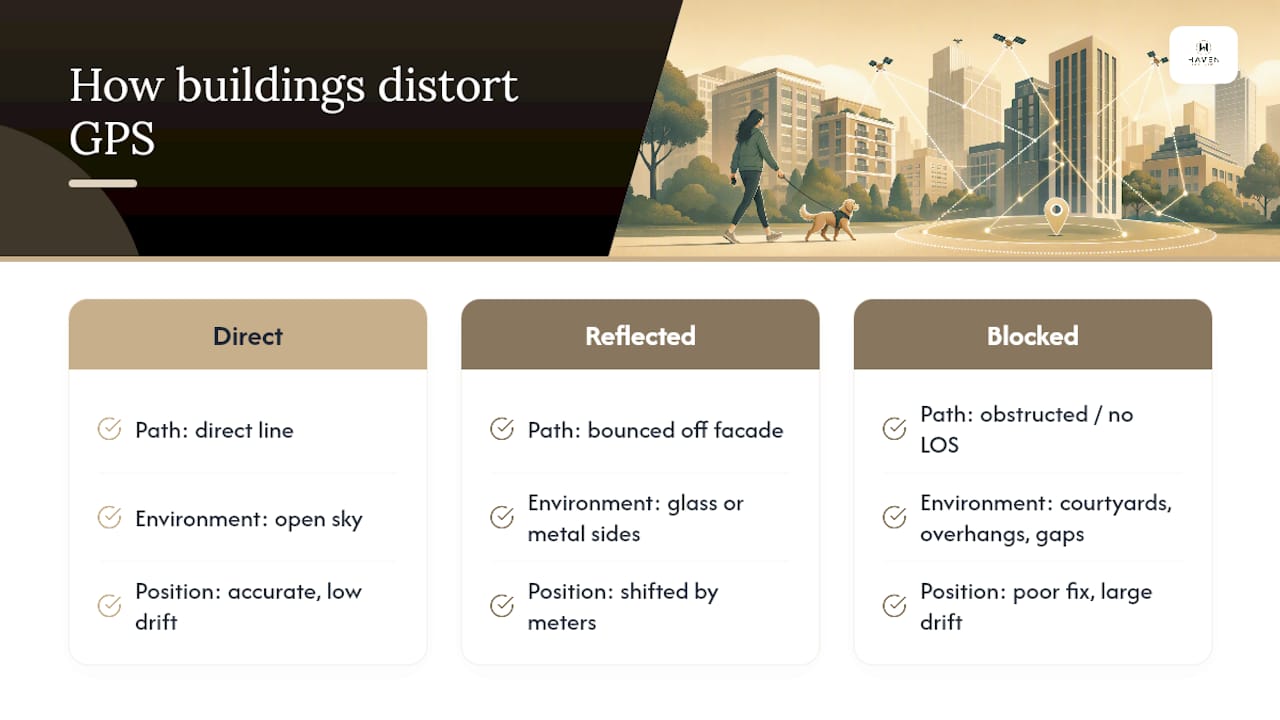
AKC’s guidance on evaluating GPS fences notes that drift is affected by tree canopy, terrain, and nearby buildings, and recommends verifying real-world accuracy under those specific conditions rather than trusting spec sheets alone.
Here’s why this matters practically: a boundary drawn with a small buffer might work fine in a backyard but fail constantly on a city block, because typical drift there can easily exceed that margin. The collar isn’t malfunctioning. It’s reporting a position that’s a few meters off, and if your buffer is thinner than the drift, you get false alerts or, worse, missed ones.
What to Look for When Choosing a System for City Use
Not every GPS fence handles urban interference the same way, so the buying decision comes down to a short list of concrete features rather than vague promises of “accuracy.”
- Independent, multi-environment testing. A device tested only in open fields tells you nothing about how it behaves between apartment blocks. Ask whether the manufacturer has tested performance near structures, not just in ideal conditions.
- Dual-band GNSS and antenna quality. These directly affect how well the collar filters out reflected signals in dense areas.
- Configurable boundary buffer. You need to widen the margin around your fence line without redrawing the whole shape from scratch.
- Warning versus correction settings. A system that lets you separate an audible warning from a static correction gives you room to catch drift-related false triggers before they become a training problem.
- Recovery features. Live tracking, escape alerts, and a sound/light/Bluetooth dog finder matter more in a city, where a loose dog is close to traffic within seconds.
- A clear cost structure. Know upfront whether the fence itself requires an ongoing plan, or whether that’s reserved for live tracking and app extras.
Setting Up a Reliable Boundary Near Buildings
- Draw the fence with a deliberate buffer. Keep the line several feet inside your actual property edge, especially near glass, metal siding, or anything reflective.
- Avoid narrow corridors. A boundary shaped like a thin strip between two buildings will trigger constantly. Widen it where you can, or split the yard into a simpler shape.
- Update firmware and confirm the fix before use. Place the collar and phone in the target area and check the app for a stable position reading, not just a green checkmark.
- Walk progressive test routes on a leash. Start near the center of the safe zone and move outward slowly, marking where alerts actually fire versus where you drew the line.
- Expand buffers where triggers happen early. If the collar warns 10 feet before your drawn line, that’s your real margin. Redraw accordingly.
- Retest at different times of day. Satellite geometry shifts throughout the day, which changes fix quality even in the same spot. A boundary that held steady at noon can drift more at dusk.
Pro Tip: Keep a simple log, even just notes in your phone, of exactly where and when a false trigger happened. Patterns show up fast, usually tied to one corner of the yard near a specific wall or overhang, and that’s the spot to fix first.
Setup guides like this walkthrough can help you move through this faster if it’s your first time mapping a boundary.
Training a Dog to Respect an Urban Boundary
Consistency, not intensity, is what makes boundary training stick. AKC’s guidance is blunt about this: dogs learn faster and stay safer when warnings behave the same way every single time, rather than when the system is simply “accurate” on a spec sheet.
- Start with audible warnings alone. Let the dog associate the tone with turning back before you introduce anything stronger.
- Only add correction after warnings have consistently failed to change behavior, and start at the lowest usable setting.
- Increase intensity gradually if needed. Jumping straight to a strong correction teaches fear, not location.
- Run short, supervised sessions and pair the tone with a verbal cue like “back” so the dog has two signals pointing the same direction.
This is slower than just turning a collar on and walking away, but it’s the difference between a dog that understands the boundary and one that just gets startled by it. A structured plan like this 14-day training approach gives the process actual pacing instead of guesswork.
How to Verify Your Boundary Actually Holds
Before leaving a dog unattended, run a repeatable walk test at more than one time of day, since satellite positioning quality shifts with the hours. Walk the perimeter slowly, note every spot where an alert fires, and average the offset from your drawn line. That average is your real buffer requirement, not the one you assumed when you first drew the fence.
Confirm that escape alerts and live tracking actually reach your phone during the test, not just the on-collar warning. If triggers stay inconsistent after several test rounds, especially clustering near one wall or corner, that spot needs a wider buffer or a physical barrier instead. A GPS fence that can’t produce a repeatable result in your specific space isn’t ready for unsupervised use yet.
Realistic Trade-Offs of Urban GPS Containment
GPS boundaries are flexible and portable in a way a physical fence never will be, but they’re not a clean substitute for a fence in a tight urban lot boxed in by buildings on three sides. The honest approach is layering: boundary training, live tracking, and supervised time until the system proves itself in your specific yard, not the manufacturer’s test field. Test before you trust it with unsupervised time.
— Haven
A Practical Option Built for This Checklist
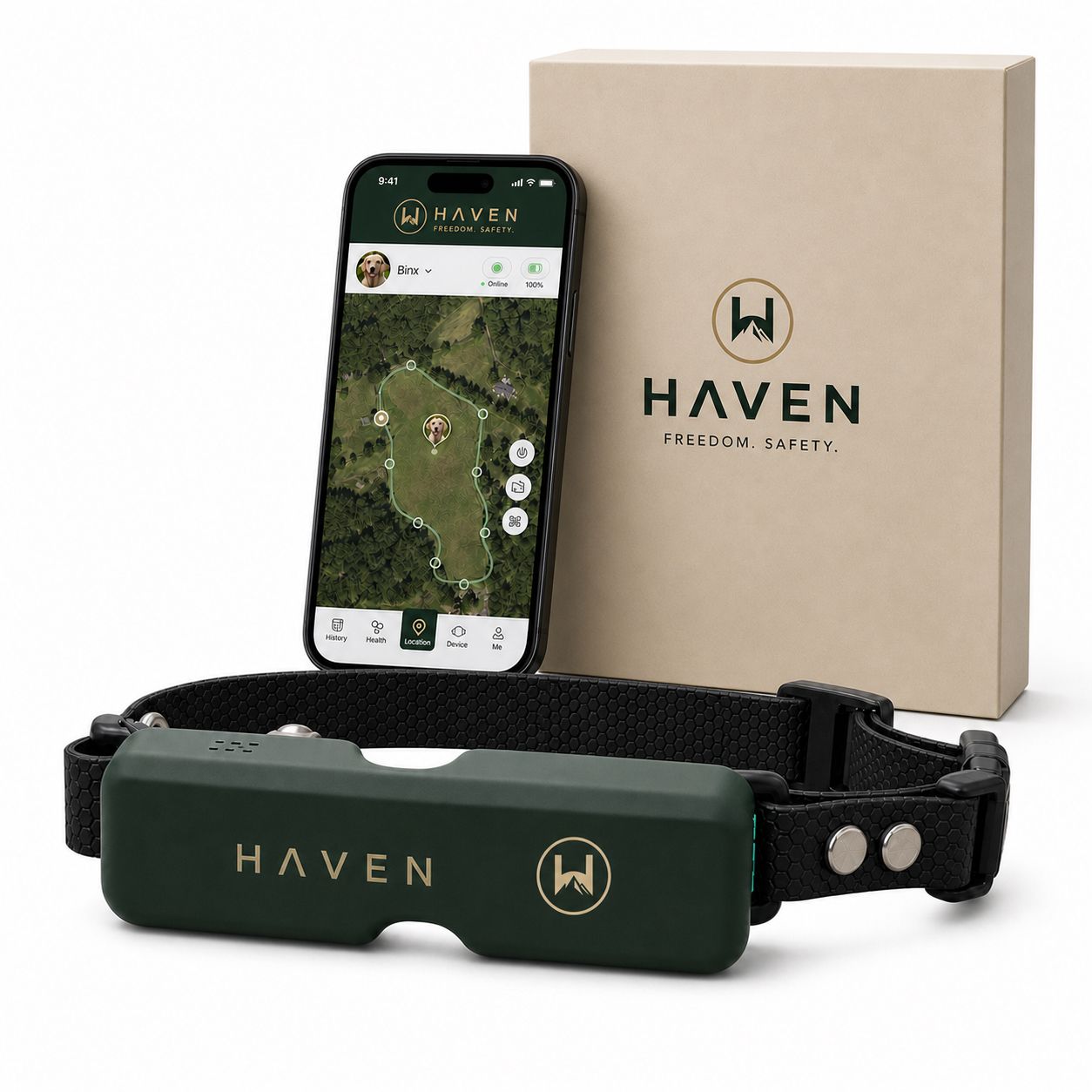
If you’re matching features against the checklist above, the HAVEN Freedom Wireless GPS Dog Fence and Tracking Collar lines up with most of it directly. It uses dual-band positioning for signal filtering, wireless boundaries with no buried wire, and a configurable buffer you can adjust as your walk tests reveal drift near specific walls or corners.
The fence itself works without a subscription. A plan is only needed if you want live tracking and escape alerts pushed to your phone in real time, which is important in urban areas where a loose dog may face hazards quickly. It also includes features to help locate a dog quickly if a boundary is crossed. The collar runs $349 one time, listed on the product page, and you can browse the full lineup on the Havenfreedom shop if you want to compare configurations before buying.
Sources
For deeper technical background, AKC’s guides on evaluating GPS fences and common questions owners ask cover drift, testing, and consistency in more detail. Technobark’s breakdown of fence collars versus trackers is useful if you’re still deciding which device type fits your living situation. Havenfreedom’s own guide on GPS fence accuracy walks through interference sources and setup troubleshooting in more depth.
- How to Evaluate a GPS Dog Fence: What Matters for Dog Safety (AKC)
- GPS Fence Collar vs. GPS Tracker: Which Is Better for Apartment Dogs? (Technobark)
FAQ
Does GPS Drift Get Worse Near Tall Buildings?
Yes, drift tends to increase near tall buildings because signals reflect off glass and metal before reaching the collar, a problem known as multipath interference. AKC’s evaluation guidance specifically flags nearby structures as a factor that affects real-world accuracy.
Should I Buy a GPS Fence or a GPS Tracker for an Apartment?
It depends on how you use the device. Technobark’s comparison suggests a tracker fits apartment life better for recovery purposes, while a fence collar earns its keep if you also use larger outdoor spaces off-leash.
Does the HAVEN Freedom Collar Require a Subscription?
No, the fence function on the HAVEN Freedom collar works without a subscription. An optional plan is only needed if you want live tracking and escape alerts, and the collar itself is a $349 one-time purchase on the product page.
How Wide Should My Boundary Buffer Be in a City?
There’s no universal number, since drift varies by building density and materials in your specific location. Run a walk test, log where alerts actually trigger, and set your buffer based on the average offset you observe rather than a fixed guess.
Can I Trust a GPS Fence Without Testing It First?
No, testing is the step that turns a GPS fence from a guess into a reliable tool. AKC recommends independent testing across multiple environments, including near structures, before relying on any boundary for unsupervised time.
Recommended
Keep reading
e collar humane
Humane E Collar Training: 7 Steps, Starting With a Vet Check
See how humane e collar training starts with a vet check, conditions tone and vibration, uses rewards, and reserves static stimulation as a last...
Read the postcoyote safety for dogs
Protect Your Dog from Coyotes in 14 Days with a GPS Boundary
Keep your dog safe from coyotes with immediate steps, yard fixes, hazing, and a 14 day GPS boundary plan you can start today.
Read the postYour adventure starts here
Ready to give your dog more room to roam?
Give your dog more freedom to explore — and give yourself the reassurance of knowing they're never far away.
