

For most large or irregularly shaped properties, a GPS fence beats buried wire the moment digging becomes impractical, and buried wire wins only when you need maximum precision under heavy tree cover. High-risk dogs, meaning bolters, chasers, or livestock guardians, still need a physical barrier at the property’s most dangerous edges. Whatever system you pick, treat training and backup ID as mandatory, not optional. This type of solution is built for exactly this acreage-first scenario.
TL;DR:
- GPS fences offer flexible, shapeable boundaries suitable for large or irregular properties, but accuracy decreases under dense canopy without premium systems.
- Buried wire provides consistent containment across large areas but involves labor-intensive installation and vulnerability if the line is cut.
- Combining physical barriers at high-risk points with GPS containment for the rest creates a practical hybrid solution, especially with proper training.
- Owners must thoroughly evaluate their property’s terrain, danger zones, dog temperament, cellular coverage, and subscription costs before choosing a containment system.
- Proper boundary training takes weeks, emphasizing consistent warnings and supervised practice to ensure dogs respect the perimeter, regardless of the fence type.
Table of Contents
- Which Large Property Dog Containment Options Actually Scale?
- How Do You Choose the Right Containment for Your Land?
- Setting Up and Training a Dog for a Large Boundary
- When a Hybrid Boundary Makes the Most Sense
- What Owners Get Wrong About Acreage Containment
- Try HAVEN Freedom on Your Own Property
- Sources
- FAQ
Which Large Property Dog Containment Options Actually Scale?
Five containment types dominate the acreage conversation, and each one behaves differently once your yard stops looking like a suburban lot and starts looking like a working piece of land.
GPS fencing draws a boundary using satellite positioning instead of a physical line. There is nothing to dig, nothing to bury, and the boundary shape can follow your property line exactly, curves and all. Premium systems now advertise coverage from a third of an acre up to 100,000 or more acres, with a dedicated forest mode for wooded terrain. That matters because GPS accuracy is not uniform. Signal drift under dense canopy is the single biggest complaint owners report, and it’s why some collars use larger antennas and multi-constellation GNSS receivers to hold accuracy closer to 2 to 5 feet even under trees, while budget units can drift by 20 feet or more.
Buried in-ground wire trades convenience for consistency. Once installed, it does not care about satellite visibility or tree cover, but running wire across 5, 10, or 40 acres means trenching, splicing, and burying it under every driveway and gate. Labor cost scales with acreage in a way GPS simply does not.
Wireless radio-circle systems broadcast from a single base station, which caps their range at a fixed radius, usually well under an acre in practice. That makes them a poor fit for genuine acreage unless you’re containing a dog to one specific zone near the house.
Physical fencing is the only option that also stops something else from getting in. It doesn’t fail from a dead battery or a lost signal, but material and labor costs climb fast across large frontages.
- GPS: any shape or size, weather to cellular coverage dependent, best forest mode systems needed under canopy
- Buried wire: any size but labor-intensive, immune to signal loss, vulnerable to a cut line
- Wireless circle: small fixed radius, simplest setup, wrong tool for open acreage
- Physical fence: cost scales with perimeter length, stops wildlife and intruders too, no battery to fail
None of these stop a coyote, a delivery truck, or a neighbor’s loose dog from entering your property, and collar weight matters too. A collar built for a 15 pound terrier is the wrong choice strapped to a 90 pound livestock guardian dog running fence lines all day.
How Do You Choose the Right Containment for Your Land?
Work through this before you buy anything:
- Look up, not just out. Walk your property and note where the sky is open versus where canopy is thick. Heavy tree cover pushes you toward buried wire or a premium GPS system with a forest mode.
- Map your danger edges. Roads, ravines, neighboring livestock, and busy driveways deserve a physical barrier or a tight GPS buffer zone, regardless of what covers the rest of the land.
- Rate your dog’s temperament honestly. A high prey drive, a history of bolting, or extreme sound sensitivity to correction tones all push you toward a physical fence, at least at the riskiest points.
- Check cellular coverage. GPS systems with live tracking depend on connectivity; a dead zone in the back forty changes your plan.
- Decide your tolerance for ongoing fees. Some collars require a paid membership just to activate containment, not merely tracking, and reviewers flag this as a genuine subscription trap worth reading the fine print on before you buy.
Ask any vendor directly what happens if the connection drops, whether containment works without a subscription, and what structured training program comes with the collar. A vague answer to any of those three is a red flag. So is a company that won’t discuss escape rates. Independent data compiled from a JAVMA survey found a a notably higher escape rate for electronic containment compared to physical fences, a gap wide enough that it should shape your expectations, not just your shopping list.
Pro Tip: Before committing to a full property boundary, test containment on your riskiest 2 acres for a week. If the dog respects the line there, it will likely hold everywhere else too.
Setting Up and Training a Dog for a Large Boundary
Containment hardware only works if the dog understands the boundary, and that takes weeks, not a weekend.
- Week 1: Walk the perimeter with your dog on leash daily, letting them hear the audio warning tone before any correction ever triggers. The American Kennel Club notes that predictable, consistent warnings matter more than correction strength for humane, effective learning.
- Week 2: Add short supervised off-leash sessions inside the boundary, watching how the dog reacts near the edges.
- Weeks 3 to 4: Extend unsupervised time gradually, starting with 10 to 15 minutes and building up only after several clean sessions.
For setup itself, keep a wider buffer zone near roads and vehicle gates than the rest of the line, and map any keep-out zones (pools, gardens, wells) separately. Fit the collar snug enough that the contact points sit against skin without pinching. Build in redundancy: ID tags, a registered microchip, a short visible fence section at the single weakest point, and a recurring check of collar battery and app firmware. Check the boundary map monthly for signal drift, especially after storms strip or grow foliage that changes canopy density.
When a Hybrid Boundary Makes the Most Sense
Livestock-guardian dog research backs up a specific pattern: fencing alone rarely works, but fencing paired with structured introduction and slow-release training does. A long-running agricultural fencing study found that leash walks along the perimeter and early, consistent correction were the deciding factors in whether guardian dogs stayed on their assigned pasture.
That’s the logic behind a hybrid setup: short physical barriers or a buried run at your highest-risk edges, GPS containment for everything else. It’s the most realistic answer for most acreage owners, not an either/or choice.
Owners running livestock-guardian training report the fence only worked once it was paired with daily perimeter walks over multiple weeks, not installed and left alone.
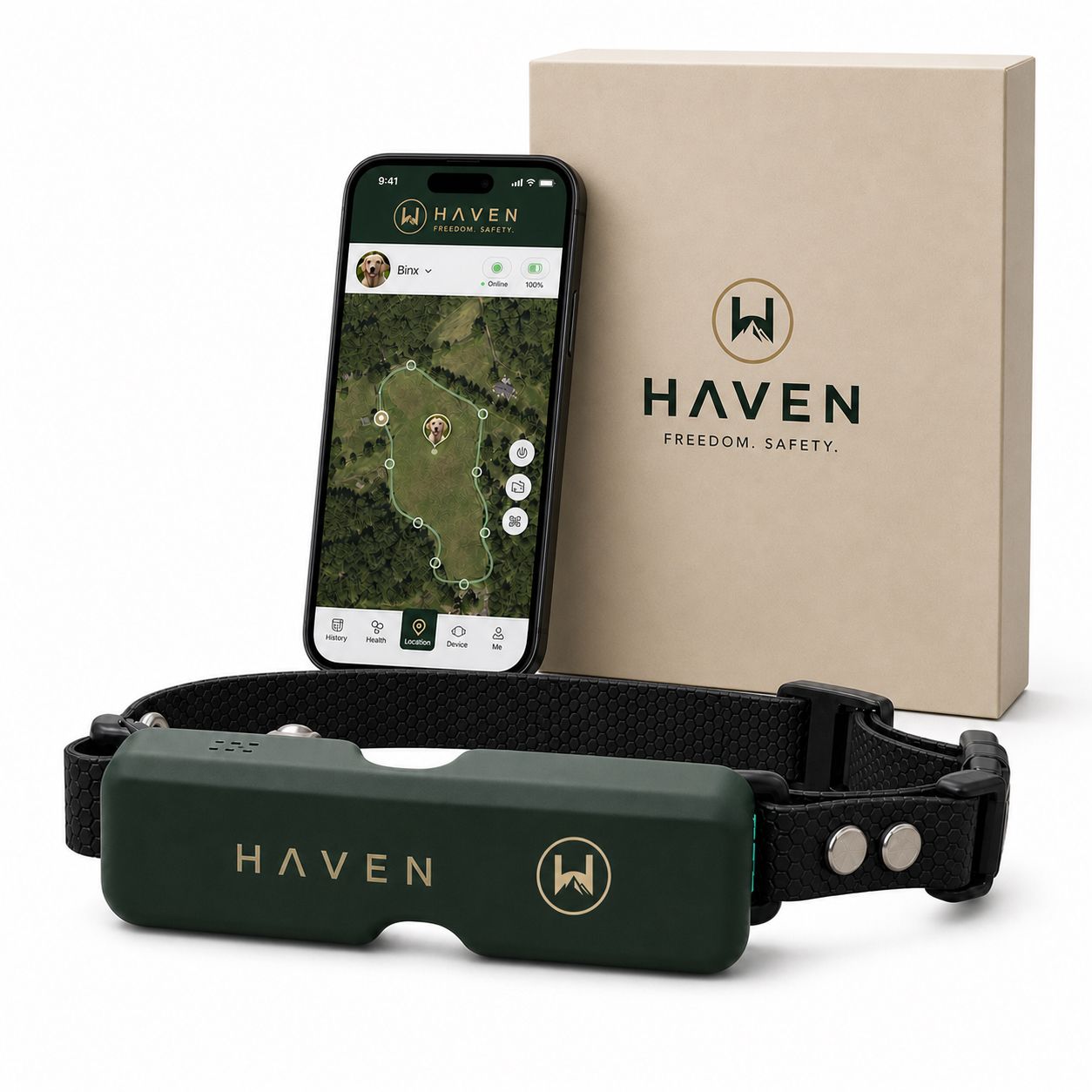
One such system fits this pattern directly. Its dual-band positioning system draws a customizable wireless boundary without any buried wire, and the fence itself works without a required subscription. A plan is only needed if you want live 4G tracking, escape alerts, and app-based activity data on top of containment. If a dog does slip past the boundary, the built-in dog finder combines sound, light, and Bluetooth radar to help you recover them fast.
- Remote pasture or acreage with no interest in trenching wire across fields
- Owners who split time across multiple properties and need a boundary that resets anywhere
- Temporary or seasonal boundaries around construction, gardens, or livestock
For readers building out the physical-barrier side of a hybrid setup, our farm dog containment guide walks through where short fencing typically pays off, and our boundary training walkthrough covers the training sequence in more depth.
What Owners Get Wrong About Acreage Containment
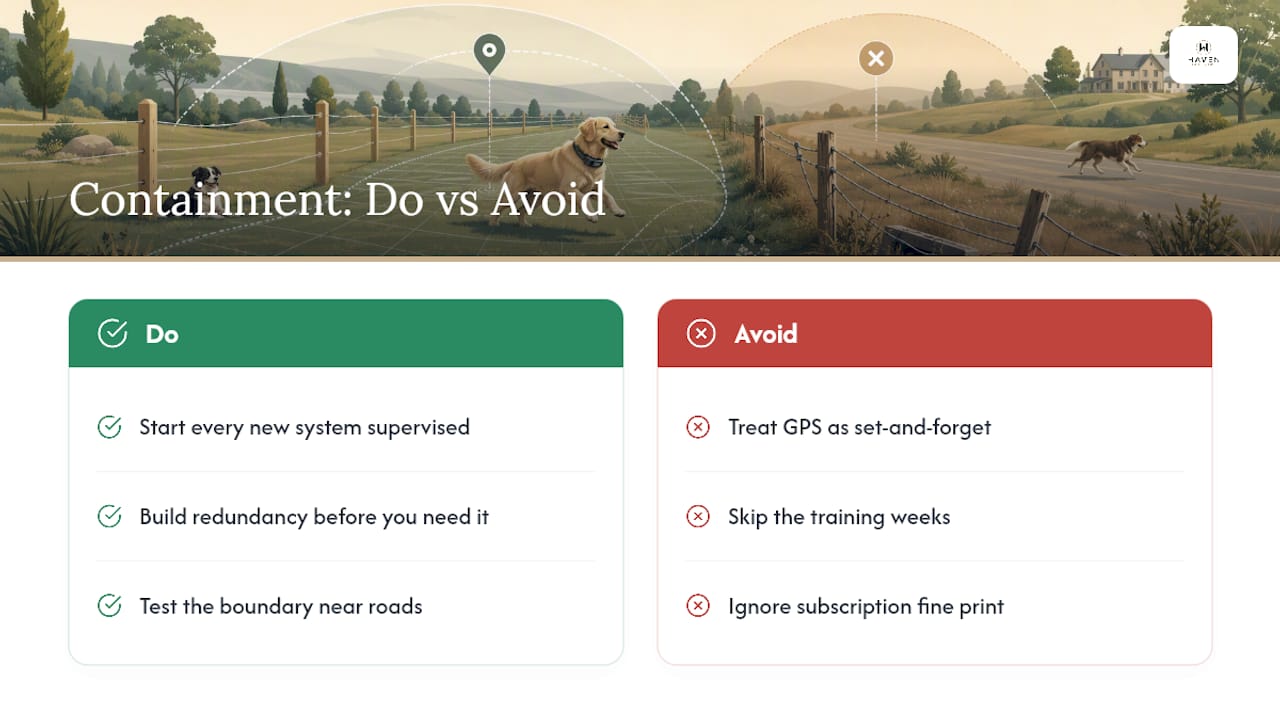
The most common mistake is treating GPS containment as set-and-forget. It’s not. Skipping the training weeks and expecting the collar alone to teach the boundary is how dogs end up a mile from home. The second mistake is ignoring subscription fine print, only to discover the containment feature itself was locked behind a membership after the return window closed.
Start every new system supervised. Build redundancy before you need it, not after a scare. And test the boundary near roads specifically, since that’s the one failure that carries the highest stakes.
— Haven
Try HAVEN Freedom on Your Own Property
If you’ve read this far, you already know the tradeoffs: buried wire is precise but labor heavy, physical fencing is the only thing that stops intruders, and GPS is the option that scales to real acreage without a shovel. This product was built specifically for that last case. Its dual-band GPS boundary works without buried wire and without a required subscription for basic containment, and you only add a plan if you want live tracking, escape alerts, or the sound, light, and Bluetooth dog finder for recovery.
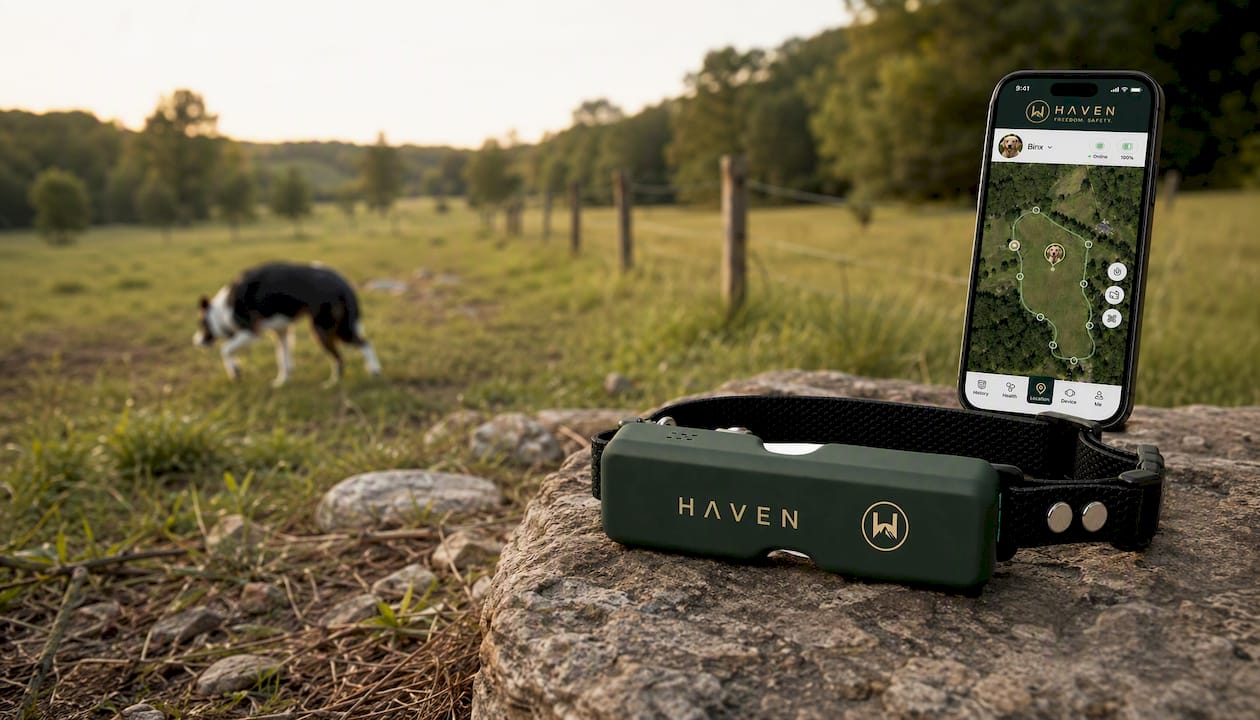
It suits acreage owners who want a flexible boundary that can be redrawn as land use changes, plus anyone managing dogs across more than one property. Check the HAVEN Freedom GPS dog fence and tracking collar page, run a supervised trial on your highest-risk acreage first, and keep ID tags and a microchip as backup no matter which system you choose.
Sources
For deeper technical and veterinary background, the AKC’s GPS fence evaluation guide covers safety and training standards, while VCA Animal Hospitals breaks down the medical pros and cons of electronic fencing. Owners preparing ground for a physical barrier may also find a landscaping resource like YardWoo useful for site prep, and those needing hands-on help can consult a directory of dog trainers for boundary work.
- How to evaluate a GPS dog fence: What matters for dog safety — AKC
- Best wireless dog fences 2026: Escape rates, subscription traps, and what the evidence shows – Pet Device Guide
- Implementation of electric fencing for establishing effective livestock guardian dogs
FAQ
What Is a Good Wireless Containment System for a Large Area?
A GPS-based wireless fence is generally the best fit for large or irregular acreage since it draws a custom boundary without trenching, though accuracy depends on canopy cover and cellular signal in that area.
How Many Acres Will 1,000 Feet of Wire Cover?
It depends entirely on the shape of the property, since a square boundary uses far less wire per acre than an irregular or narrow one; buried wire systems require enough footage to trace the full perimeter, not a fixed acreage figure.
What Is the Best Dog Fence for a Large Area?
For most large properties, GPS containment is the practical choice because it scales to any size without digging, while buried wire remains the better option when you need maximum precision under heavy tree cover.
What Are the Best Fencing Options for Large Properties?
The strongest setups combine a physical barrier at high-risk edges, like roads or neighboring livestock, with GPS containment covering the rest of the acreage, giving you both stopping power and flexible coverage.
Does HAVEN Freedom Require a Subscription to Work?
No. The HAVEN Freedom fence functions without a monthly plan, and a subscription is only needed for optional features like live 4G tracking and escape alerts.
Recommended
Keep reading
en
14 Days to Keep Your Dog on Your Property With a Boundary Plan
Compare fences, fence upgrades, GPS collars, and pens, then follow a 14 day boundary plan to reduce escapes and choose a setup that fits...
Read the poste collar humane
Humane E Collar Training: 7 Steps, Starting With a Vet Check
See how humane e collar training starts with a vet check, conditions tone and vibration, uses rewards, and reserves static stimulation as a last...
Read the postYour adventure starts here
Ready to give your dog more room to roam?
Give your dog more freedom to explore — and give yourself the reassurance of knowing they're never far away.
