

For most owners, the choice in the Haven vs Halo vs Spot On debate comes down to one question: do you want to pay once, or pay forever? HAVEN Freedom and SpotOn Nova both run their core containment fence without a required subscription, while Halo has basic fence function behind a paid membership, requiring ongoing fees. If you’re keeping the collar more than two years, that difference alone decides which system actually costs less.
TL;DR:
- HAVEN Freedom offers a subscription-free fence that only requires payment for optional live tracking, making it cost-effective for long-term ownership.
- SpotOn Nova has the highest upfront cost at $999 and does not require ongoing payments for containment.
- Systems that depend on ongoing memberships can cost more over several years than one-time purchases, especially if owners keep the collar for five or more years.
- Larger, wooded properties or those with multiple zones benefit from systems supporting custom boundaries and overlapping no-go zones, avoiding simpler circular fences.
Table of Contents
- Haven vs Halo vs Spot On: Quick Verdict
- How Accurate Is Each System Under Trees?
- Is a Subscription Required for Containment?
- How Long Does the Battery Last on Each Collar?
- What Training Features and Corrections Come With Each System?
- Does Your Property Fit the Boundary Shapes You Need?
- What Makes HAVEN Freedom Different From Halo and SpotOn?
- How Do You Choose Between These Systems?
- What Actually Matters When You Compare These Systems
- Get a Fence That Doesn’t Send You a Bill Every Month
- Sources
- FAQ
Haven vs Halo vs Spot On: Quick Verdict
Here’s the fast version, before you get into satellite counts and battery charts.
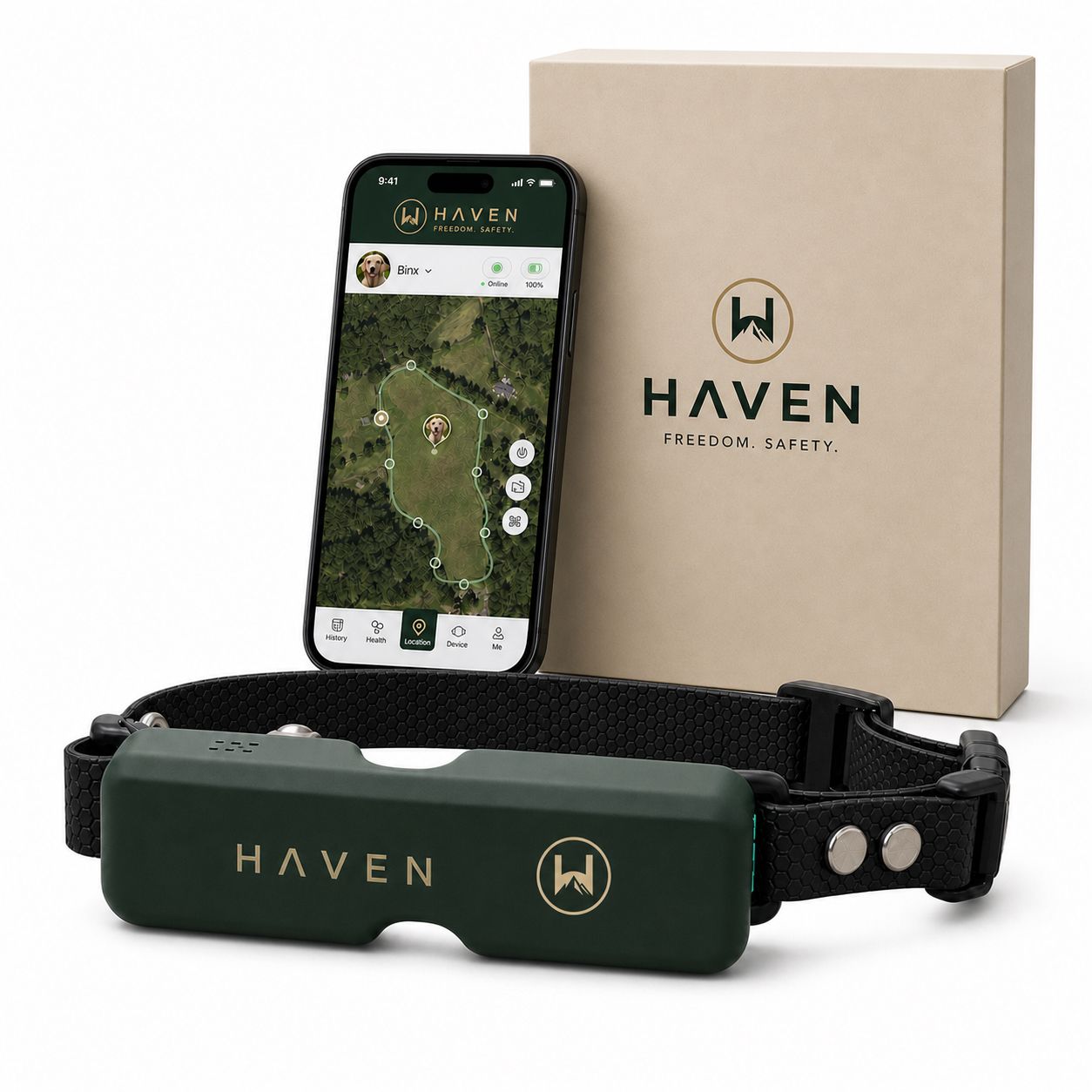
HAVEN Freedom is the subscription-free option with the lowest total commitment.
At $247.99 it's the cheapest of the three upfront, the wireless fence runs on
its own, and a plan is only needed for live 4G tracking and location history,
which is included free for the first twelve months on every collar.
SpotOn Nova is the premium, no-subscription-required containment system with a documented return and accuracy record. It costs the most upfront, at $999 direct from the manufacturer, but the fence itself doesn’t stop working if you skip the monthly tracking add-on.
Halo leads with a competitive sticker price and bundled training content, but its containment fence generally requires an active paid membership to function. That’s a meaningfully different ownership model than either HAVEN Freedom or SpotOn Nova.
Quick pros and cons:
- HAVEN Freedom: No subscription needed to run the fence; live tracking and app extras are optional add-ons, not requirements. 90-day return window.
- SpotOn Nova: Strong accuracy reputation and a 90-day return window, but the highest upfront price of the three.
- Halo: Cheaper to buy than SpotOn, more expensive to keep running if containment truly depends on an ongoing membership.
- Wired/buried fence: No monthly bill and no satellite dependency, but permanent installation and none of the app-based boundary flexibility.
The multi-year math is where this gets interesting. A subscription that costs less than the alternative in month one can cost more by year three or four, simply because it never stops billing. A $999 one-time purchase that never charges again starts to look cheap once you run the numbers past 36 months.
How Accurate Is Each System Under Trees?
GPS accuracy is the single biggest factor separating a fence that feels safe from one that clips your dog on a boundary line by accident. Every GPS collar relies on GNSS (Global Navigation Satellite System) signals, and most modern units combine GPS with GLONASS or Galileo constellations to lock a position faster and hold it steadier. Some systems add dual-band reception, which reads two separate satellite frequencies instead of one, reducing the chance that a single blocked signal throws off your dog’s location.
The problem is tree cover. Open sky is easy for any GPS chip. Dense canopy, tall structures, and steep terrain bend or block satellite signals, and that’s when drift shows up as a boundary line that doesn’t match the fence you actually drew.
Vendors describe their own accuracy very differently, which is worth knowing
before you weigh their numbers against each other. SpotOn claims patented
positioning using a network of 151 satellites, boundary accuracy comparable to
a buried wire, and a 99.3% success rate keeping dogs inside their boundaries. Haven and Halo acknowledges that GPS signal can be reduced under dense canopy or near tall buildings, and recommends setting a wider buffer zone on heavily wooded
properties.
Treat all of it as best-case. Open-sky specs printed on a box are a ceiling,
not a guarantee, and no vendor publishes independently verified drift figures
under canopy. Build margin into any boundary near a road, a property line or
water.
Here’s the practical rule: if your property backs onto a road, a neighbor’s yard, or open water, build your boundary at a safe distance inside the true property line, especially under canopy. If your yard is open and mostly clear of tall obstructions, you can run boundaries tighter to the actual edge. Accuracy under trees is the one spec worth knowing before you obsess over app design or collar color.
Is a Subscription Required for Containment?
This is where the three systems genuinely diverge, and it’s the single most consequential line item in any Haven vs Halo vs Spot On comparison.
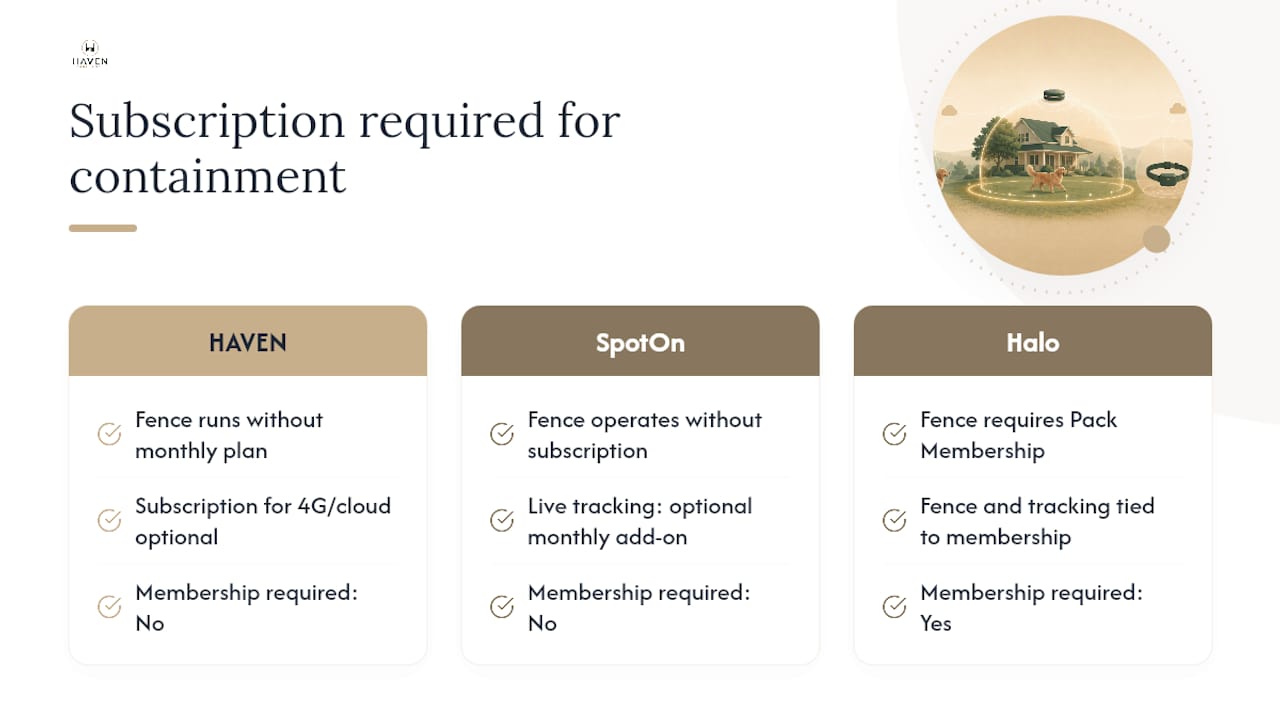
HAVEN Freedom’s core fence runs without a monthly plan. A subscription only comes into play if you want live 4G tracking, escape alert notifications sent to your phone in real time, or cloud-based location history. The containment boundary itself, the part that actually keeps your dog safe, doesn’t depend on a recurring payment.
SpotOn Nova follows a similar model. Its containment fence operates without a subscription, and live tracking is a separate, optional add-on billed monthly. The $999 upfront price is steep, but you’re not locked into ongoing payments just to keep the fence active.
Halo generally requires an active Pack Membership for the fence to function, not just for tracking extras. That distinction between a “fence” and a “tracker” trips up a lot of buyers. As one comparison explains, a GPS fence provides local containment while a GPS tracker adds cloud tracking on top, and conflating the two is how owners end up surprised by a bill they didn’t expect.
Here’s the tipping point math. Say a lower-cost collar runs a few hundred dollars upfront but requires a monthly membership just to keep containment active. By month 20, you’ve paid more in subscription fees than the collar cost to buy. By a few years, that ongoing membership model can equal or exceed a comparable one-time purchase, and it keeps climbing every year after that.
If you rent, move often, or simply don’t want a bill you can’t cancel without losing containment, prioritize a system where the fence works without cell signal or ongoing payment. Owners who relocate or travel frequently often prefer a subscription-free core fence specifically to avoid service interruptions tied to address changes or carrier issues. If you’re keeping the collar for five-plus years on one property, do the math before you buy based on sticker price alone.
How Long Does the Battery Last on Each Collar?
Battery life is an important factor to consider for outdoor dogs, especially in colder weather
Runtime varies a lot depending on how hard you’re using the tracking features versus running passive containment. Passive fence mode, where the collar only needs to check its position against a boundary, sips less power than live 4G tracking, which constantly pings a cell tower and streams location data.
Published figures vary widely by mode. SpotOn states at least 33 hours with tracking enabled, and longer in extended battery mode. Halo Collar 4 advertised 30+ hours, with the Collar 5 marketed for multi-day use. HAVEN Freedom is rated for up to 96 hours in normal containment use, dropping to around 48 hours with real-time tracking active.
The gap between those two HAVEN numbers is the point: passive containment sips power, live tracking doesn't. If you run tracking all day every day, plan around the lower figure whatever collar you buy.
A few practical habits solve most battery anxiety. Charge the collar every night on a fixed schedule rather than waiting for a low-battery alert. If your dog spends full days outside unsupervised, keep a second charged unit or a spare battery pack on hand. Most apps show battery percentage in real time, and checking it before your dog heads out for a long day is a five-second habit that prevents a dead collar at the worst moment.
If your dog travels with you, camps, or spends multi-day stretches outdoors, longer runtime stops being a nice-to-have and becomes the deciding spec. A collar that dies after 10 hours isn’t containment. It’s a countdown.
What Training Features and Corrections Come With Each System?
Hardware gets the headlines, but training determines whether a dog actually respects the boundary. A perfectly accurate fence means nothing if your dog has never learned what the tone or vibration warning signals.
Structured training programs, the kind bundled with several GPS collar systems, typically walk owners through gradual boundary introduction over one to two weeks: leashed walks along the boundary line, supervised off-leash tests, then full independence. That sequencing matters more than any spec sheet. Our own wireless fence boundary training plan covers a 14-day version of this process, and boundary training fundamentals apply regardless of which collar you’re using.
Correction types generally fall into three tiers: audible tone, vibration, and static, with most systems letting you set escalating levels rather than jumping straight to the strongest correction. Multiple levels matter because a dog that responds to a tone alone shouldn’t need static, and having that gradation built into the app avoids over-correcting.
App features split cleanly into two buckets. Local fence operation, tone or vibration or static corrections, and boundary editing typically work without any paid plan. Live tracking, cloud breadcrumb trails, and real-time escape alerts sent straight to your phone are the features that usually require a paid tier across most systems in this category.
Does Your Property Fit the Boundary Shapes You Need?
Property shape and size determine which system actually makes sense, more than brand reputation does.
Most GPS fence systems recommend a minimum boundary size, and SpotOn specifically recommends a minimum boundary size for reliable operation. Below that, a tiny suburban lot with tight satellite geometry can produce false triggers or inconsistent readings, and a traditional buried wire or radio fence may genuinely perform better on a very small, simple rectangular yard.
Custom boundary shapes matter once your property isn’t a clean rectangle. Irregular lots, L-shaped yards, or properties that wrap around a neighbor’s land need a system that lets you draw a custom polygon rather than forcing a circle or square.
Overlapping fences and Keep Out Zones are the underrated feature here. A Keep Out Zone lets you carve an exclusion area inside your main boundary, a pool, a garden bed, a compost pile, without redrawing the whole fence. Overlapping fences and no-go zone capability are a genuinely practical differentiator for anyone with a pool, a garden, or multiple activity zones on one property. Some brands cap how many saved fences or overlapping zones you get on lower-tier plans, so check that limit before you buy if your yard has more than one distinct area to manage.
For irregular or multi-zone properties, sketch your boundary on paper first, mark every no-go area, and confirm the app you’re considering supports that shape before purchase. Our GPS dog fence setup guide walks through getting a working boundary drawn correctly in under two hours.
What Makes HAVEN Freedom Different From Halo and SpotOn?
The wireless boundary is stored on the collar itself, so containment works with
no plan, no cellular signal and no base station. Nothing to bury and no
transmitter to install. Setup happens in the app.
Positioning runs on dual-band GNSS across GPS, GLONASS, BeiDou, Galileo and
QZSS, with WiFi, Bluetooth and cell-tower fallback when satellites aren't
available. The manufacturer's published accuracy is 1–2 metres in open areas
and 3–5 metres in complex environments, we publish both figures rather than
only the open-sky one, because the second number is the one that matters if
your yard has canopy.
HAVEN Freedom is $247.99, and every collar includes 12 months of connectivity
free — a $60 value at the standard monthly rate. That covers live 4G tracking,
escape alerts and remote app access. After the first year, plans start at $2.50
a month, and the fence keeps working either way.
Beyond the fence:
- Six saved safe zones and no-go zones, circular or four-sided, plus scene
presets for home, work and outdoor so you can switch boundaries without
redrawing them
- Live tracking and escape alerts, included free for the first year on every collar
- Dog Finder for locating your dog nearby using sound and light
- Adjustable guidance spanning tone, vibration and optional static, so training
can escalate gradually rather than jumping to the strongest setting
- IP67 water resistance, and up to 96 hours per charge in normal use or 48
hours with real-time tracking active
How Do You Choose Between These Systems?
Run through this checklist before you commit to any GPS collar:
- Measure your property. Under ⅓ acre and simple in shape, consider whether a wired fence covers your needs more cheaply.
- Decide your ownership horizon. Keeping the collar 3+ years favors a higher upfront cost with no mandatory subscription.
- Count your no-go zones. Pools, gardens, or multiple yard sections mean you need overlapping-zone support, not just a basic single boundary.
- Check tree cover. Heavy canopy means you need more than just an open-sky accuracy spec.
- Confirm your dog’s temperament. A nervous or sound-sensitive dog benefits from a system with fine-grained tone and vibration steps before static.
Before buying, ask support directly: What’s the actual return window, and does it accept normal wear? Is the warranty a full replacement or a discounted repair? Does the containment fence stop working if I cancel my plan?
Pro Tip: Ask that last question in writing. A verbal “no, the fence stays on” from a sales rep means nothing if the terms of service say otherwise.
Red flags worth walking away from: a fence that goes dark the moment a subscription lapses, a return window under 30 days, or a warranty that’s vague about what “replacement” actually covers.
What Actually Matters When You Compare These Systems
The conventional advice on GPS collars treats this like a spec-sheet contest: whoever has the tightest accuracy number or the longest battery life wins. That’s backwards. The research here points somewhere else entirely: property type and ownership horizon predict satisfaction better than any single spec.
An owner with a half-acre suburban lot and a mellow dog gets more value from a cheap, simple boundary than from premium forest-mode accuracy they’ll never test. An owner with five wooded acres and a dog that bolts at deer needs the accuracy and the no-go zones, and the subscription question becomes secondary to whether the fence holds under canopy.
What’s overrated: brand prestige and headline battery numbers. What’s underrated: reading the actual subscription terms before you buy, and figuring out honestly whether you’re a two-year owner or a ten-year owner. That single number changes which system wins the math. Buy for your yard and your timeline first. Let the spec sheet settle the details second.
Get a Fence That Doesn’t Send You a Bill Every Month
If you’ve read this far and landed on “I want containment that works without a recurring payment,” HAVEN Freedom is built for exactly that situation. The wireless boundary runs on its own, no buried wire, no base station, no mandatory plan just to keep your dog inside the yard.
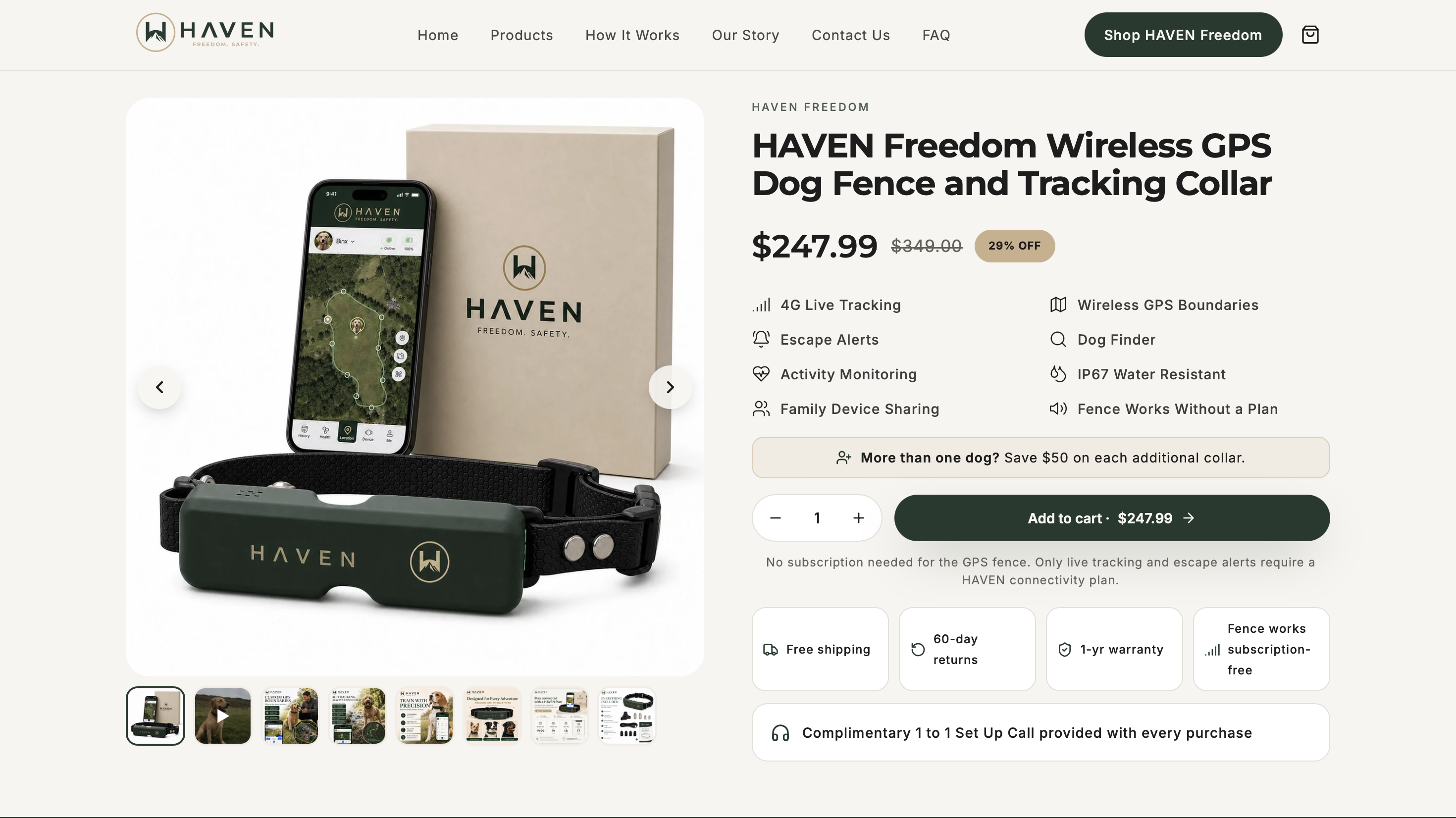
Live tracking, escape alerts sent to your phone, and the sound-and-light dog finder are there when you want them, priced as an add-on rather than baked into the base cost. That structure fits owners who move, travel, or simply don’t want to budget for a subscription they can’t quit without losing containment. If you’re weighing a wooded property against a suburban one, or a two-year commitment against a ten-year one, the HAVEN Freedom product page has full specs and current pricing so you can run your own numbers. Check availability and place an order today.
Sources
The comparisons and figures in this article draw from the following sources. Confirm current pricing, warranty terms, and return windows directly at checkout, since policies change.
- SpotOn vs. Halo: Which GPS Dog Fence Wins in 2026?
- SpotOn GPS Dog Fence Review (Nova Edition)
- Halo Collar — Virtual GPS Fencing (membership requirement and plan pricing)
- Halo Collar Help Centre — What Are Halo Membership Plans and Why Do I Need One?
- SpotOn — Virtual Fence (warranty, return window, subscription policy, minimum property size)
- SpotOn — GPS Dog Fence Nova Edition product page
- HAVEN Freedom GC07B user manual (positioning, accuracy and battery specifications)
Claims about Halo and SpotOn in this article are taken from each company's own published pages and support documentation, current as of September 2026. Specifications for HAVEN Freedom come from the GC07B user manual supplied with every collar. Pricing, warranty and return terms change — confirm current terms directly with each vendor before purchase.
FAQ
Which Is Better, Halo or SpotOn?
SpotOn generally wins on GPS accuracy and subscription-free containment, while Halo tends to offer a lower upfront price and bundled training content, but often requires an active membership for the fence itself to run.
Why Is SpotOn So Expensive?
SpotOn Nova’s price reflects its premium GNSS hardware and the fact that the fence works without a mandatory subscription, so the cost is concentrated upfront rather than spread across years of billing.
What Dog Collar Is Better Than Halo?
For owners prioritizing a fence that never stops working over a billing cycle, both SpotOn Nova and HAVEN Freedom are positioned as stronger fits than a membership-dependent system, since neither requires an active plan to keep the boundary active.
Recommended
Keep reading
en
14 Days to Keep Your Dog on Your Property With a Boundary Plan
Compare fences, fence upgrades, GPS collars, and pens, then follow a 14 day boundary plan to reduce escapes and choose a setup that fits...
Read the poste collar humane
Humane E Collar Training: 7 Steps, Starting With a Vet Check
See how humane e collar training starts with a vet check, conditions tone and vibration, uses rewards, and reserves static stimulation as a last...
Read the postYour adventure starts here
Ready to give your dog more room to roam?
Give your dog more freedom to explore — and give yourself the reassurance of knowing they're never far away.
