

A GPS dog collar carries real dog gps data privacy risk, mostly because location history reveals an owner’s patterns of life, not just a pet’s wandering. The fix isn’t avoiding trackers. It’s checking your app’s location permission today, turning on two-factor authentication, and confirming the vendor lets you delete stored history. Devices that process fencing locally, rather than routing every position through the cloud, cut your exposure automatically.
TL;DR:
- Location history can reveal detailed patterns of your daily routines, making de-anonymization and targeted risks possible even with anonymized data.
- Security flaws like unencrypted traffic and pre-consent data transmission are common in pet apps and can expose ownership information.
- Auditing app privacy settings and choosing local processing options can significantly reduce your data exposure without sacrificing device functionality.
- Regulatory protections vary, but laws like California’s CPRA grant rights to access and delete location data linked to households.
- Opting for devices with on-device fencing and minimizing constant cloud tracking can help protect your privacy while still benefiting from GPS containment features.
Table of Contents
- What Data Your Dog’s GPS Collar Actually Collects
- The Real Privacy Risks: Profiling and De-Anonymization
- Security Flaws Researchers Keep Finding in Pet Trackers
- How to Audit a Tracker’s App Before You Trust It With Your Data
- Settings and Habits That Cut Your Exposure Today
- What the Law Actually Says About Your Pet’s Location Data
- Why Local Processing Changes the Privacy Equation
- An Owner’s Take on Tracking Without Oversharing
- Get the Safety Benefits Without the Constant Cloud Trail
- Sources
- FAQ
What Data Your Dog’s GPS Collar Actually Collects
A collar doesn’t just report “dog is in the backyard.” It generates a stream of records, most of which say more about you than your dog.
- Real-time GPS coordinates, updated every few seconds to minutes depending on the device.
- Location history, a timestamped trail that, over weeks, maps every place the dog (and usually the person walking it) goes.
- Activity and sleep logs, tracking movement patterns and rest cycles.
- Device and account metadata, including collar serial numbers, app login times, IP addresses, and paired phone details.
- Media and sensor data, if the app supports photo sharing, notes, or vet record uploads.
The typical flow runs collar to cellular or Bluetooth network, then to the vendor’s cloud servers, then often to third-party services for analytics, crash reporting, or advertising. Each hop is a point where data can be logged, retained, or shared beyond what you’d expect from a pet product.
Location history is the most sensitive category by far. A few weeks of overnight coordinates reliably marks home. A cluster of weekday points marks work. SEC Consult’s analysis of the pet tracking ecosystem treats this data as an accurate proxy for the owner’s own movement, not just the animal’s. That’s the core of pet tracking privacy: the dog wears the device, but the person holds the risk.
The Real Privacy Risks: Profiling and De-Anonymization
Companies rarely need your name to know who you are. Location traces alone are often enough. Cross-reference a handful of labeled points, home address, workplace, favorite park, with an anonymized dataset, and re-identification becomes straightforward. That’s de-anonymization, and it’s the mechanism behind most GPS collar privacy concerns that go beyond simple hacking.
The practical harms are concrete. A burglar who learns a household leaves for a two-hour hike every Saturday at 9 a.m. has a window. A stalker tracking an ex-partner’s dog walker learns a daily routine without ever touching the person’s own phone. Insurers or data brokers buying aggregated movement data can infer health status, work schedule, or relationship patterns from something as mundane as dog-walking routes.
Industry reviews of GPS dog tracker security consistently flag that “anonymized” location data is not the same as safe location data. Anonymization strips names and account IDs, but it rarely strips the patterns that make a person identifiable.
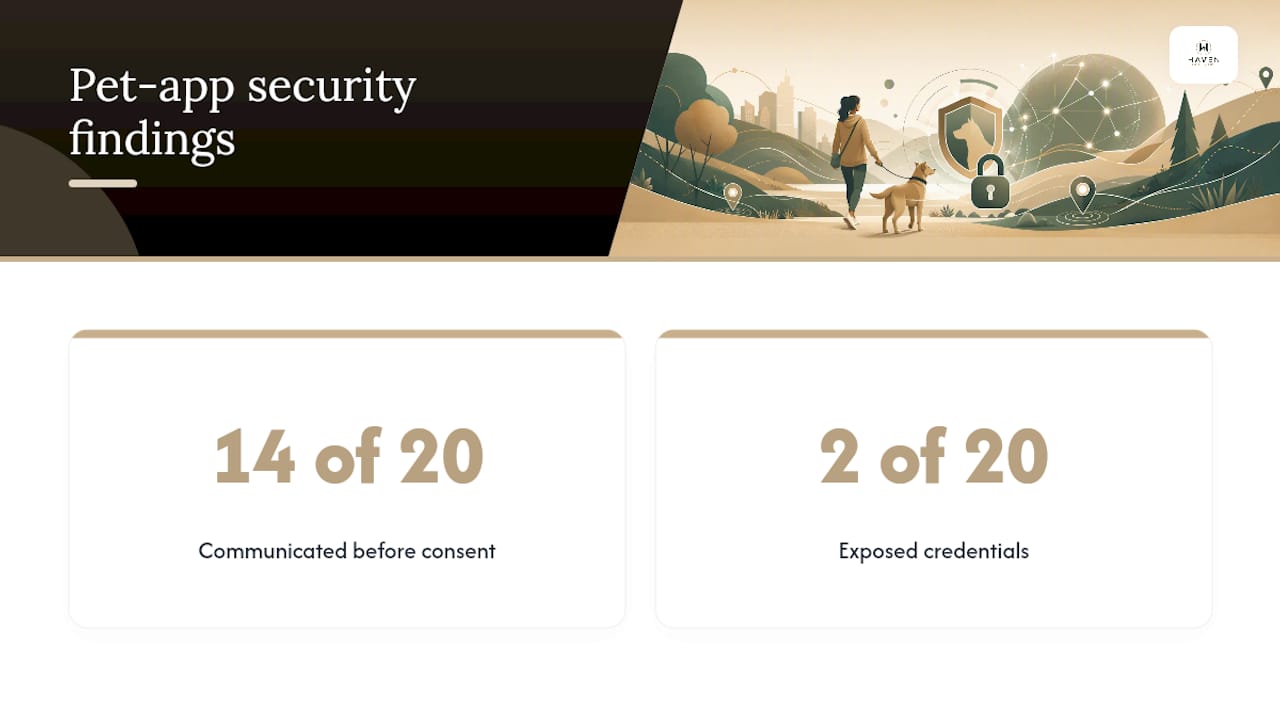
One documented pattern stands out: academic evaluation of pet apps found that 14 of 20 tested apps communicated with their trackers before the user had given consent, meaning data started flowing before anyone had a chance to say no. Two of the 20 exposed login and account credentials over unencrypted connections. That’s not a hypothetical GPS tracking data risk. It’s a measured one, across nearly a fifth of the sample.
Security Flaws Researchers Keep Finding in Pet Trackers
Privacy and security are different problems, but they compound each other. A tracker can have a reasonable privacy policy on paper and still leak your data through sloppy engineering.
The same Frontiers evaluation of 20 pet apps that found pre-consent data transmission also documented weak authentication and unencrypted traffic carrying account details. ScienceDaily’s coverage of that research put it bluntly: pet apps can leak information about their owners, not just their pets.
Common vulnerabilities to watch for include:
- Login credentials or session tokens sent over plain HTTP instead of encrypted channels.
- Apps that start pulling tracker data before the user has accepted any consent screen.
- APIs that don’t properly verify who’s requesting location data, allowing unauthorized pulls.
- No published patch history or security update log for the app or firmware.
- Vague or missing language about encryption standards in the privacy policy.
Dog tracking security problems tend to hide behind an app’s five-star rating. A collar can work perfectly for containment while its companion app quietly mishandles your account data in the background. Check the app store’s “data safety” or “app privacy” disclosure before you check the reviews.
Pro Tip: Search the app’s name plus “vulnerability” or “security research” before buying. Independent researchers, like the SEC Consult team that examined the consumer pet tracking ecosystem, often publish findings that never make it into marketing copy.
How to Audit a Tracker’s App Before You Trust It With Your Data
Run this check before checkout, or right after your first install if you already own one.
- Read the retention section of the privacy policy. Look for a specific number of days or months, not a vague “as long as necessary.”
- Confirm deletion is actually possible. You want a self-serve option to erase account and location history, not just a “contact support” promise.
- Check for third-party sharing language. Advertising and analytics partners should be named or at least categorized, and there should be an opt-out.
- Set app permissions to “while using” rather than “always.” A tracker rarely needs your phone’s location around the clock; the collar has its own GPS.
- Verify encryption claims. Look for mentions of TLS 1.3 in transit and AES-256 for stored data, the baseline security guidance for GPS dog trackers now recommends.
- Ask support directly where data is hosted, how long it’s kept, and whether you can export or delete it on demand. A vendor that stalls on this question is telling you something.
Settings and Habits That Cut Your Exposure Today
Small changes make a real difference without sacrificing the safety benefit you bought the collar for.
- Switch location permission from “always” to “while using the app.”
- Turn off automatic photo or media uploads if the app offers a social or sharing feature you don’t use.
- Trim history retention to the shortest window the app allows, and manually delete old logs periodically.
- Use a fence mode that runs locally on the device rather than routing every boundary check through the cloud.
- Set a unique password for the tracker app, separate from anything reused elsewhere, and turn on two-factor authentication.
- Keep the app and collar firmware updated, and connect through home Wi-Fi rather than public networks when syncing.
Researchers behind the pet-app security study specifically recommend unique passwords and a habit of reviewing permissions, treating pet tech with the same caution as any other connected device on your network.
Pro Tip: Reserve live cloud tracking for genuinely high-risk moments, road trips, unfamiliar trails, boarding stays, and lean on local fence mode plus a basic ID tag or microchip the rest of the time. Less constant cloud logging means less to expose.
What the Law Actually Says About Your Pet’s Location Data
Pet location data occupies a gray zone in U.S. privacy law, mostly because regulations were written around human data, not animal telemetry that happens to reveal human patterns. Where it gets legal traction is through frameworks like California’s CPRA, which grants residents rights to access, delete, and opt out of the sale of personal information, and location history tied to an identifiable household clearly counts once it’s linked to an account.
The FTC has also shown willingness to act against companies whose privacy claims don’t match their actual data practices, regardless of whether the product is marketed for pets or people. That enforcement angle matters because most tracker privacy policies are, in effect, promises the FTC can hold a company to.
Practically, your rights depend on the vendor honoring its own disclosures. Contact the company’s privacy or support channel directly, use any self-serve privacy portal it offers, and ask in writing for a copy of what’s stored and a deletion timeline. SEC Consult’s researchers argue that technical security alone can’t fix this: the analysis points to transparency and privacy-by-design, not just better encryption, as the real long-term fix.
Why Local Processing Changes the Privacy Equation
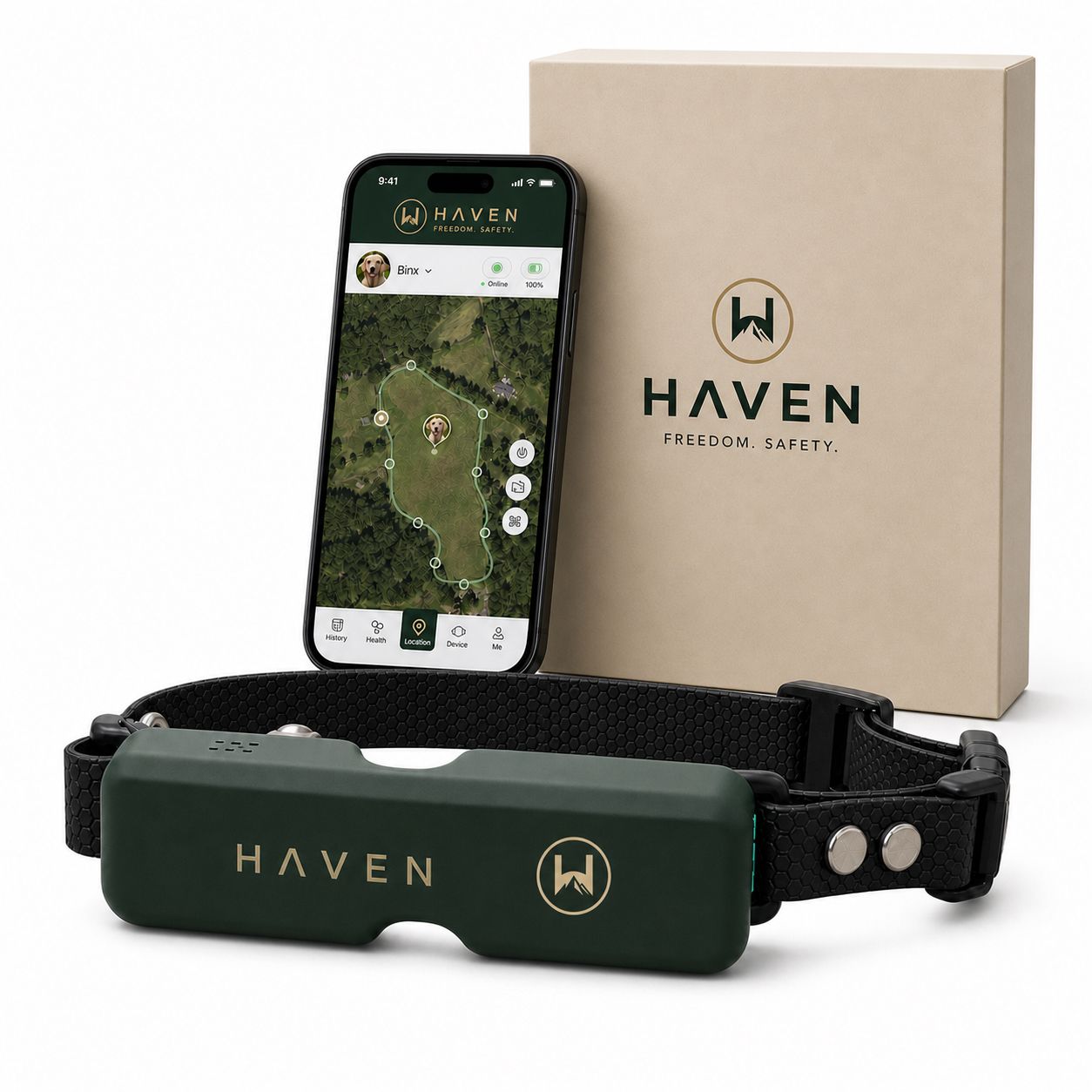
Best practices for pet GPS safety increasingly point toward devices that don’t need the cloud for core functions. HAVEN Freedom’s fence uses dual-band positioning to build a wireless boundary that runs without a subscription, meaning containment decisions happen locally rather than as a round-trip to a server. Live 4G tracking and escape alerts remain optional, paid features for the moments you actually want cloud connectivity, not a default data stream running at all times.
An Owner’s Take on Tracking Without Oversharing
Tracking tech genuinely protects dogs that dig under fences or bolt at the sight of a squirrel. It also collects more about you than most owners realize. Audit your settings, keep backups of your data preferences, and don’t hesitate to ask a vendor hard questions about retention and sharing.
— Haven
Get the Safety Benefits Without the Constant Cloud Trail
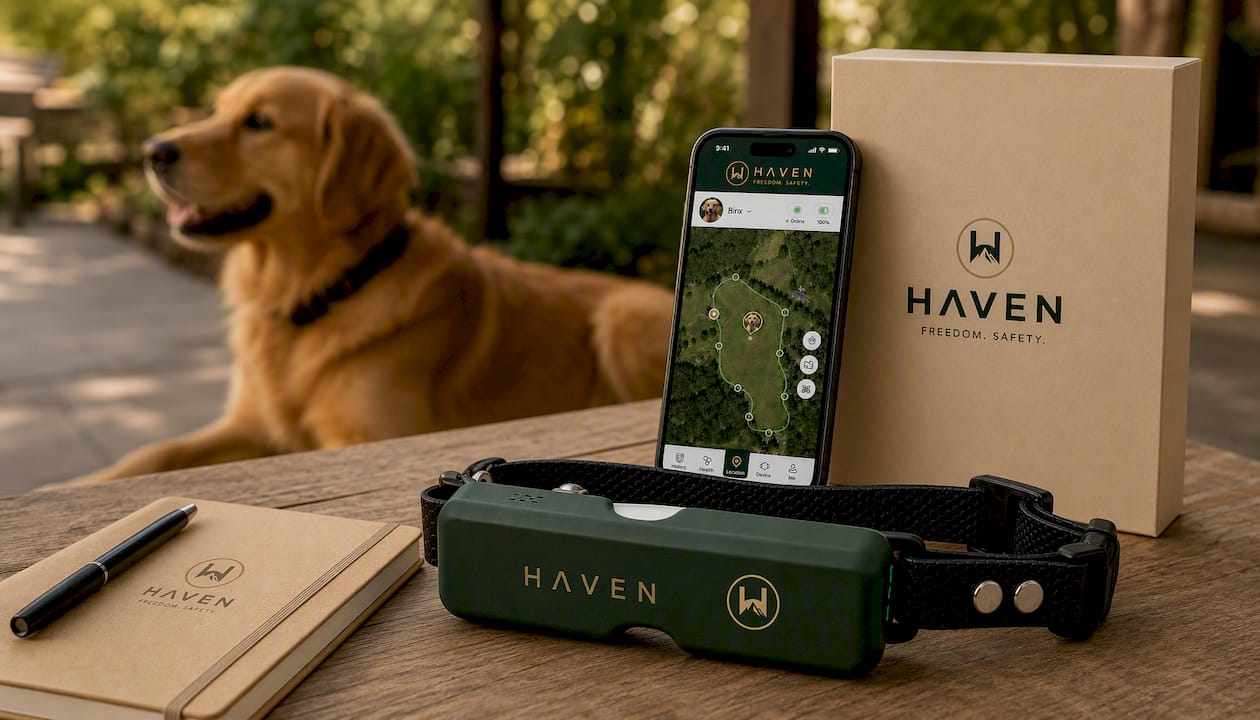
Most trackers force a trade: real containment and location awareness in exchange for a steady stream of your movements sitting on someone else’s server. The HAVEN Freedom Wireless GPS Dog Fence and Tracking Collar breaks that trade. Its dual-band boundary runs locally and works without any subscription, so day-to-day containment never depends on cloud data flowing back and forth. Live 4G tracking, escape alerts, and the sound-light-Bluetooth dog finder stays available as optional app features when you actually need them, not as a default always-on feed.
Before you buy or renew, walk through your current app’s permission settings and retention window using the checklist above. If you’re setting up boundaries for the first time, the GPS dog fence setup guide walks through building a working local boundary in under two hours, no continuous cloud logging required. Check the product page for current plan options and start with the fence-only setup if live tracking isn’t something you need every day.
Sources
- Security and privacy of pet technologies: actual risks vs user perception (Frontiers)
- Are our pets leaking information about us? | ScienceDaily
- Navigating the ethical boundaries of independent security research (SEC Consult)
FAQ
Is an AirTag or a Dedicated GPS Tracker Better for Dogs?
A dedicated GPS collar generally beats an AirTag for dogs because it offers live, real-time location over cellular networks, while an AirTag relies on nearby Apple devices and works better for short-range recovery than continuous tracking.
Can Someone Track My Location Without My Consent Through My Dog’s Collar?
Yes, if the collar’s app has weak security or shares data with third parties, someone with account access or intercepted data could infer your movements, which is why researchers found that some apps transmitted data before consent was even given.
What Are the Main Pros and Cons of GPS Trackers for Dogs?
The main benefit is faster recovery and real containment without buried wires, as with HAVEN Freedom’s subscription-free fence mode; the main drawback is that location history data creates dog gps data privacy exposure if the vendor’s app has weak encryption or broad data sharing.
Can a Private Investigator Legally Use GPS Tracking on a Pet or Person?
Private investigators generally cannot install a tracker on a vehicle or person without consent or a legitimate legal basis, and laws vary by state, so tracking someone else’s dog to monitor its owner would raise the same consent and stalking concerns as tracking a person directly.
How Do I Know if My Dog Tracker’s App Is Handling My Data Safely?
Check the privacy policy for named retention periods, confirm the app supports TLS 1.3 encryption and two-factor authentication, and set location permissions to “while using” rather than “always” to limit background data collection.
Recommended
Keep reading
e collar humane
Humane E Collar Training: 7 Steps, Starting With a Vet Check
See how humane e collar training starts with a vet check, conditions tone and vibration, uses rewards, and reserves static stimulation as a last...
Read the postcoyote safety for dogs
Protect Your Dog from Coyotes in 14 Days with a GPS Boundary
Keep your dog safe from coyotes with immediate steps, yard fixes, hazing, and a 14 day GPS boundary plan you can start today.
Read the postYour adventure starts here
Ready to give your dog more room to roam?
Give your dog more freedom to explore — and give yourself the reassurance of knowing they're never far away.
