

The most reliable way to track dog sleep is a collar-mounted accelerometer tracker that builds a personal baseline over time, backed up by saved video or written notes for anything unusual. This combination catches trends a single bad night never reveals. It won’t diagnose sleep-stage disorders the way a clinical sleep lab would, so any pattern that worries you still belongs in front of a veterinarian, not just an app screen.
TL;DR:
- Collars with accelerometers can reliably detect sleep by measuring movement, with 94% sensitivity and 96% specificity, but cannot distinguish sleep stages.
- Consistent collar fit, tracking for at least two weeks, and logging contextual factors are essential for accurate sleep baseline establishment and identifying meaningful deviations.
- Major sleep changes involving more than two to three hours from a dog’s personal baseline should prompt vet consultation, especially when accompanied by behavioral red flags.
- Using video footage of unusual episodes enhances the veterinarian’s ability to diagnose, as collar data alone can misinterpret restlessness or environmental influences.
- The HAVEN Freedom collar combines containment and sleep tracking, ensuring consistent wear, and is suitable for long-term monitoring without subscription costs, provided it is maintained properly.
Table of Contents
- How Dog Sleep Tracking Actually Works
- Devices and Methods for Tracking Pet Sleep Cycles
- How to Set Up Reliable Dog Sleep Tracking at Night
- Reading the Data: What’s Normal and When to Call the Vet
- How Accurate Are Consumer Dog Sleep Trackers?
- Why HAVEN Freedom Fits Into a Sleep-Tracking Routine
- Battery Life and Maintenance for Sleep Tracking Collars
- Privacy and Data Security for Pet Tracking Devices
- What Most Owners Miss When Tracking Sleep
- Track Your Dog’s Sleep With HAVEN Freedom
- Sources
- FAQ
How Dog Sleep Tracking Actually Works
Every consumer sleep tracker for dogs relies on the same core technology: an accelerometer, the same kind of motion sensor in a phone or fitness band. It measures movement dozens of times per second, and software translates long stretches of near-zero movement into “rest” or “sleep.” This method is called actigraphy, and it’s been used in human sleep research for decades before showing up on dog collars.
A pilot study using a collar-mounted Actical accelerometer found that a threshold of zero movement counts per minute detected sleep and rest periods with 94.0% sensitivity and 96.1% specificity. That’s a strong signal for a method that requires no wires, no lab, and no cooperation from the dog beyond wearing a collar.
Once your dog’s tracker logs enough nights, most apps surface a handful of core metrics:
- Total rest time — how many hours were classified as sleep or stillness in a 24 hour window
- Interruptions — how many times your dog woke or moved during a rest period
- Longest uninterrupted stretch — the single longest block of continuous rest, often the most telling number for quality
- Sleep efficiency — the percentage of time in bed (or in the crate, or on the bed) that was actually spent resting
- Heart rate or respiratory rate, on devices that include those sensors, layered on top of movement data
What actigraphy can’t do is separate REM from deep non-REM sleep. It sees stillness, not brain activity, so it’s a strong rest-detection tool and a poor substitute for polysomnography, the multi-sensor test used in clinical sleep labs.
Devices and Methods for Tracking Pet Sleep Cycles
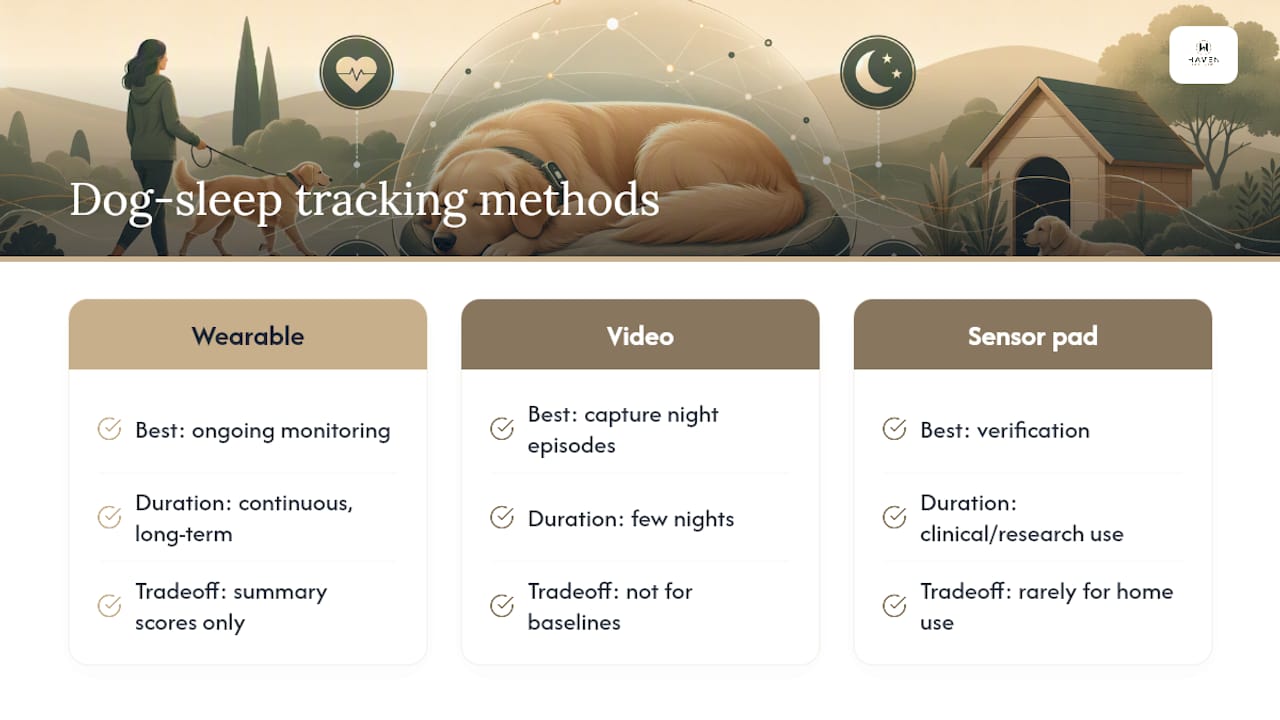
Three practical approaches dominate home sleep tracking, and each fits a different situation.
Wearable collars are the default choice for ongoing monitoring. They’re noninvasive, they ride with your dog everywhere, and they generate the long-term trend lines that actually matter for health tracking. The tradeoff is that most consumer apps show you a summary score rather than raw accelerometer output, which is fine for spotting a trend but less useful if a vet wants the underlying numbers.
Video monitoring earns its place for one-off events, not baselines. If your dog has been gasping or pacing at 3 a.m., a camera pointed at the crate for a few nights tells you far more than a sleep score does. Veterinary resources consistently note that clinics rarely witness these episodes firsthand, which is exactly why owners are advised to capture video of anything unusual.
Sensor pads show up mostly in clinical or research settings, less so at home, and they’re best for verification rather than daily use.
Wearable data and behavioral observation don’t always agree point for point, but total sleep estimates tend to land close together between the two methods, which is reassuring for anyone relying on a collar alone.
How to Set Up Reliable Dog Sleep Tracking at Night
Getting usable data starts with the basics: the collar has to fit snugly enough to stay in the same position all night, without shifting down the neck or riding up under the chin. A loose collar generates noisy data that looks like restlessness even when your dog is sound asleep.
Here’s a workflow that produces vet-ready results:
- Fit the collar so two fingers slide under it comfortably, no more.
- Enable night mode or the sleep-tracking setting in your app before bed.
- Track for 7 to 14 consecutive nights before drawing any conclusions. Shorter windows are a known source of false alarms, since one restless night can look like a trend when it’s really just a hot room or a late dinner.
- Log context each night: medication changes, travel, house guests, or a heat wave. Sleep data means nothing without the backstory.
- Export the data weekly so you have a running record instead of a single snapshot.
- If something looks off, sync a short video clip to the same timestamp as the flagged event.
Pro Tip: Keep at least one full night of matched video on hand any time a worrying pattern shows up. A vet can do far more with 30 seconds of footage showing labored breathing than with a chart alone.
Reading the Data: What’s Normal and When to Call the Vet
Healthy adult dogs typically log 12 to 14 hours of sleep per day; senior dogs often run higher, at 14 to 16 hours. Once you’ve got a two-week baseline, the number that matters isn’t the raw hour count. It’s the shift.
A change of more than 2 to 3 hours from your dog’s own baseline, in either direction, is a practical threshold for concern worth mentioning to a vet.
That’s not an arbitrary line. Big deviations from a personal baseline tend to show up before more obvious symptoms do, which is the entire appeal of longitudinal tracking over a one-time vet visit.
Alongside the numbers, watch for behavioral red flags that a tracker alone might miss or undercount:
- Constant pacing or restlessness before settling down
- Repeated circling or pawing at bedding
- Snoring or gasping during sleep, which can point to airway or pain issues
- Frequent, unexplained awakenings night after night
When you do need to loop in a veterinarian, bundle three things into one packet: the exported sleep chart, a short video clip of the behavior, and a plain-language note on what changed and when. That combination gives a vet far more to work with than a verbal description of “he’s been sleeping weird lately.”
How Accurate Are Consumer Dog Sleep Trackers?
Consumer trackers are good at what actigraphy was built for: telling the difference between movement and stillness. A beacon-based accelerometer model achieved roughly 79% agreement with dedicated sleep meters in classifying sleep versus wake, and that number climbs higher in studies using a simple zero-count threshold on collar accelerometers. Solid numbers, but not clinical-grade.
Three mistakes cause most of the confusion owners run into:
- Judging sleep quality off a single night instead of a two-week baseline
- Assuming any stillness counts as restorative sleep, when a dog can lie motionless while anxious or in pain
- Ignoring the environment: a hot bedroom or a new dog in the house will change sleep data without any underlying illness
Treat a tracker as a trend tool, not a diagnostic device. Pair the numbers with your own eyes and, when something looks wrong, a vet’s exam.
Pro Tip: If your dog’s rest score suddenly looks “great” after weeks of poor sleep, check the collar fit before celebrating. A collar that’s slipped loose often reads as more stillness than actually happened.
Why HAVEN Freedom Fits Into a Sleep-Tracking Routine
Sleep tracking only works if the collar stays put, and that’s where containment and monitoring overlap. The HAVEN Freedom Wireless GPS Dog Fence and Tracking Collar combines GPS-enabled boundaries, live tracking, escape alerts, and a sound, light, and Bluetooth radar dog finder with activity and sleep tracking, all through one app. The wireless fence works without a subscription; a plan is only needed for live tracking and premium app features.
Because the same collar handles both containment and sleep monitoring, it stays on your dog’s neck consistently night after night instead of getting swapped for a different device. That consistency is exactly what a reliable baseline needs. If you already own one or you’re weighing the purchase, start with a two-week baseline period, set the fence up properly first, then export the sleep data to review with your vet.
Battery Life and Maintenance for Sleep Tracking Collars
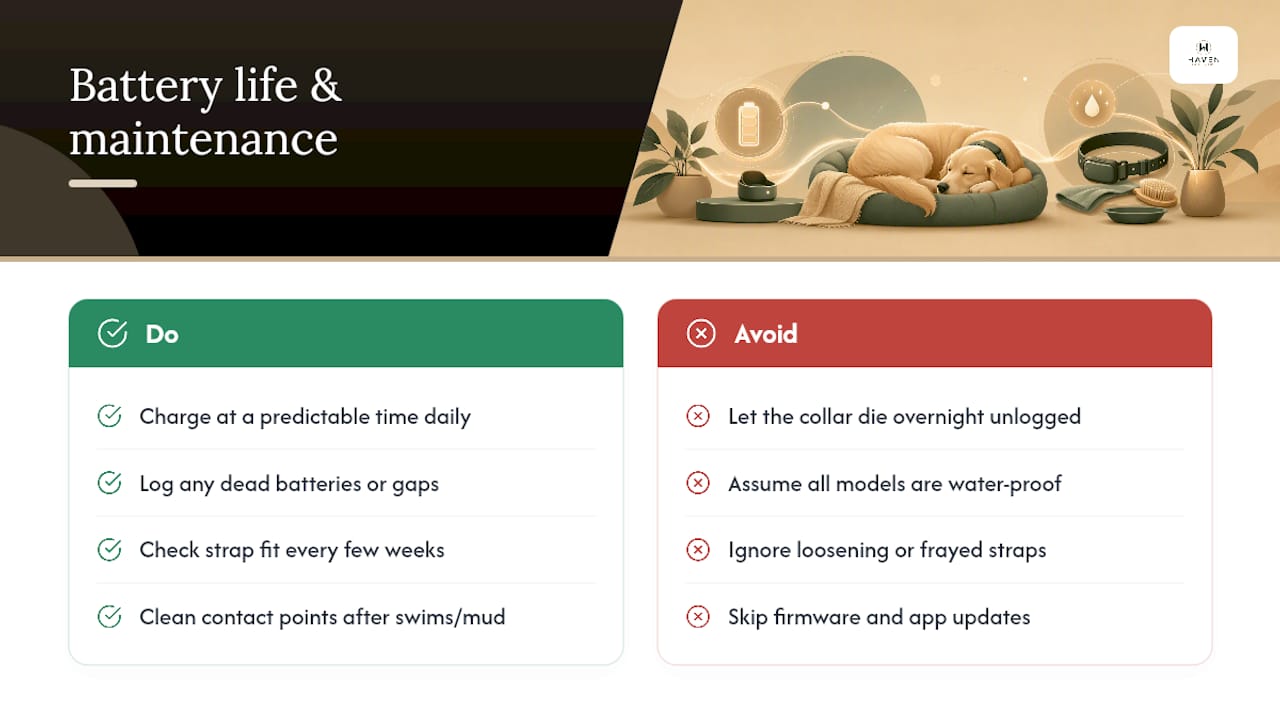
Battery life varies widely depending on how much of the collar’s feature set is running at once. A device doing pure sleep tracking with the GPS radio mostly idle will stretch further than one actively pinging live location updates throughout the day. Most GPS-enabled tracking collars fall somewhere in the range of a few days to about a week per charge under typical use, though heavy live-tracking use during outdoor adventures will drain a battery faster than overnight rest monitoring alone.
Charging routines matter more than most owners expect. A collar that dies at 2 a.m. leaves a gap in your data that can look like a missed night of sleep rather than a dead battery, which throws off trend comparisons if you’re not careful to log it. Building a charging habit around a predictable time, like plugging in during your dog’s morning walk, avoids random gaps in the record.
Maintenance beyond charging is mostly about the physical collar itself. Check the strap for fraying or stretching every few weeks, since a loosened fit changes how the accelerometer reads movement and can quietly degrade data quality without any obvious sign. Clean the contact points where the collar touches skin, especially for dogs that swim or get muddy often, since buildup there can cause skin irritation over time. Water resistance ratings differ by device, so confirm what your specific tracker can handle before assuming it survives a lake swim or a rainy hike.
Software updates matter too. App-connected collars periodically push firmware updates that can improve sleep-detection algorithms or fix battery drain issues, so it’s worth checking for updates rather than assuming the device you set up months ago is still running its best version.
Privacy and Data Security for Pet Tracking Devices
Every sleep and location tracker generates a data trail, and that trail is more detailed than most owners initially realize. A collar logging GPS position, activity levels, and sleep patterns around the clock is building a fairly complete picture of your household’s daily rhythm, not just your dog’s.
The practical question to ask before enabling any feature is where that data goes and who can see it. Location and activity data typically sync to a manufacturer’s servers to power the app’s charts and alerts, which means the company’s data-handling practices matter as much as the collar’s sensors do. Look for clear opt-out options for data sharing, and check whether exported data can be sent directly to a vet without routing through a third party.
Sharing sleep data with a veterinarian is one of the better use cases for a tracker, but it’s worth confirming your app lets you export a clean report rather than requiring you to hand over full account access. HAVEN Freedom owners can review their data sharing choices directly, which is the kind of control worth checking for on any device before you commit to months of nightly tracking.
Bluetooth-based features, like dog-finder radar functions, generally operate on a short range and don’t broadcast data beyond nearby devices, which is a meaningfully different privacy profile than continuous cellular GPS tracking. Understanding which parts of a device use which connection type helps you gauge what’s actually being transmitted and when.
What Most Owners Miss When Tracking Sleep
Owners tend to fixate on the hour count and miss the more useful signal: consistency. A dog logging 13 hours with three abrupt wake-ups every night is telling you something different than a dog logging 13 hours in one long, uninterrupted block. Disturbance resistance matters as much as raw duration when you’re using sleep as a welfare indicator.
Small environmental fixes often move the needle more than any device does. A cooler room, a consistent bedtime routine, and reduced evening stimulation frequently smooth out fragmented sleep before you ever need to worry about a vet visit.
Use the tracker to build evidence, not conclusions. Bring the chart to your vet, let them interpret it alongside a physical exam, and treat the collar training basics as part of the same routine that keeps your data clean.
— Haven
Track Your Dog’s Sleep With HAVEN Freedom
If you’re piecing together a sleep-tracking routine from a separate wearable, a camera, and a notebook, HAVEN Freedom gives you one collar that handles containment and monitoring together.
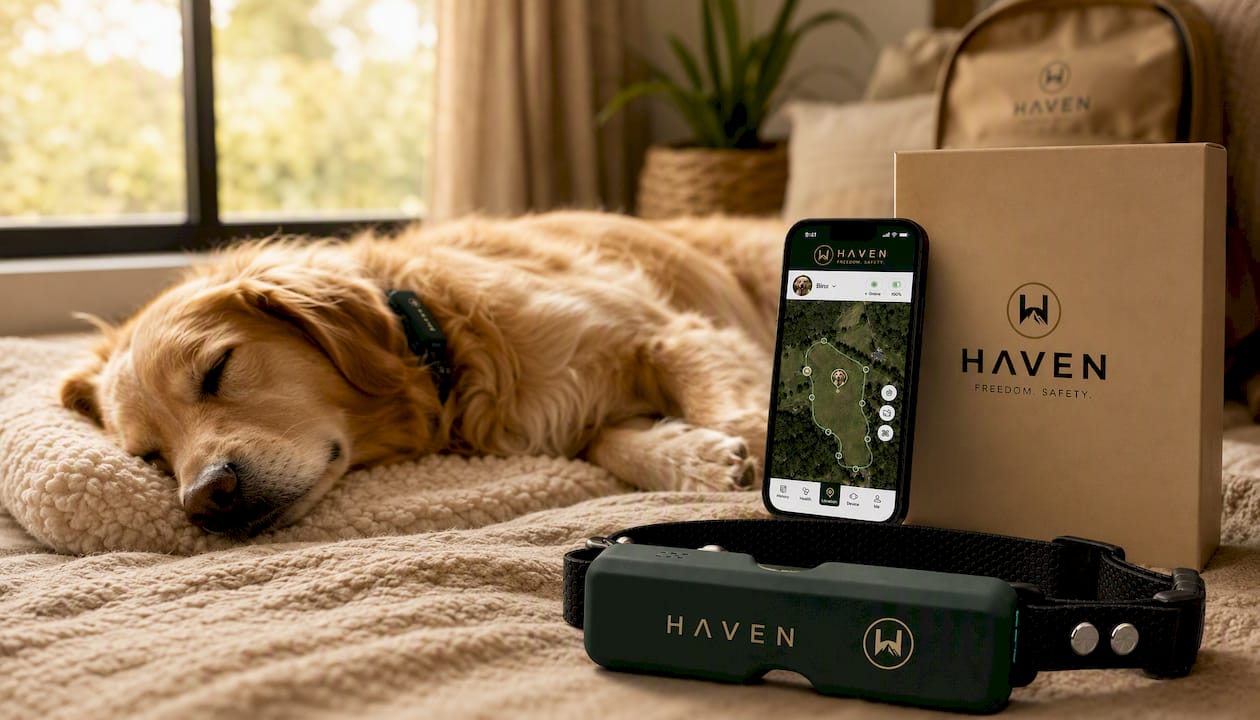
The same device that keeps your dog inside a customizable boundary also logs activity and sleep, so the collar never comes off between an outdoor adventure and bedtime. That consistency is what a reliable baseline depends on. Owners get escape alerts, a sound, light, and Bluetooth radar dog finder for quick recovery, and a wireless fence that works with no subscription required, with a plan needed only for live tracking and extra app features.
Start with a two-week baseline: fit the collar, let it run overnight consistently, then export the sleep data to review with your vet. If you’re ready to see how it fits your routine, check out the HAVEN Freedom collar and get your dog set up this week.
Sources
- Most common sleep disorders in dogs — PetMD
- Beacon-based accelerometer sleep–wake analysis in dogs — PMC
- Actical accelerometers as a clinical tool for monitoring sleeping and resting periods in individual dogs — Animals (MDPI)
FAQ
What is the 7-7-7 rule for dogs?
There’s no established veterinary standard called the “7-7-7 rule” for dog sleep. Definitions circulating online vary widely, so it’s best treated as informal advice rather than a clinical guideline.
How long does one hour feel to a dog?
There’s no reliable scientific measurement of how dogs subjectively experience time, so any specific ratio you see online is speculation rather than established science.
Do dogs sleep better near their favorite person?
Many dogs settle faster and show fewer nighttime disturbances near a person or pet they’re bonded to, largely because familiar presence reduces anxiety, though sleep needs and preferences vary by individual dog.
Do dogs like blankets over them?
Many dogs seek out the warmth and pressure of a blanket, and it can support deeper, less interrupted rest, though some dogs prefer open space and will simply move off a blanket if they overheat.
How many nights should I track before drawing conclusions?
Track for 7 to 14 consecutive nights before drawing conclusions; shorter windows are a common source of false alarms since one restless night can look like a trend.
Recommended
Keep reading
e collar humane
Humane E Collar Training: 7 Steps, Starting With a Vet Check
See how humane e collar training starts with a vet check, conditions tone and vibration, uses rewards, and reserves static stimulation as a last...
Read the postcoyote safety for dogs
Protect Your Dog from Coyotes in 14 Days with a GPS Boundary
Keep your dog safe from coyotes with immediate steps, yard fixes, hazing, and a 14 day GPS boundary plan you can start today.
Read the postYour adventure starts here
Ready to give your dog more room to roam?
Give your dog more freedom to explore — and give yourself the reassurance of knowing they're never far away.
