

Stop most escapes by diagnosing the exact method your dog uses to get out, then applying the matching fix: buried mesh for diggers, coyote rollers or inward toppers for jumpers, and secured gate hardware for the rest. Add a GPS backup like the HAVEN Freedom collar so a missed spot never turns into a lost dog. Run a quick audit first. Fix the worst point immediately.
TL;DR:
- Fix active escape points immediately, focusing on gates and digging sites, as they produce the highest reduction in escapes for the lowest cost.
- Use proven hardware like coyote rollers or inward toppers for fence climbing and remove objects near the fence that could serve as stepping stones or launch pads.
- Bury galvanized wire mesh 12 to 18 inches deep or install a gravel strip to prevent digging tunnels, especially on persistent diggers.
- Reinforce gates with self-closing hinges and two-step latches, and regularly check for sagging or loose frames to prevent weak points.
- Combine physical barriers with training, enrichment, and GPS backup systems for layered containment, reducing long-term escape risks and liabilities.
Table of Contents
- What’s the fastest way to run an escape-proof yard dogs audit?
- How do you stop a dog from jumping or climbing the fence?
- What stops a dog from digging under the fence?
- How do you close gaps and squeeze-through spots in a fence?
- How do you make a gate secure enough to stop escapes?
- Can training and exercise reduce a dog’s urge to escape?
- Why do multiple containment layers work better than one fence?
- What can you fix in the yard right now, today?
- HAVEN Freedom: where a wireless GPS collar complements physical containment
- Which dog breeds and individual dogs are less prone to escaping?
- What training techniques actually reduce escape attempts?
- What legal and safety liabilities come with escape-proofing your yard?
- A humane, layered approach beats a quick fix
- Give Your Containment Plan a Real Backup
- Sources
- FAQ
What’s the fastest way to run an escape-proof yard dogs audit?
Walk your entire fence line slowly, at your dog’s pace, not yours. Most owners spot the failure point in under ten minutes once they know what to look for.
Here’s the sequence that works:
- Check the ground first. Fresh soil, disturbed mulch, or a shallow trench along the base signals a digger. Diggers usually work the same 2 to 3 spots repeatedly, often near a gate or a corner where they can see something outside.
- Look up and out. Scuffed paint, bent wire, or worn grass on the fence face means a jumper or climber. Check for anything nearby, a woodpile, an AC unit, patio furniture, that could work as a launch pad.
- Test every gate. Push on it. A gate that swings loosely or doesn’t latch flush is often the real culprit, even when owners blame “the fence.”
- Note the timing. A dog that bolts the instant you turn your back is usually anxious or bored. One that escapes at random, often when a squirrel or another dog passes, is driven by prey drive or social interest.
Mark trouble spots with something visible, chalk, a stake, tape, so you can prioritize. Fix the gate and any active dig site today; schedule the bigger fence work for the weekend. Practical fence guides consistently find that gates and corners produce the biggest reduction in escapes per dollar spent, so start there even if a full fence overhaul is still on your list.
How do you stop a dog from jumping or climbing the fence?
A dog that clears a 5 or 6-foot fence isn’t defying physics, it’s using something you gave it. Coyote rollers and inward-angled fence extensions are proven fixes here: rollers spin under a climbing dog’s paws so it can’t get a grip at the top, while inward toppers physically block the arc a jumping dog needs to clear the fence.
Coyote rollers work best on wood, vinyl, or chain-link fences at least 5 feet tall, and they install along the top rail without raising the fence height, which matters if your HOA caps fence dimensions. Inward-leaning toppers, angled wire or mesh extensions that tilt into the yard, tend to work better for dogs that are climbing rather than jumping, since the incline defeats a paw-over-paw scramble.
Beyond hardware, remove what’s giving your dog a boost:
- Move planters, woodpiles, dog houses, and patio furniture a safe distance from the fence line to remove any objects that could help your dog climb over.
- Trim tree limbs that overhang the yard from either side.
- Replace or line chain-link with a solid or slatted panel. Chain-link gives fence-focused dogs both a foothold and a clear view of whatever’s exciting them on the other side, and blocking that sightline alone stops some dogs cold.
- Choose smooth-faced materials (vinyl, solid wood) over anything with horizontal rails a dog can climb like a ladder.
Pro Tip: Before installing a roller or topper, watch your dog’s escape attempt once from a distance (safely, on leash nearby). Knowing whether it climbs, claws, or launches tells you which fix actually solves the problem instead of guessing.
What stops a dog from digging under the fence?
Diggers need a physical barrier below ground, not just a taller fence above it. Your options scale with how determined your dog is and how much you want to spend.
- Buried welded-wire mesh: Bury galvanized wire mesh 12 to 18 inches deep along the fence line. This is widely considered the most reliable retrofit for persistent diggers because there’s no gap for a dog to find with repeated effort.
- L-footer apron: Instead of digging straight down, bend the mesh into an L-shape that runs horizontally under the soil, away from the fence. Dogs typically dig close to the fence itself, so they hit buried wire before they can tunnel under it, even with a shallower installation.
- Concrete curb or footer: The most permanent and most expensive option. A poured concrete strip along the base stops digging completely but requires real construction, not a weekend project.
- Gravel or paver strip: A quick, lower-cost option. Dogs generally dislike digging through loose rock or solid pavers, and this doubles as a clean visual border.
- Pinned hardware cloth: For a same-day fix, stake heavy hardware cloth flat against the ground along active dig sites using landscape staples.
Match the fix to the dog. A casual digger bored on a hot afternoon might stop with gravel and some shade. A dog that’s dug three escape tunnels in a month needs buried mesh or concrete, full stop. Either way, pair the physical fix with something that reduces the urge to dig: shade structures for hot yards, a dedicated digging pit filled with sand, or rotating chew toys.
How do you close gaps and squeeze-through spots in a fence?
Small gaps are the sneakiest failure point because they look harmless until a determined dog proves otherwise. Puppies and slim, flexible breeds can squeeze through openings that look far too narrow to a human eye.
Start by testing every gap with your hand, or a tape measure if you want precision. If your fist fits through, assume your dog can eventually widen it.
- Install a welded wire liner along the bottom 2 feet of picket or split-rail fences, where spacing is usually widest.
- Add a solid bottom board or kickboard where the fence meets uneven ground, closing the low gaps that develop as soil settles.
- Use a gate sweep or threshold strip under gates, the same product used to block drafts under doors, to eliminate the low gap dogs find fastest.
- Fasten mesh with galvanized staples every 4 to 6 inches, and reinforce corners where wire tends to pull loose first.
- Bend cut wire ends inward or cap them, since exposed mesh edges cause real injuries to paws and noses.
Paint wire liners to match the fence color if you want the fix to disappear visually. It holds up just as well and looks intentional rather than patched.
How do you make a gate secure enough to stop escapes?
Gates fail more often than fences, and it’s rarely the latch alone. Sagging hinges, warped wood, and gaps at the bottom conspire to create the one weak point a smart dog finds within days.
- Upgrade to self-closing hinges. These pull the gate shut automatically if it’s left ajar, which covers for the moment someone forgets to check behind them.
- Install a two-step or keyed latch. A single-action latch is easy for a paw to bump open. Two-step latches require a lift-and-pull motion dogs can’t replicate.
- Add a secondary safety clip or carabiner as backup, especially on gates near the street or a pool.
- Check for sag monthly. Push down on the far corner of the gate. If it drops or scrapes the ground, tighten hinges or add an anti-sag kit, a diagonal turnbuckle wire that pulls the frame back square.
- Reinforce with a corner brace or steel plate if the gate frame itself is loose, not just the hinges.
If a gate is actively failing today and you can’t repair it this minute, a carabiner or padlock through the latch holds until you can.
Can training and exercise reduce a dog’s urge to escape?
Physical barriers stop the exit. Reducing the motivation to leave in the first place is what makes those barriers hold long-term. Skip this step and you’re just building a better wall for a dog that’s more determined than ever.
Start with a vet visit if the escaping is new, sudden, or paired with other changes. Board-certified veterinary behaviorists recommend ruling out pain or medical issues before assuming an escape is purely behavioral, since discomfort, anxiety, or even hearing loss can all shift a dog’s behavior in ways that look like defiance but aren’t.
From there, focus on the basics that actually move the needle:
- Hit a real daily exercise target, most adult dogs need 30 to 60 minutes of active movement, not just a walk around the block.
- Add mental enrichment: puzzle feeders, snuffle mats, or scent games that tire a dog out mentally as much as physically.
- Practice door manners and a solid recall cue daily, in short sessions, so leaving through a door or gate becomes boring rather than exciting.
- Consider spay or neuter if your dog’s escapes track with mate-seeking behavior, particularly in intact males who roam.
Pro Tip: A dog that escapes the moment you leave for work is telling you something different than one that escapes chasing a rabbit. Match the intervention to the actual trigger, or you’ll fix the fence and still lose the dog.
Why do multiple containment layers work better than one fence?
No single fix is bulletproof, which is why layered containment, primary barrier plus a secondary buffer plus tracking, consistently produces the best outcomes for determined escape artists. Think of it as redundancy: if the fence fails, something else catches the dog before it reaches the street.
- Primary barrier: your main fence line, fully audited and patched.
- Secondary layer or airlock: a double-gate entry system, two gates with a small buffer zone between them, so a dog can’t slip past you the instant a gate opens.
- Secure dog run: a fully enclosed, roofed area for unsupervised time when you can’t watch the yard directly.
- Active supervision: the simplest layer, and the one most often skipped.
- GPS tracking as a safety net: GPS-enabled collars serve as a practical retrieval tool once an escape happens, cutting the time it takes to find and recover a loose dog.
Roughly a third of pet dogs get lost at some point in their lives, according to industry estimates, which is exactly why a tracking layer matters even after every fence gap gets sealed. GPS collars have real limits, battery life, signal dead zones, and boundary accuracy that varies by terrain, so treat them as backup, not a replacement for a solid fence.
What can you fix in the yard right now, today?
Some fixes take a weekend. Others take ten minutes and buy you time until the real repair happens.
- Bring the dog inside if you can’t supervise the yard right now. This is the only truly instant fix.
- Remove obvious launch points, furniture, planters, woodpiles, near any fence section your dog uses.
- Clip or tie the gate shut with a carabiner if the latch is questionable.
- Pin hardware cloth over active dig sites using landscape staples, even as a stopgap before burying mesh properly.
- Lay pavers or a gravel strip over the worst digging spot.
- Add temporary privacy slats or a tarp over see-through fence sections that trigger fence-running or barking matches with a neighbor’s dog.
Once the immediate risk is handled, budget the bigger jobs by cost and urgency: gates and active dig sites first, full mesh burial or coyote rollers next, cosmetic upgrades last.
HAVEN Freedom: where a wireless GPS collar complements physical containment
Physical fixes stop most escapes. HAVEN Freedom exists for what happens when one doesn’t, or when your yard setup doesn’t allow a traditional fence at all. The collar uses dual-band positioning to create a customizable wireless boundary with no buried wire, so you’re not trenching your yard to add a containment layer on top of what you already have.
Inside that boundary, the collar tracks live location, sends an alert the moment your dog crosses the line, and includes a finder system that combines sound, light, and Bluetooth radar if a dog does get loose. That last piece matters most in the minutes right after an escape, when speed of recovery counts more than anything else.
It fits best for:
- Owners who want a flexible boundary without construction, particularly on rented properties or oddly shaped lots.
- Anyone who already has a decent fence but wants a tracking backup for peace of mind.
- Adventurous dogs and owners who travel or hike off standard yard turf, where a fixed fence isn’t an option at all.
The wireless boundary works without a monthly subscription. A plan is only needed for live tracking and premium app features, so you’re not locked into recurring costs just to keep the basic containment running.
Which dog breeds and individual dogs are less prone to escaping?
Breed matters, but individual temperament often matters more. Breeds bred for independent work, huskies, Australian shepherds, beagles, and terriers among them, tend to have higher escape drives because their original jobs rewarded roaming, chasing, or digging. A husky’s endurance and problem-solving skill make it a notorious fence-tester; a beagle’s nose can override almost any training if a scent trail crosses the yard.
That said, plenty of individual dogs within “escape-prone” breeds never test a fence in their life, while calmer breeds occasionally produce a determined runner. Age, energy level, and how much mental and physical stimulation a dog gets day to day usually predict escape risk better than breed alone.
If you’re choosing a dog with containment in mind, ask breeders or shelters about the specific dog’s history with fences, not just breed tendencies. A dog that’s already shown climbing, digging, or bolting behavior will likely repeat it in a new home unless the underlying drive gets addressed. For dogs already in your home, treat high energy or strong prey drive as a planning input, not a life sentence, layered containment and enrichment work regardless of breed.
What training techniques actually reduce escape attempts?
Training that targets escape behavior directly works faster than general obedience work. Start with door and gate manners: teach your dog to sit and wait at every threshold until released, practiced daily until it’s automatic rather than something you have to enforce.
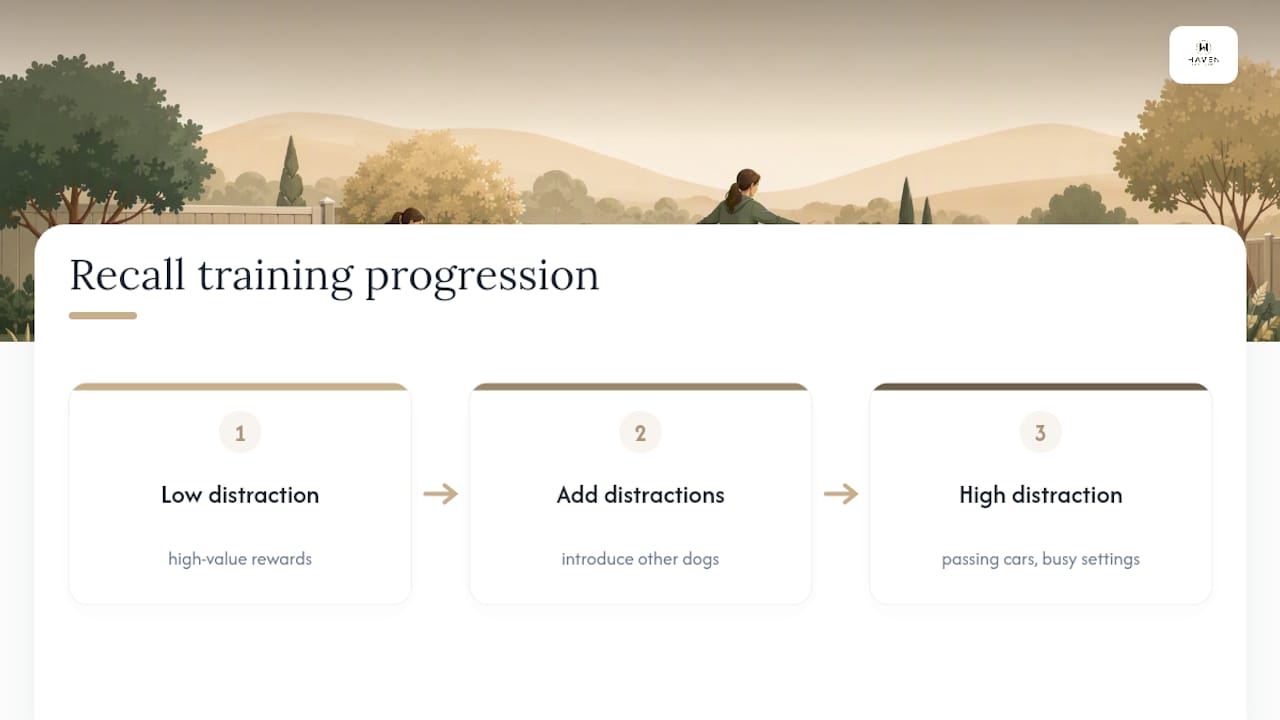
Recall training matters just as much, since a dog with a rock-solid “come” is far easier to manage even if a gap or gate does fail temporarily. Practice recall with high-value rewards in low-distraction settings first, then gradually add distractions like other dogs or passing cars.
For dogs escaping out of boredom or anxiety, counter-conditioning helps more than correction. Pair yard time with something the dog actually wants, a puzzle toy, a buried treat trail, supervised play, so the yard itself becomes the reward rather than something to escape from. For fence-fighting or barrier reactivity toward neighbors or passersby, blocking the sightline (see the gap-fixing section above) often does more than any training session, since you can’t out-train a dog’s reaction to a stimulus it can still see.
Consistency across every household member matters more than any single technique. A dog that gets away with darting through a cracked door once will keep testing that same door indefinitely.
What legal and safety liabilities come with escape-proofing your yard?
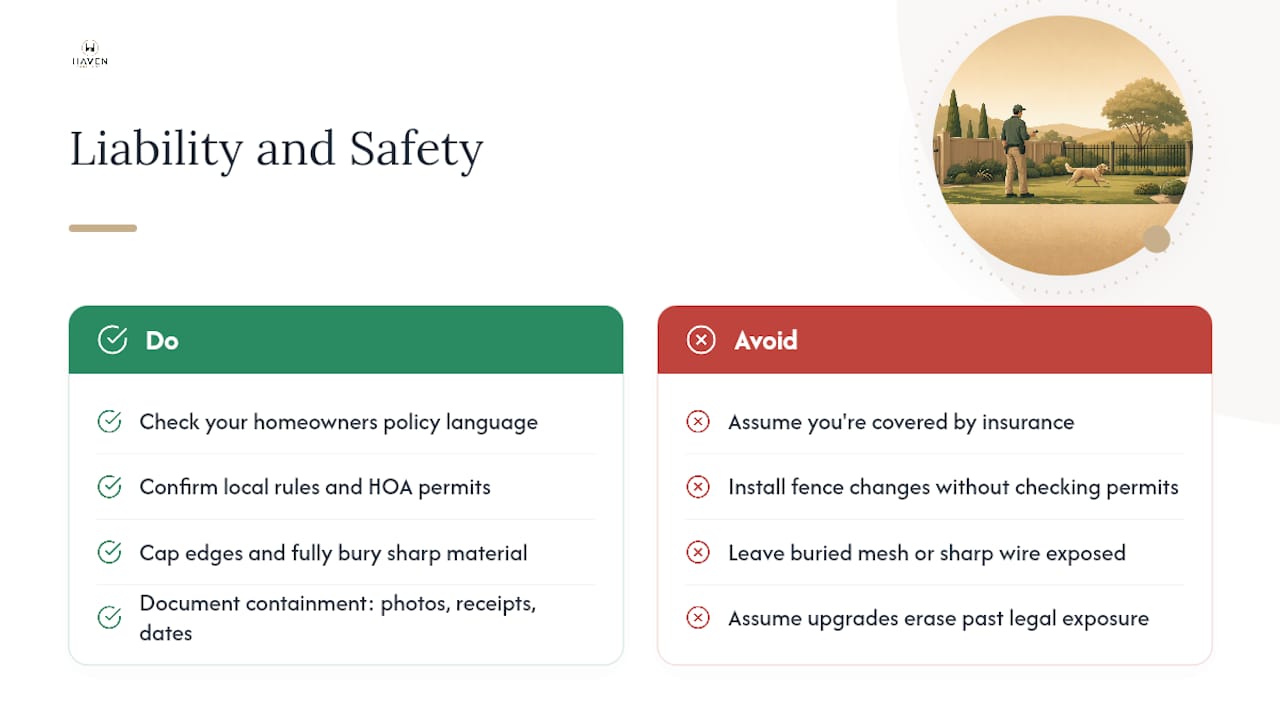
A dog that escapes and injures someone, damages property, or gets hit by a car creates real liability, and most homeowners underestimate how quickly that liability lands on them specifically. Local leash laws and containment ordinances vary by city and county, but the general principle holds nationwide: owners are responsible for reasonable containment, and “the fence had a gap” rarely qualifies as a defense in a dog-bite or property-damage claim.
Homeowners insurance often covers dog-related liability up to a policy limit, but many policies exclude specific breeds or reduce coverage after a prior bite incident, so check your policy language rather than assuming you’re covered. Some municipalities also require permits for fence height or materials, particularly in HOA communities, so confirm local rules before installing coyote rollers, extensions, or concrete footers that change your fence’s profile.
Safety liability runs the other direction too. Buried mesh, sharp wire ends, and unfinished hardware installations can injure your own dog if installed carelessly, cap exposed edges and bury sharp material fully. If your dog has bitten or threatened someone before, containment upgrades reduce risk but don’t eliminate legal exposure retroactively, a documented containment plan (photos, receipts, dates) can matter if a claim or dispute ever arises.
A humane, layered approach beats a quick fix
Escape-proofing works best when it treats the dog as a whole animal, not just a containment problem. Physical barriers matter, but pairing them with enrichment, exercise, and a vet or trainer’s input when something seems off produces results that actually hold up over months and years, not just until the next storm knocks a fence panel loose.
I’d caution against leaning on shock-based invisible fences as a primary solution. They can suppress the behavior temporarily without addressing why the dog wants out, and a determined or anxious dog will sometimes push through the correction anyway. Start with the audit. Fix what’s broken today, plan the rest, and treat tracking as a backup, not a substitute for a fence that actually holds.
— Haven
Give Your Containment Plan a Real Backup
A perfectly sealed fence still has one blind spot: the day a storm knocks a panel loose, a gate gets left open, or your dog finds the one gap you missed. That’s the gap HAVEN Freedom is built to close. Its wireless boundary works without buried wire, so you get a functioning containment layer the same day you set it up, no trenching, no waiting on a contractor.
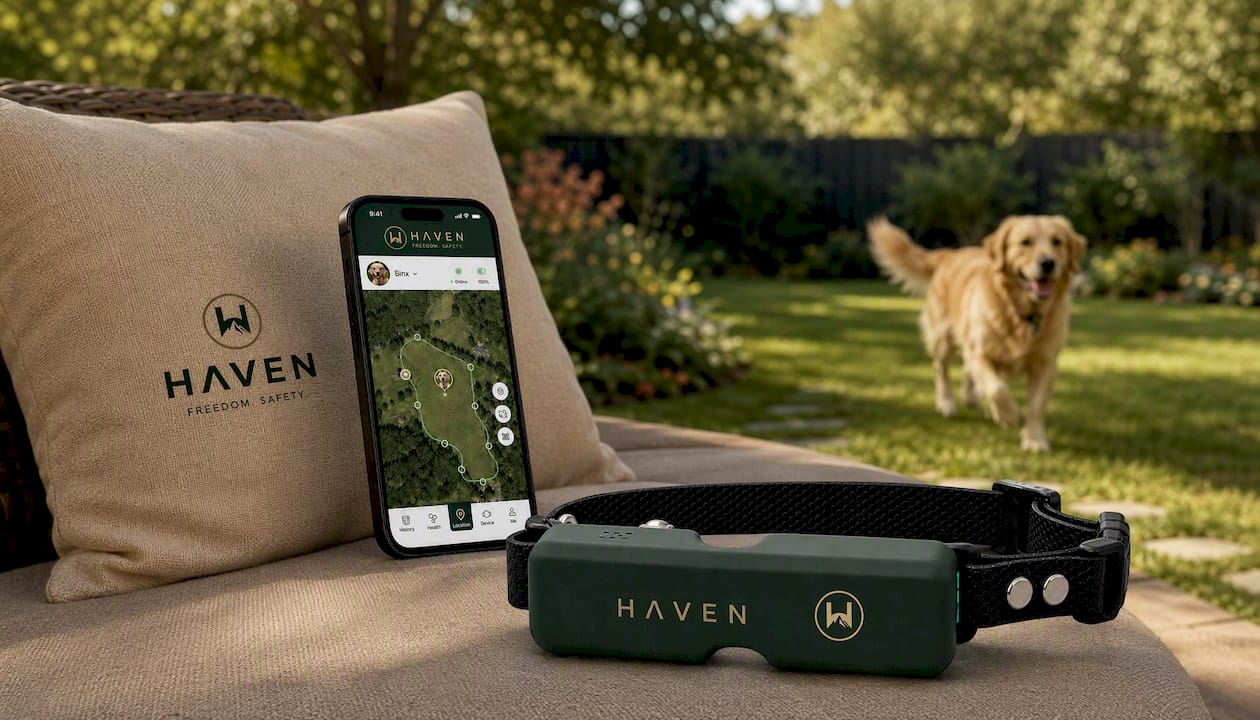
If your yard already has solid fencing, the collar earns its keep as backup: live tracking, instant escape alerts, and a sound, light, and Bluetooth finder system for the rare moment a dog actually gets loose. If you’re dealing with a rental, an odd-shaped lot, or a dog that needs boundaries beyond the yard on hikes or trips, it can function as your primary containment layer instead. Either way, the boundary itself runs without a monthly subscription, you only pay for live tracking and premium app features if you want them.
Check specs, pricing, and setup details on the HAVEN Freedom product page and see whether it fits into your containment plan today.
Sources
- How to Help Prevent Your Dog From Escaping the Yard — American Kennel Club
- How to dog-proof your fence: a practical step-by-step guide — CT Fence & Gate
- Why and how dogs escape fences — Whole Dog Journal
FAQ
How do I stop a dog from escaping a fenced yard?
Diagnose the exact escape method first (digging, jumping, climbing, or a gap), then apply the matching fix: buried mesh for diggers, coyote rollers or inward toppers for jumpers, and secured gate hardware for weak latches. Layer in exercise, training, and a GPS backup like HAVEN Freedom for extra security.
What is the 3-3-3 rule for dogs?
The 3-3-3 rule describes a general adjustment timeline for newly adopted dogs: roughly 3 days to decompress, 3 weeks to learn the household routine, and 3 months to feel fully settled. It’s a helpful reminder that a new dog’s escape risk often drops as they bond with their home and family.
What is the 7-7-7 rule for dogs?
Definitions of some socialization checklists vary across trainers and aren’t standardized, so treat any specific version cautiously. They’re generally used as loose guidelines rather than escape-prevention rules.
What can I use to keep other dogs out of my yard?
Solid or privacy-slatted fencing blocks the sightline that triggers fence-fighting between neighboring dogs, which reduces the reactivity driving both dogs to escape. Pairing a visual barrier with your own dog’s containment upgrades, buried mesh, secure gates, addresses the problem from both directions at once.
Does a GPS collar replace the need for a fence?
No. A GPS collar like HAVEN Freedom works best as a backup or a boundary option where a traditional fence isn’t practical, not as a replacement for a physical barrier a dog already tests. It shortens recovery time if an escape happens rather than preventing the initial gap or gate failure.
Recommended
Keep reading
en
Puppy E-Collar Age: When Is It Safe, and What to Use First
No vet-backed minimum age exists for shock collars on puppies. See what vets advise, what to do before 6 months, and how a GPS...
Read the postcharge dog collar camping
Charging a Dog Collar at Camp: Skip Bedding, Use a Hard Surface
Charge a dog collar safely at camp with a power bank, original cable, and solar or car backup. Follow National Park Service battery safety...
Read the postYour adventure starts here
Ready to give your dog more room to roam?
Give your dog more freedom to explore — and give yourself the reassurance of knowing they're never far away.
