

Yes, dog sleep tracking works as a trend tool. Modern collar sensors infer sleep from stillness, not brainwaves, and validation studies put that inference at roughly 79% to 94% agreement with lab-grade methods. That’s accurate enough to catch meaningful shifts in restlessness, resting respiratory rate, and resting heart rate over days, not hours. Your first move tomorrow morning: open the app, check last night’s sleep-like hours against your dog’s normal range, and note anything unusual in the app’s log rather than reacting to one bad night.
TL;DR:
- Consumer dog sleep trackers have an accuracy range of about 79% to 94% compared to lab-grade methods, primarily detecting stillness rather than actual sleep stages.
- Proper collar fit, consistent sleeping location, and a two-week baseline are essential for reliable data, as noise and day-to-day variations can mislead interpretation.
- Key health indicators include resting respiratory rate, resting heart rate, and sleep fragmentation, with significant trends over days being more meaningful than single-night deviations.
- Owners should focus on long-term trends, like a 20% to 50% increase in restlessness or SRR over five to ten days, before seeking veterinary advice.
- Costs commonly range from $50 to $150 for the device, with optional subscriptions of $5 to $15 monthly for trend monitoring, not real-time tracking or containment features.
Table of Contents
- How Does Dog Sleep Tracking Actually Work?
- How Accurate Is Canine Sleep Tracking Compared to a Sleep Lab?
- Which Sleep Metrics Actually Matter for Your Dog’s Health?
- How Do You Set Up a Reliable Sleep Baseline?
- When Should You Bring Sleep Data to Your Vet?
- What Does a Dog Sleep Tracker Cost?
- Our Take: Data Over Panic, Trends Over Snapshots
- Why HAVEN Freedom Fits Into a Sleep-Monitoring Routine
- Sources
- FAQ
How Does Dog Sleep Tracking Actually Work?
A tracking collar doesn’t watch your dog sleep. It watches your dog not move, and infers sleep from that pattern. Inside the collar sits a tri-axial accelerometer, often paired with a gyroscope, collectively called an inertial measurement unit or IMU. The device slices the night into short windows, commonly 60-second epochs, and calculates a motion signal for each one. When that signal stays below a threshold for a sustained stretch, often around 10 minutes, the software labels it “sleep-like.” This is called actigraphy, and it’s the same basic method used in human sleep-tracking wearables.
From that raw motion stream, apps generate the numbers you actually see:
- Sleep-like bouts: total stretches of inferred sleep across the night
- Interruptions: how many times your dog stirred or repositioned
- Longest uninterrupted rest: the single longest unbroken sleep bout
- Sleep score: a composite number blending duration and fragmentation
- Resting respiratory rate (SRR): breaths per minute during confirmed stillness
- Resting heart rate: pulled from optional vitals sensors on some collars
- Scratch or bark events: audio-based flags on collars that include microphones
Not every collar measures all of these. Some devices skip vitals entirely and rely on motion alone, while others add audio detection to explain why a dog seems restless. Feature sets vary by manufacturer, and the underlying classification algorithms are usually proprietary, which means you’re trusting a black box to translate motion into “sleep.”
How Accurate Is Canine Sleep Tracking Compared to a Sleep Lab?
Here’s the number that matters most for setting expectations: a beacon-based accelerometer study found roughly 79% sleep-wake coincident accuracy when classifying dog sleep against a sleep meter and video-based labels. A separate pilot study using Actical accelerometers pushed higher, reporting 94.0% sensitivity and 96.1% specificity for sleep and rest minutes, using a simple activity-count cutoff.
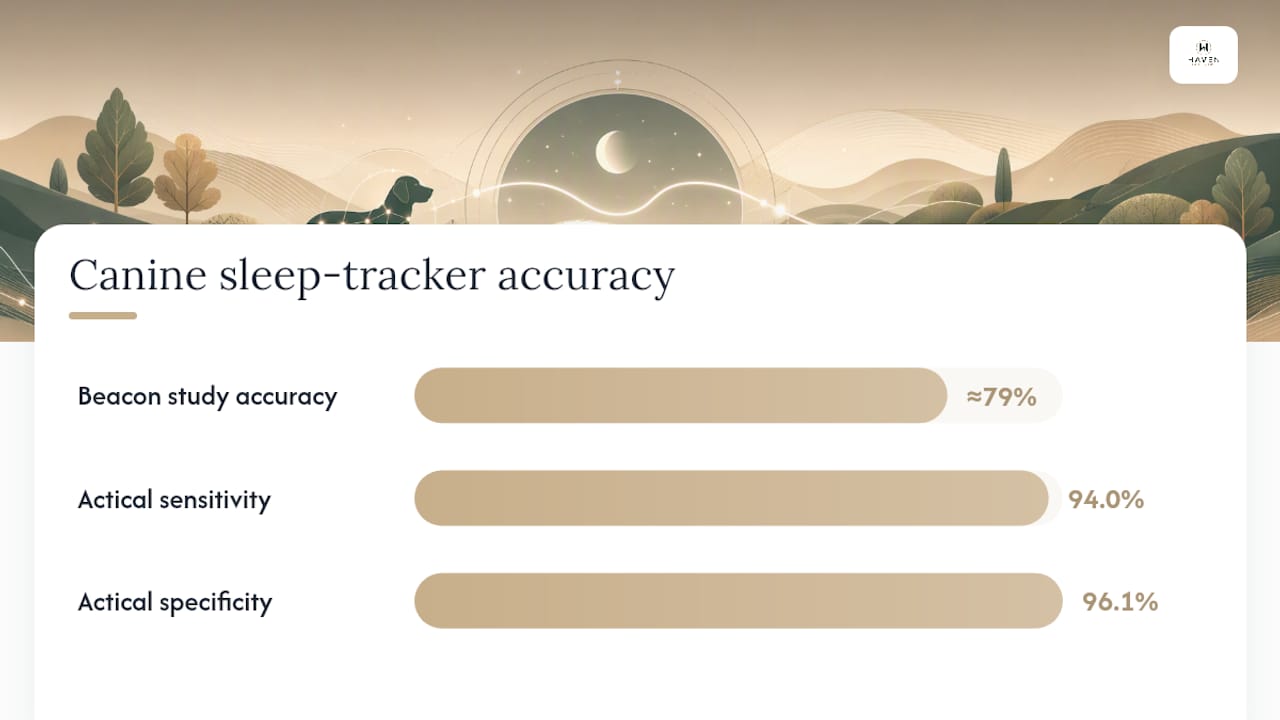
That’s a meaningful range. It tells you consumer trackers land somewhere between “decent” and “quite good” depending on the algorithm and hardware, but none of them match polysomnography, the gold-standard lab test that reads brainwaves directly. Trackers detect stillness. Polysomnography detects actual sleep architecture, including REM stages a motion sensor simply cannot see.
That gap creates predictable failure modes. A dog lying perfectly still while wide awake, watching a squirrel through the window, can register as asleep. Small, low-movement breeds may generate less signal noise than a restless Border Collie, which can shift how sensitive the threshold needs to be. Consumer wearable research on actigraphy limitations backs this up. Trackers work best as longitudinal trend tools, not minute-by-minute sleep diagnostics.
Three things reduce the noise:
- Fit the collar snugly enough that it doesn’t shift or slide during rest.
- Spot-check the app’s sleep log against what you actually observe for a few nights.
- Run at least a two-week baseline before treating any single number as meaningful.
Which Sleep Metrics Actually Matter for Your Dog’s Health?
Not every number in the app deserves equal attention. Some are noise. A few are genuinely useful early-warning signals, and veterinary commentary on objective home sleep monitoring points to the same short list clinicians actually use.
- Resting respiratory rate (SRR): measured while your dog is confirmed asleep, this is one of the most sensitive indicators of early cardiac or respiratory trouble. A rising trend over several days can precede visible symptoms.
- Resting heart rate: available on collars with vitals sensors, this tracks alongside SRR as a second cardiac signal.
- Restlessness or fragmentation: frequent interruptions during sleep often point to pain, anxiety, or itching that hasn’t shown up any other way yet.
- Total rest time, tracked over days: a slow, sustained drop matters far more than one short night after a long hike.
Pro Tip: Don’t react to a single rough night. Clinical practitioners generally look for a sustained shift of 20% to 50% over five to ten days before treating a trend as meaningful, according to veterinary trend-monitoring guidance. One bad night after a long hike or a thunderstorm isn’t a health event. A week of rising restlessness is worth a closer look.
Rising SRR points toward respiratory or cardiac concerns. Escalating restlessness often signals pain or anxiety. A loss of the ability to hold long, uninterrupted rest bouts can flag cognitive decline in older dogs or chronic discomfort that’s fragmenting sleep without eliminating it.
How Do You Set Up a Reliable Sleep Baseline?
A baseline is what turns raw nightly data into something you can actually act on. Without one, you have no way to know if last Tuesday’s numbers were unusual or completely normal for your dog.
Setup checklist before you start:
- Fit the collar so two fingers slide under the band, snug but not tight.
- Keep your dog sleeping in the same spot each night if possible.
- Confirm sleep and vitals sensors are enabled in the app settings.
- Check battery level and signal coverage before the first night.
The two-week protocol:
- Let your dog follow a normal routine. No new medications, no boarding, no big schedule changes.
- Use the app’s notes feature to log context. Visitors, thunderstorms, vet visits, and new food all belong here.
- At the end of two weeks, pull the sleep score trend and the SRR chart and look for a stable, repeatable range.
- Note your dog’s typical longest uninterrupted rest bout. That’s your reference point going forward.
Households with multiple pets or a lot of nighttime foot traffic tend to see noisier data, since a nearby dog’s movement can occasionally register on the wearer’s sensor. If a night shows missing data entirely, check for a loose fit or a battery that died partway through the night before assuming something’s wrong with your dog.
When Should You Bring Sleep Data to Your Vet?
Sleep trackers document. They don’t diagnose. Veterinary experts frame objective home monitoring as most valuable for dogs who get anxious in the clinic, where a stressed exam masks their actual baseline, and for tracking chronic conditions like arthritis or heart disease between visits.
Bring your vet a short, quantified summary rather than raw screenshots:
- The trend, not the noise: “Restlessness has roughly doubled over the past eight nights.”
- The SRR chart if it shows a sustained upward slope.
- Any drop in longest uninterrupted rest, especially in senior dogs.
Book a visit for consistent worsening over five to ten days, or any sudden, large deviation from baseline. A related veterinary resource covers how clinics increasingly ask owners for exactly this kind of pre-visit summary, since it shortens the diagnostic path considerably.
What Does a Dog Sleep Tracker Cost?
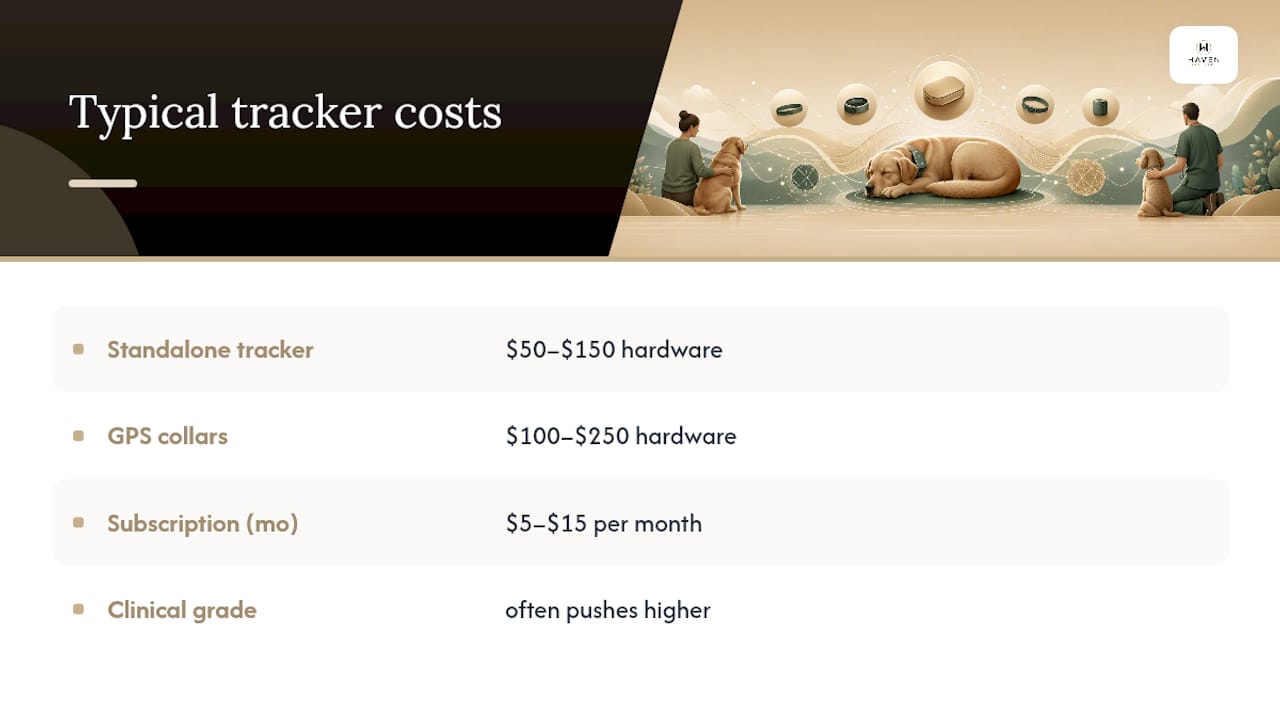
Standalone sleep and activity trackers typically run somewhere in the $50 to $150 range for the hardware itself, with some clinical-grade or multi-sensor devices pushing higher. Combination GPS and sleep-tracking collars, which add live location and containment features on top of activity monitoring, tend to sit in a wider band, often $100 to $250 depending on features.
The bigger cost variable is usually the subscription, not the hardware. Many trackers bundle sleep and activity data into a monthly app fee, often $5 to $15, required just to access historical trends. Others separate core features from premium ones. A collar that includes GPS containment alongside sleep tracking may let the boundary and fence functions work with no subscription at all, while charging only for live tracking or real-time location features as an optional add-on.
That distinction is worth checking before you buy. If your main goal is sleep and activity trends for a vet conversation, you don’t necessarily need a live-tracking plan running every month. If you also want escape alerts and real-time location for an adventurous dog, factor that recurring cost into your decision, since it compounds over a year in a way the upfront hardware price doesn’t.
Our Take: Data Over Panic, Trends Over Snapshots
The biggest mistake owners make with sleep trackers is treating one bad night like a diagnosis. It isn’t. The validation research is clear that these devices are trend detectors, not lab equipment, and the beacon-based accuracy studies prove that out. Somewhere between 79% and 94% agreement with lab methods is genuinely useful, but only if you’re patient enough to build a real baseline first.
Conventional pet-tech marketing oversells precision and undersells patience. A restlessness trend that climbs steadily for a week means something worth a vet call. Owners who chase every daily fluctuation burn out on the feature fast. Owners who check in weekly, log context in the app, and watch the slope rather than the snapshot get the actual clinical value this technology offers.
Prioritize SRR and restlessness trends first. Vitals second. Everything else is supporting detail.
— Haven
Why HAVEN Freedom Fits Into a Sleep-Monitoring Routine
HAVEN Freedom was built around the same principle this whole guide leans on: motion data is most useful when it’s continuous, comfortable, and easy to check daily. The collar’s onboard sensors feed activity and sleep data into the app alongside GPS location, so you’re not juggling two devices for two jobs.
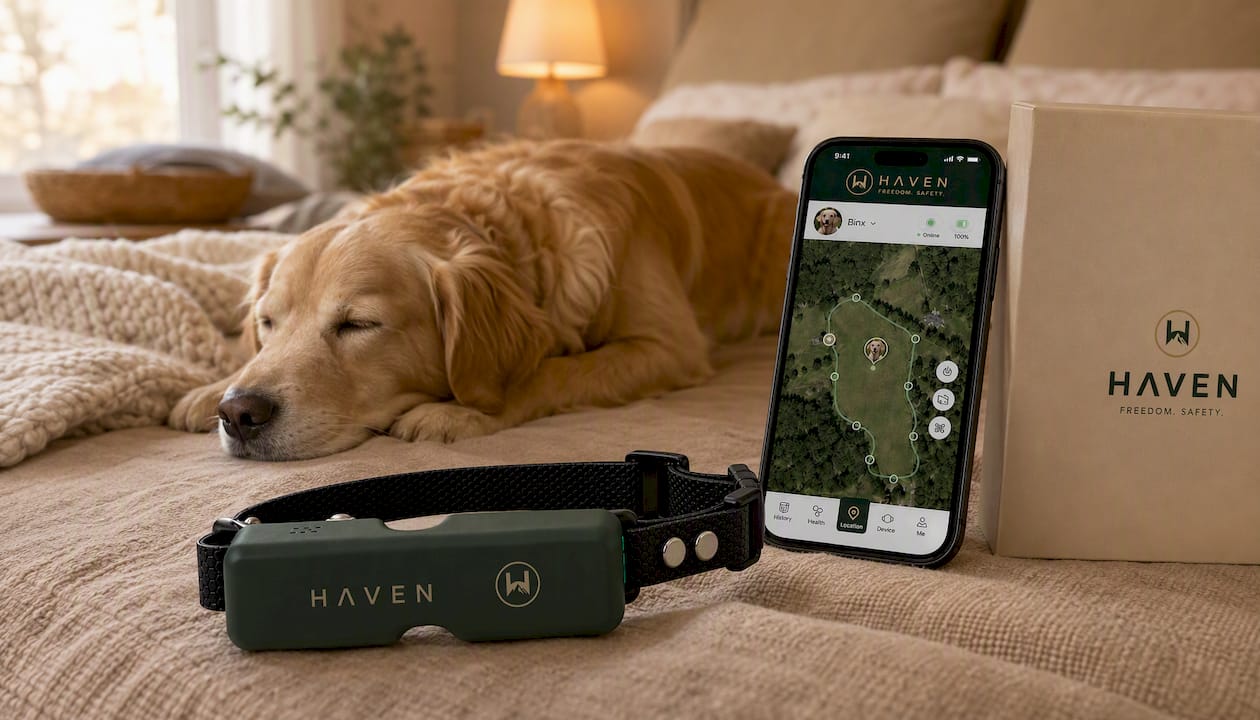
The wireless fence operates without requiring a monthly subscription, which can be beneficial if your main goal is to establish a clear two-week sleep baseline without extra recurring charges. Live tracking, escape alerts, and a sound-light-Bluetooth dog finder system may be available as optional app features, allowing you to start with sleep and activity monitoring and potentially add containment tools later without switching devices.
If you’re ready to build a real baseline for your dog and want the sleep, activity, and location picture in one app, check out the HAVEN Freedom collar and start logging tonight.
FAQ
Do dogs like blankets over them at night?
Many dogs do seek out covered, den-like spots to sleep, which likely relates to a deep-rooted denning instinct, though preference varies a lot by individual dog and breed.
How long will a dog remember its owner?
Some gifted dogs have retained learned associations for at least two years, which is part of why tracking trends over weeks and months, not single nights, gives you the most reliable read on your dog’s patterns.
Is a GPS tracker better than an AirTag for monitoring a dog?
A dedicated GPS collar like HAVEN Freedom offers live tracking, escape alerts, and boundary containment that a general-purpose item tracker isn’t designed to provide, making it the more complete option for active or escape-prone dogs.
Do dogs prefer sleeping near their favorite person at night?
Many dogs gravitate toward the person they feel safest with, and consistent sleep location matters for tracking accuracy too, since a stable sleeping spot reduces noise in your baseline data.
Recommended
Keep reading
e collar humane
Humane E Collar Training: 7 Steps, Starting With a Vet Check
See how humane e collar training starts with a vet check, conditions tone and vibration, uses rewards, and reserves static stimulation as a last...
Read the postcoyote safety for dogs
Protect Your Dog from Coyotes in 14 Days with a GPS Boundary
Keep your dog safe from coyotes with immediate steps, yard fixes, hazing, and a 14 day GPS boundary plan you can start today.
Read the postYour adventure starts here
Ready to give your dog more room to roam?
Give your dog more freedom to explore — and give yourself the reassurance of knowing they're never far away.
