

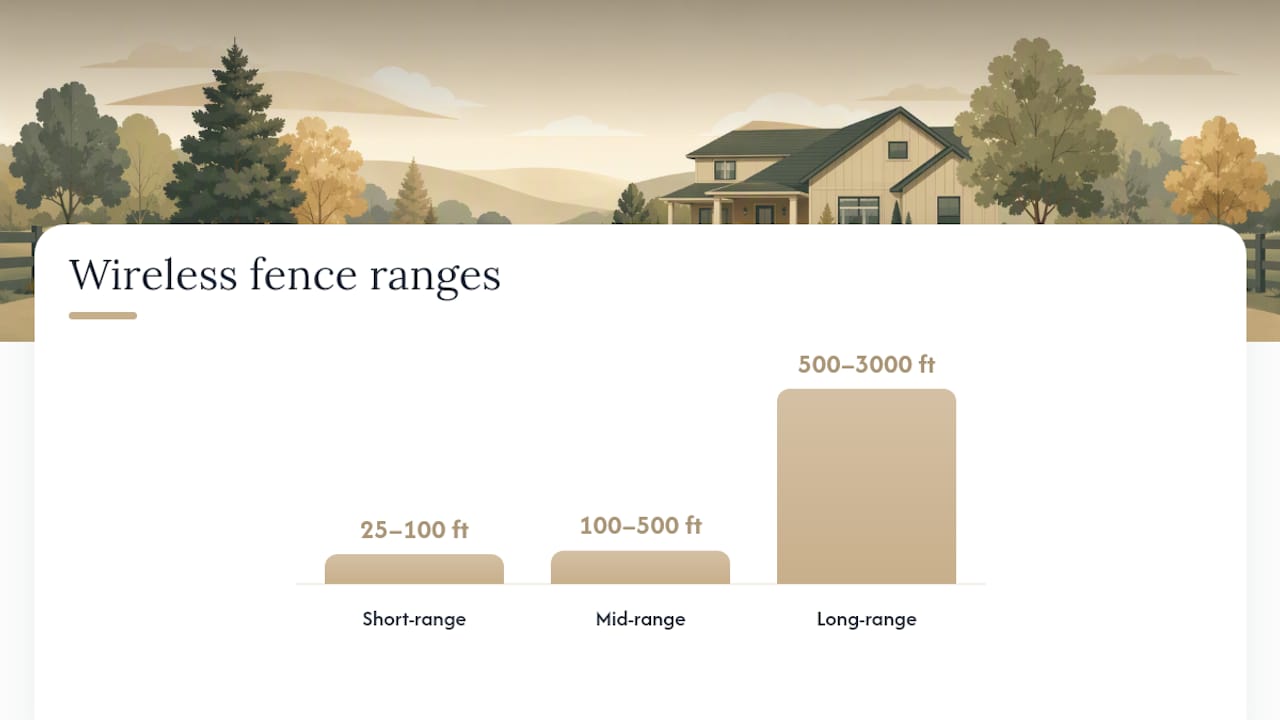
Short-range wireless systems hold a dog within roughly 25 to 100 feet of a base station, which fits patios and small yards. Mid-range wireless setups stretch to 100 to 500 feet, covering most suburban lots up to about three-quarters of an acre. GPS-based collars claim 500 to 3,000 feet or more, aimed at large properties and off-leash exploring, though accuracy and battery life both drop as the claimed radius climbs.
The one thing every range number hides: it’s a best-case figure. Tree cover, hills, nearby buildings, and even the collar’s GPS chipset can cut a “500 foot” radius down to something much smaller in practice.
- Small lots (under 0.25 acre): short-range wireless, 25 to 100 feet
- Suburban yards (0.25 to 0.75 acre): mid-range wireless, 100 to 500 feet
- Large or rural properties (1+ acre): GPS containment, 500 feet and up
If your yard has heavy woods, a lot of elevation change, or borders a busy road, a buried-wire or physical fence often gives more consistent containment than any wireless option.
Key Takeaways
Effective wireless dog fence range depends more on terrain, transmitter placement, and device quality than on the number printed on the packaging.
| Point | Details |
|---|---|
| Match range to yard size | Short-range (25 to 100 ft) fits small yards; mid-range (100 to 500 ft) fits suburban lots; GPS (500 to 3,000-plus ft) fits acreage. |
| Terrain shrinks real coverage | Trees, hills, and metal structures reduce actual containment below the advertised nominal radius. |
| Lot shape matters | Irregular or narrow lots need polygon GPS boundaries, not fixed-radius circles. |
| Battery trades against range | Live tracking and long-range GPS draw more power than basic short-range radio collars. |
| HAVEN Freedom fits varied terrain | Dual-band positioning and customizable boundaries address terrain-related accuracy loss, with no subscription required for fence-only use. |
Table of Contents
- What Determines Effective Wireless Dog Fence Range?
- How Far Does Wireless Fence Technology Really Reach?
- How Do You Match Fence Range to Your Yard Size?
- Getting the Most Range Out of Your Setup
- Battery Life and Maintenance Trade-Offs
- Training and Safety Come Before Range Numbers
- How Do You Choose the Right System for Your Yard?
- How Does HAVEN Freedom Solve the Range Problem?
- Frequently Asked Questions
- Sources
What Determines Effective Wireless Dog Fence Range?
Three different technologies get lumped under “wireless fence,” and they behave differently. Radio-based systems use a transmitter that broadcasts a signal in a rough circle, and the collar reacts as your dog nears the edge. GPS collars, instead, compare your dog’s satellite-tracked position against a boundary you draw in an app, so the shape doesn’t have to be a circle at all. Buried-loop, in-ground fences run a physical wire and are the most consistent, but they require digging and don’t move with you.
Environment is the biggest wildcard. Dense tree canopy scatters GPS signals and radio waves alike. Metal siding, chain-link fences, and even parked cars create multipath interference, where the signal bounces and confuses the receiver. Hills block line-of-sight radio signals entirely. Nearby Wi-Fi routers, baby monitors, and power lines add background noise that radio-based systems are especially sensitive to.

Device quality matters just as much as geography. A collar’s GPS chipset, antenna design, and firmware calibration all affect how tightly it can pin down a dog’s position. Testing across multiple products shows that heavy tree cover, steep slopes, and metal structures reliably shrink the containment radius compared to open, flat land.
That’s why the number printed on the box is a nominal radius, a theoretical maximum measured under ideal conditions. Your actual, practical containment zone will usually run smaller.
- Open, flat land with no obstacles: closest to the advertised range
- Wooded or hilly terrain: expect a meaningfully smaller working radius
- Urban or suburban settings with lots of structures: more interference, less predictable edges
How Far Does Wireless Fence Technology Really Reach?
Real-world coverage breaks into three practical bands, and matching your yard to the right one saves you from buying too little (or too much) system.
- Short-range (25 to 100 feet): Built for patios, courtyards, and small fenced-in yards. These systems use a single base transmitter and work best when the whole yard sits within line-of-sight of that unit.
- Mid-range (100 to 500 feet): Covers the typical suburban lot, roughly a quarter-acre up to three-quarters of an acre. This is where most homeowners land, and it’s the band where terrain starts to matter more than the spec sheet.
- Long-range GPS (500 to 3,000-plus feet): Designed for large acreage, farms, and dogs that roam while their owners hike or work outdoors. Manufacturer listings advertise wide swings here, with some roundups citing claimed maxima from 25 yards up to several thousand feet depending on the system.
That top band deserves a skeptical eye. A collar rated for 3,000 feet in open desert might realistically hold a boundary at half that distance in a yard with rolling hills and a stand of oak trees. Manufacturer numbers describe what’s technically possible under clear sky, not what you’ll get behind a house with a detached garage and a line of maple trees along the property edge.
Battery behavior shifts with range, too. Long-range GPS collars that also handle live tracking draw more power than a simple short-range radio collar, so bigger range often means more frequent charging. Before assuming you need the biggest number on the shelf, measure what your yard actually requires. Most dogs don’t need 3,000 feet of freedom; they need reliable coverage of the ground they actually use.
How Do You Match Fence Range to Your Yard Size?
Converting your property into a usable radius takes about five minutes with a tape measure or a satellite map tool. Start from the spot where you’d mount a transmitter or where your dog spends the most time, then measure outward to your farthest usable boundary.
A rough shortcut: one acre equals about 43,560 square feet. If you want a circular boundary covering a full acre, you need a radius close to 118 feet (area equals pi times radius squared). A half-acre needs roughly 83 feet of radius. A quarter-acre fits inside about 59 feet.
Lot shape changes everything about these numbers. A perfectly square half-acre lot fits a circular boundary reasonably well. A long, narrow lot, common in older suburbs, does not. If your property is 60 feet wide and 360 feet deep, a circular wireless boundary will either cut off your backyard or spill onto your neighbor’s lawn. GPS systems that let you draw custom polygon boundaries handle these shapes far better than radio-based circles.
- Measure from your actual transmitter location, not your property’s geometric center
- Account for any offset if the transmitter has to sit near a garage or house wall for power access
- If your lot is narrow, oddly shaped, or split by a driveway, favor GPS boundary-drawing over fixed-radius radio systems
When your lot includes a shared fence line with neighbors, backs onto a busy street, or wraps around a pool, a wireless boundary alone often isn’t enough. Pair it with a physical barrier at the highest-risk edges.
Getting the Most Range Out of Your Setup
GPS systems have no transmitter to position, which removes the single biggest source of setup error in radio-based fences. The boundary is drawn on a map and stored on the collar itself, so there's no central unit to place, no power outlet to work around, and no circular radius forcing itself onto an awkward lot. What matters instead is where you draw the line and how well the collar can see the sky along it.
- Survey your sky before you draw. Stand at several points along your intended boundary — particularly under trees, beside buildings, and at the bottom of any slope — and look straight up. The more open sky the collar can see at a given point, the tighter it holds the line there. Do this at two different times of day, since satellite positions shift.
- Keep the shape simple. Straight lines and gentle curves hold better than sharp corners and narrow corridors. Where two boundary lines run close together, a small positional error can put the collar on the wrong side of the wrong line.
- Build wider buffers where the sky is poorest. Your boundary doesn't have to be a uniform distance from your property line. Pull it further in under heavy canopy and near structures, and you can run it tighter across open ground.
- Fit the collar snugly — two fingers between strap and neck, contact points against skin. Fit affects antenna orientation as well as correction delivery; a collar hanging loose sits at a different angle to the sky than one worn properly.
- Walk the boundary and flag where the tone actually fires. Carry the collar at your dog's head height and mark each point with a flag. This is the step that turns a line on a map into something you know the behaviour of.
- Repeat the walk from at least three directions, and on more than one day. A single clean test tells you nothing about consistency, which is the thing that matters for training.
Canopy is the main variable to watch. A section of yard under dense trees can behave differently from open ground twenty feet away, and foliage changes seasonally — a boundary that tests cleanly in February may behave differently in July. Nearby buildings and metal roofing cause multipath reflection, where the signal bounces before reaching the collar, so expect wider variance along those edges too.
Pro Tip: Walk the full perimeter with the collar before letting your dog use the system unsupervised. Five minutes of testing catches the weak spots that would otherwise become escape routes — and re-walk it after any major landscaping change or once the leaves come back in spring.
Battery Life and Maintenance Trade-Offs
Range and battery life pull against each other. A collar broadcasting a stronger signal or pinging GPS satellites constantly for live tracking drains faster than a basic short-range radio collar. Vendor documentation typically separates standby battery life from active-tracking battery life, and the gap between those two numbers can be significant.
- Entry-level short-range systems: simplest hardware, often the longest standby battery life, lowest price point
- Mid-range wireless systems: moderate battery draw, priced for the average suburban buyer
- Premium long-range GPS collars: highest battery draw when live tracking runs, priced accordingly, but capable of covering far more ground
A no-subscription fence-only mode extends practical uptime since it skips the constant data transmission that live tracking requires. Whichever system you choose, check firmware updates seasonally and replace or recharge batteries on a fixed schedule rather than waiting for a low-battery alert mid-walk.
Training and Safety Come Before Range Numbers
No wireless system replaces training. Canine behavior experts commonly recommend wireless containments are used alongside, not instead of, positive reinforcement and supervised boundary practice.
- Introduce the boundary on leash first, rewarding your dog for stopping at the warning tone before any correction ever triggers.
- Extend off-leash time gradually over one to two weeks, staying nearby to intervene if your dog tests the edge.
- If an escape happens, check the collar fit and boundary calibration immediately rather than assuming the dog needs a stronger correction.
Veterinary literature on containment safety supports checking collar fit regularly and consulting a vet or trainer if a dog shows anxiety around the system. Pro Tip: A dog that hesitates at the yard’s edge every time isn’t being stubborn. Recalibrate the boundary before assuming a training problem.
How Do You Choose the Right System for Your Yard?
Run through this before buying:
- Required radius: measured from your actual transmitter or center point, not a guess
- Terrain match: flat and open favors any system; wooded or hilly favors GPS with polygon boundaries over fixed-radius radio
- Lot shape: irregular or narrow lots need custom boundary drawing, not a circle
- Battery and charging habits: daily charging tolerance versus a collar that lasts a week on standby
- Training mode flexibility: adjustable tone and vibration levels matter more than raw range for a nervous or sensitive dog
- Budget: short-range systems cost far less than long-range GPS collars with live tracking
Red flags worth walking away from: a company that won’t state real-world accuracy separate from marketing range, no return policy, or no searchable support documentation. Ask directly about accuracy under tree cover and battery life under continuous GPS use, not just standby time, before you buy.
How Does HAVEN Freedom Solve the Range Problem?
HAVEN Freedom uses dual-band positioning to hold boundary accuracy in conditions that typically confuse single-band GPS, including yards with mixed tree cover and uneven terrain. Boundaries are fully customizable, so an oddly shaped lot doesn’t get forced into a circle.
- No buried wire, no subscription required for fence functionality alone
- Live tracking and escape alerts available as optional app features when you want retrieval support after a break
- Dog finder system combines sound, light, and Bluetooth radar for fast recovery if a boundary is crossed
Setup accuracy depends on placement and calibration as much as hardware. Walking the full boundary during setup, the same practice recommended across the industry, gives the collar’s dual-band system its best chance at holding a tight, reliable line.
Pro Tip: Recalibrate after any major landscaping change, a new shed, a felled tree, since those alter the terrain the system already learned.
HAVEN’s take on containment choices
GPS containment fits dogs that roam varied terrain and owners who want live tracking as backup. For dogs with severe anxiety or a documented fence-jumping history, pair any wireless system with training support and a vet or trainer’s input first.
A Practical Next Step If Wireless Fits Your Yard
If your property lands in the mid to long-range band and the terrain and lot-shape checks above line up, HAVEN Freedom’s dual-band GPS collar is built for exactly that gap between suburban wireless fences and full GPS acreage coverage. Customizable boundaries handle irregular lots without forcing a circle, the fence function runs with no required subscription, and live tracking with escape alerts is there as an optional add-on if you want retrieval support built in. Read the how it works page for the full technical breakdown of setup and boundary calibration, then order directly when you’re ready to test it in your own yard.
Frequently Asked Questions
How far does a wireless dog fence actually work? Most wireless radio systems hold reliably within 100 to 500 feet of the transmitter, while GPS collars can extend to 500 feet or beyond depending on terrain, though open-field claims of thousands of feet rarely hold up around trees and hills.
Are wireless dog fences accurate? Accuracy in the 2 to 5 feet range is achievable under clear sky with a properly calibrated collar, but heavy tree cover, buildings, and hills can widen that margin significantly.
Do wireless dog fences actually work? Yes, for many dogs and yards, but they work best as a supplement to training rather than a replacement for it, and they require correct transmitter placement and regular calibration checks.
What’s the range of popular wireless fence brands? Claimed ranges across the market span roughly 25 feet for basic short-range units up to several thousand feet for premium GPS collars, though real-world performance typically lands well under the advertised maximum.
Is a physical fence better than a wireless one? For heavily wooded, steeply sloped, or oddly shaped lots, a physical or buried-wire fence often delivers more consistent containment than a wireless system can manage.
Sources
- Best Wireless Dog Fences 2026 - Forbes
- Journal of the American Veterinary Medical Association (JAVMA)
- 15 Best Wireless Dog Fence Systems for 2026 - Avaoroi
Recommended
Keep reading
en
Road Trip Dog Containment: Keep Your Dog Safe in the Car and at Every Stop
How to contain a dog on a road trip: crash-tested restraints in the car, plus safe setups at rest stops, campsites and rentals, including...
Read the posten
Puppy E-Collar Age: When Is It Safe, and What to Use First
No vet-backed minimum age exists for shock collars on puppies. See what vets advise, what to do before 6 months, and how a GPS...
Read the postYour adventure starts here
Ready to give your dog more room to roam?
Give your dog more freedom to explore — and give yourself the reassurance of knowing they're never far away.
